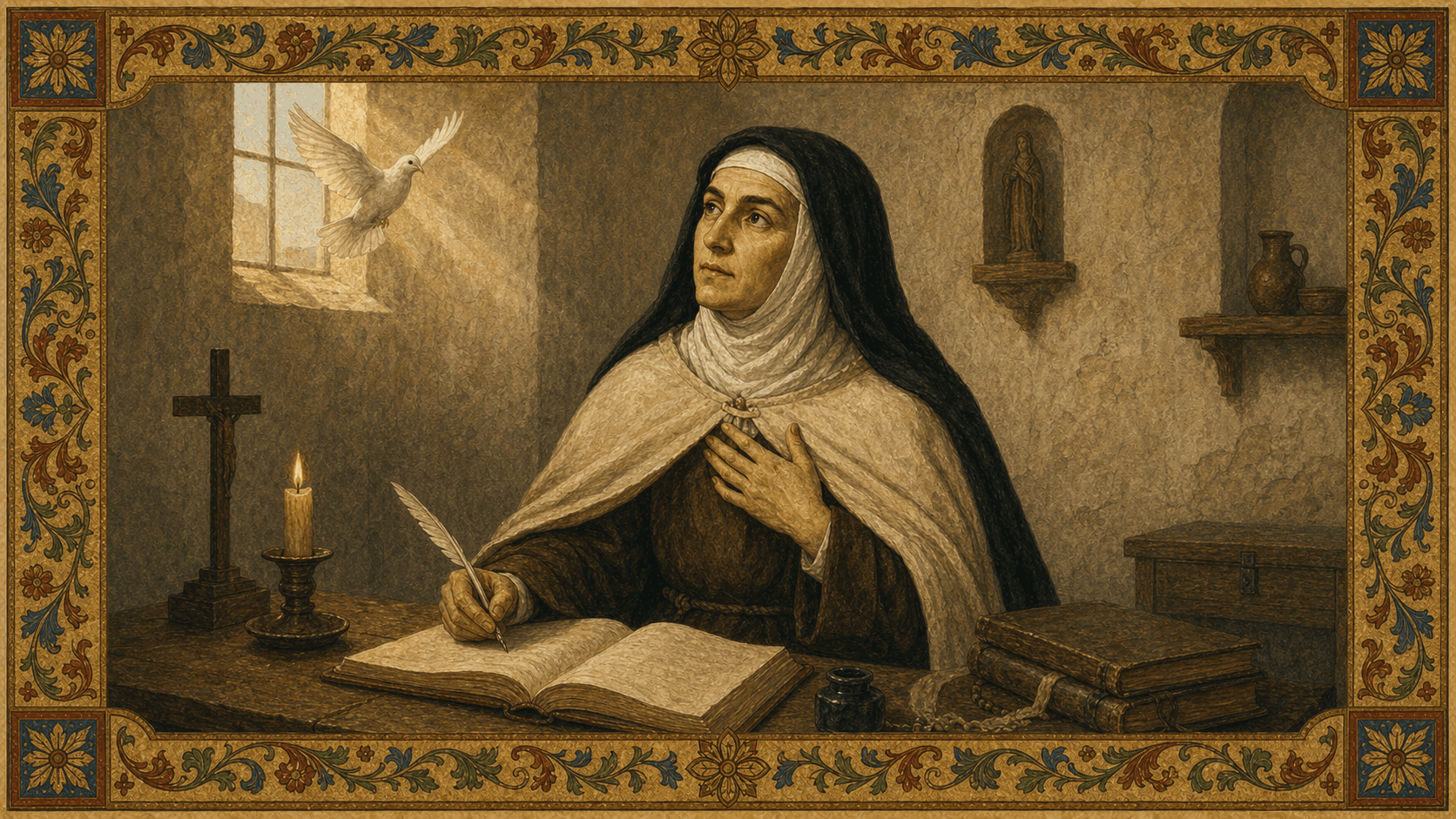
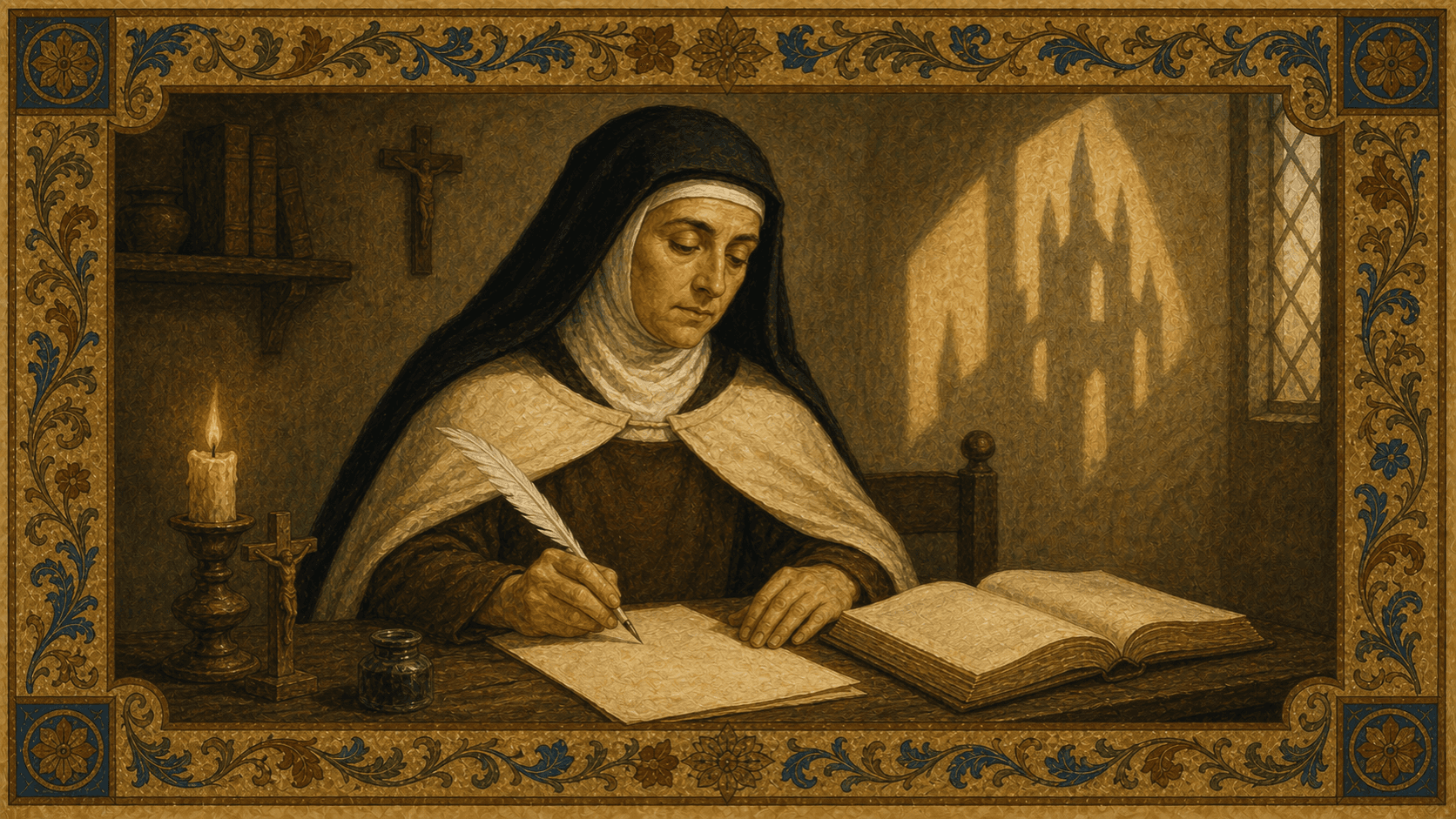
St. Teresa of Avila writing by candlelight in a Discalced Carmelite habit.

Saints Library

Teresa of Ávila

Feast October 15 · Doctor of the Church · 1515-1582

The Spanish nun who spent twenty years as a mediocre religious before a midlife conversion made her one of the greatest teachers of prayer in the Western Church.

The Story

The mediocre nun became a Doctor.

Teresa de Ahumada entered the Carmelite convent in Avila at about twenty, and for the next two decades she was, by her own brutally honest account, a thoroughly mediocre nun. She was charming, intelligent, and popular; she kept the rules loosely, spent long hours in the convent parlor entertaining visitors, and prayed badly when she prayed at all.

Then, in her late thirties, something broke open. Praying one day before a statue of the suffering Christ, she was overwhelmed by the gap between his love and her half-heartedness, and she made a decision she had avoided for twenty years: to hold nothing back.

From that second conversion her life transformed. She became the supreme teacher of prayer in the Western tradition and a reformer of ferocious practical energy, crossing Spain to found a stricter, poorer, more prayerful Carmel against opposition from almost every direction.

She did all of it while sick, exhausted, and harassed, with a sense of humor that never deserted her. In 1970 the Church named her a Doctor of the Church — the first woman ever given that title.

Castile

The world she came from.

She was born in 1515 in Avila, a walled city on the high plain of Castile, into the Spain of the Golden Age — the Spain of Charles V, the Inquisition, and a Catholicism intense, suspicious, and everywhere. Her family was prosperous and pious; her grandfather, it is now known, was a Jewish convert to Christianity, a fact that placed a quiet shadow over the family's standing.

She was a spirited, imaginative child. There is a famous story, which she tells on herself, that at about seven she and her brother set off to walk to the land of the Moors to be martyred for Christ and win heaven quickly, and were retrieved by an uncle just outside the town walls.

She lost her mother young, was educated by nuns, and after a period of resistance entered the Carmelite Convent of the Incarnation around 1535. The convent was large, crowded, and lax — a place where it was easy to be a comfortable, half-serious nun for a lifetime. Teresa managed it for nearly twenty years.

Mediocrity

She wasted twenty years.

Teresa writing the Interior Castle with a subtle castle shadow on the wall.
The later teacher of prayer knew the divided heart from the inside.

Teresa is one of the most honest saints who ever wrote, and she does not spare herself. In The Book of Her Life she describes the long middle stretch of her religious life with a frankness that is almost uncomfortable. She was not a bad nun. She was a half-hearted one.

A serious illness early on nearly killed her and left her partly disabled for years. She tried to pray and gave it up; she took it up again and gave it up again. The convent parlor, with its visitors and gossip and harmless flirtation, was always more appealing than the hard, dry work of prayer.

This is part of why she is so useful to ordinary people. Teresa did not arrive at sanctity in a straight line. She wasted twenty years. And then she did not.

Conversion

The statue that undid her.

A symbolic still life for Teresa with a quill, book, Carmelite cord, and simple convent objects.
Book, quill, cord, and Carmelite poverty.

The turn came when she was about thirty-nine. She happened upon a statue that had been brought into the convent — an image of Christ scourged, covered in wounds — and the sight of it undid her. She had seen a thousand images of Christ. This one, on this day, broke through.

From that moment Teresa's prayer became real, and her interior life opened into a mystical intensity that frightened her as much as it consoled her. She experienced raptures, visions, interior locutions, and unions with God so vivid that she spent the rest of her life trying to understand them and submit them to the judgment of the Church.

She was terrified of being deceived. Teresa submitted everything to her confessors and developed tests for discerning true mystical experience from delusion. The proof of a real encounter with God, she concluded, was never the experience itself. It was the humility, love, and obedience it left behind.

Prayer

The castle inside the soul.

Teresa's greatest gift to the Church is her teaching on prayer, and her masterpiece is The Interior Castle.

She imagines the soul as a castle made of a single diamond, containing many rooms — seven dwelling places or mansions, arranged in concentric rings, with God himself dwelling in the innermost room at the center. The spiritual life is the journey inward, room by room, toward the center where the soul is united with God.

What makes Teresa's mysticism trustworthy is that it is never vague. She writes about the deepest states of union with precision and practicality. She insists that the test of advanced prayer is advanced charity: that the surest sign you have been close to God is that you have become kinder, humbler, and more useful to the people around you.

Mysticism

The wound of love.

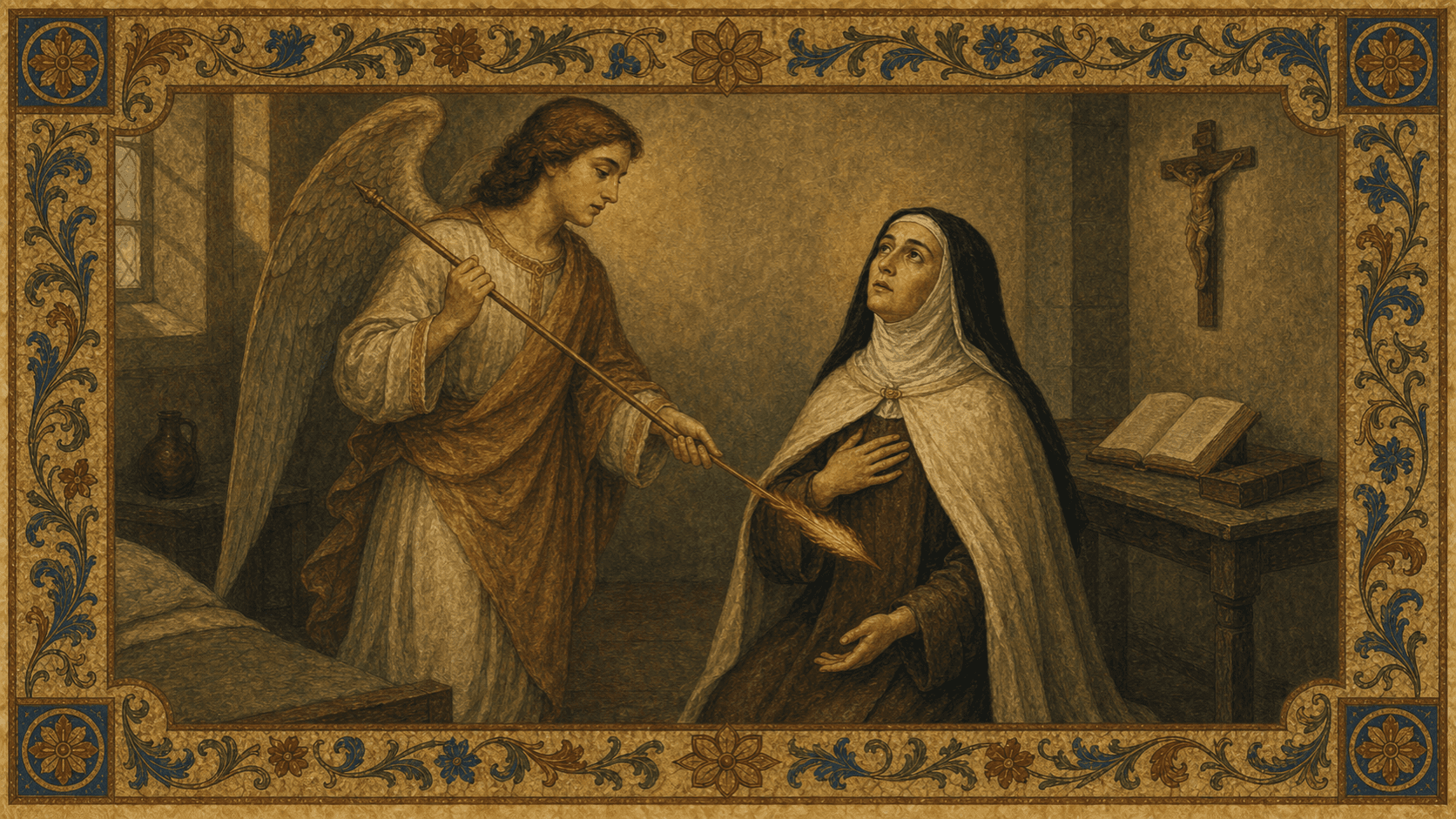
The transverberation of Teresa, shown soberly with Teresa upright and grave before a restrained angel.
The transverberation is shown as a grave mystical wound, not theatrical spectacle.

The most famous of Teresa's mystical experiences is the one called the transverberation — the piercing of her heart.

She describes it in her Life: an angel appeared to her, holding a long golden spear tipped with fire, and with it the angel pierced her heart, leaving her all on fire with a great love of God Life of Teresa. The pain, she said, was sharp, and yet it was a pain so sweet that she never wanted it to end.

It should be received the way Teresa meant it: not as spectacle, and not as anything other than what she said it was — the soul so seized by the love of God that the longing became a wound.

Reform

The builder on the road.

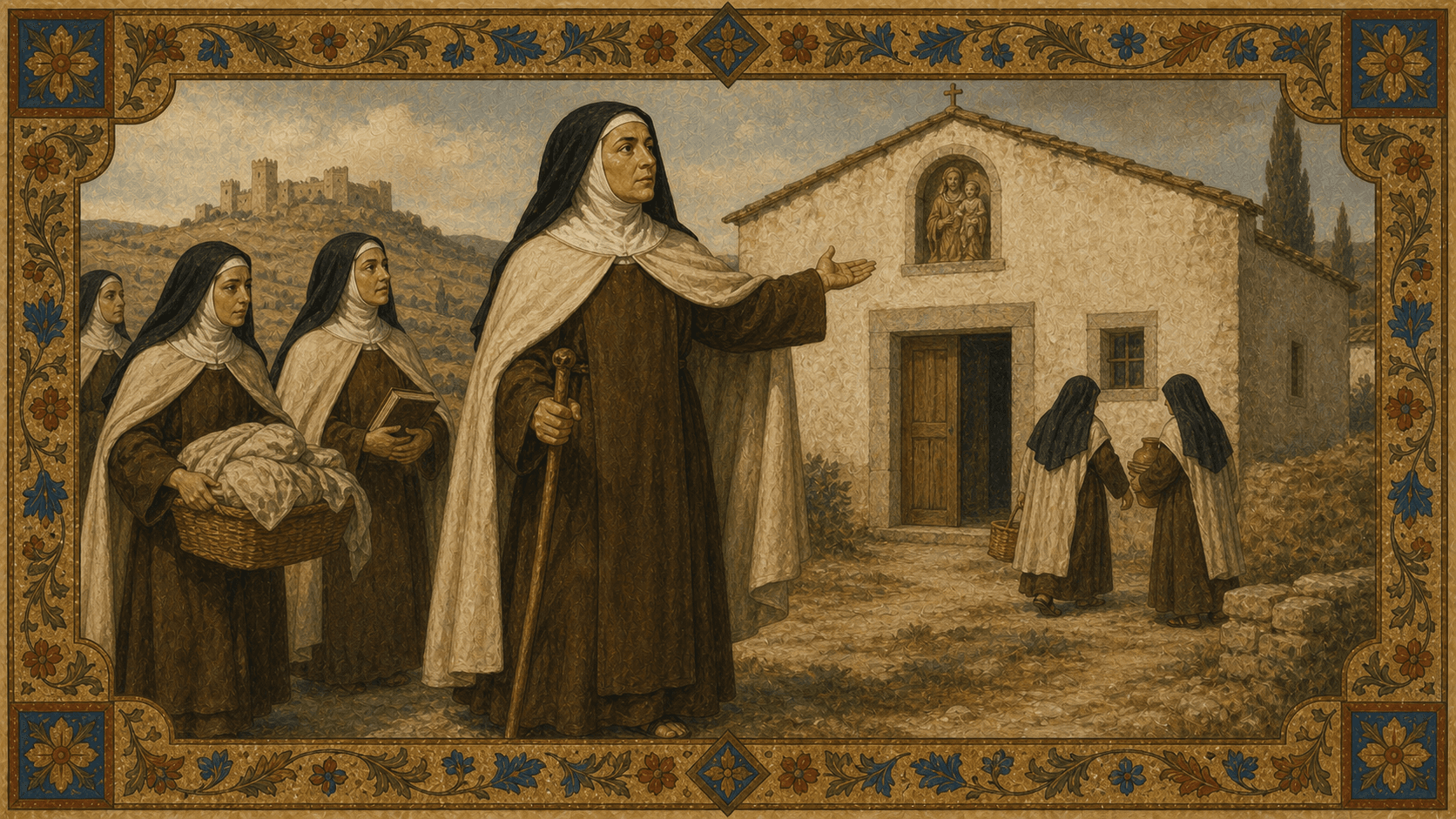
Teresa founding St. Joseph's in Avila with a plain Discalced Carmelite community.
The first reformed convent was St. Joseph's in Avila.

Teresa might have remained a convent mystic, admired and watched. Instead, in her late forties, she became one of the great reformers and founders in the history of the Church.

She believed the comfortable Carmel she had lived in for decades had betrayed the order's original ideal: real poverty, real enclosure, real prayer, small communities of women wholly given to God. In 1562, against fierce opposition, she opened a tiny new convent in Avila under the stricter primitive rule and named it St. Joseph's.

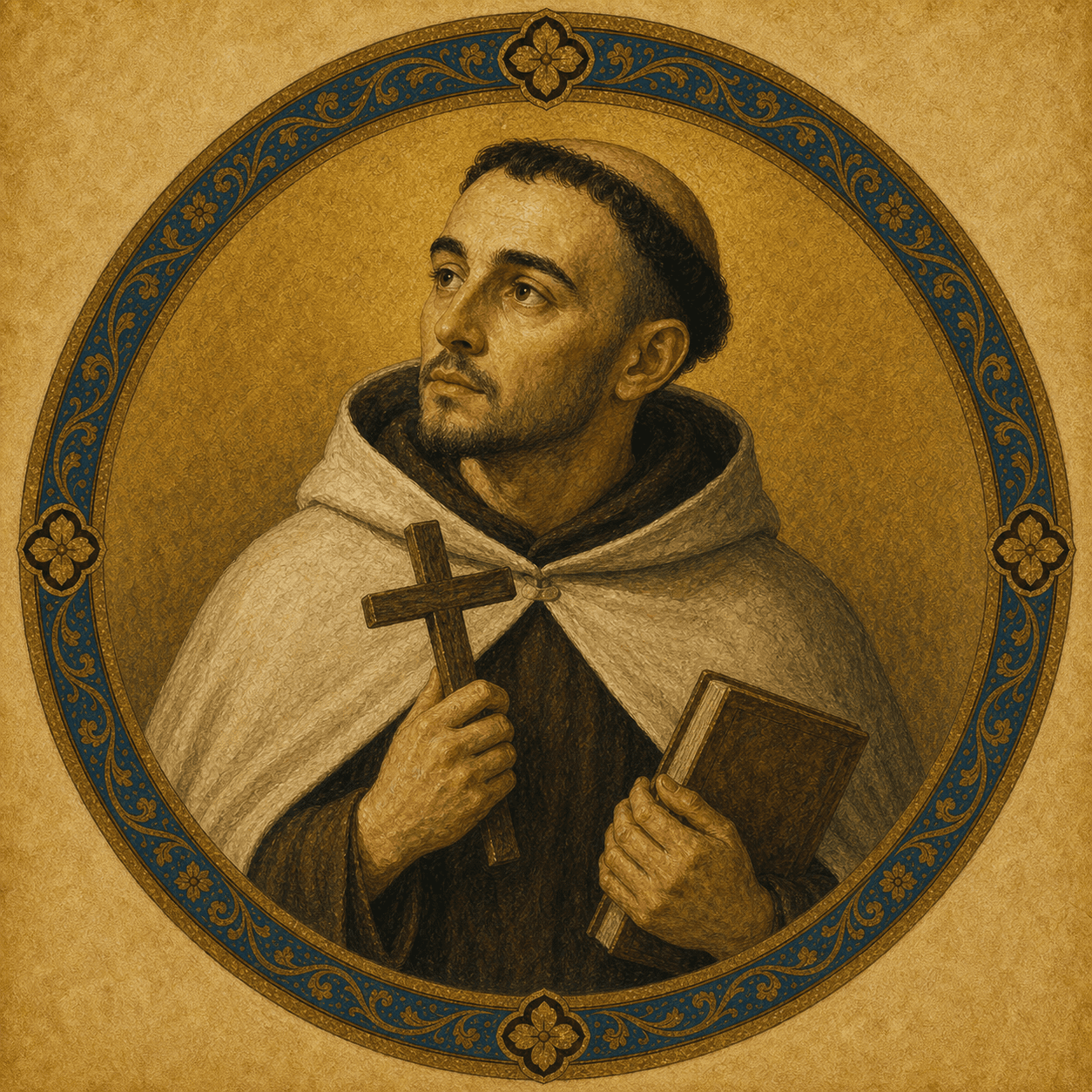
Then she did not stop. For the last twenty years of her life Teresa crossed Spain — sick, aging, jolted in carts over bad roads — founding convent after convent and extending the reform to the friars with the help of St. John of the Cross. The greatest contemplative of her age was also one of its most formidable administrators.

St. Joseph

The patron of her reform.

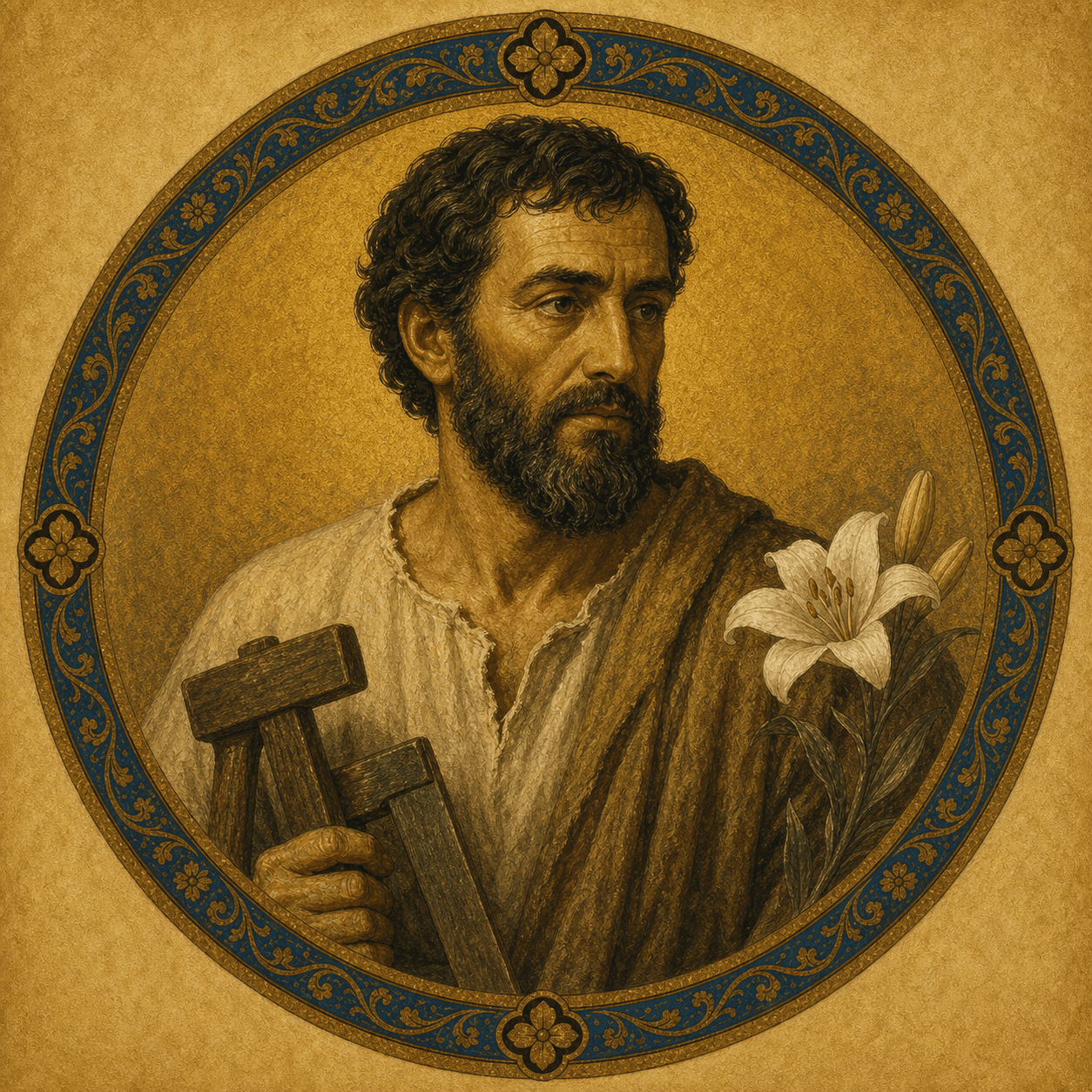
It was no accident that Teresa named her first reformed convent after St. Joseph. She had a profound personal devotion to him, credited him with her recovery from an early near-fatal illness, and took him as the patron and protector of her whole reform.

She loved to point out that, since Joseph had cared for the child Jesus and his mother on earth, he could obtain anything in heaven. The modern flowering of devotion to St. Joseph owes an enormous debt to this Spanish nun who made him the patron of her convents and never tired of praising him.

Alba de Tormes

A daughter of the Church.

She died as she had lived for twenty years — on the road, in the middle of the work. In the autumn of 1582, worn out and ill, she was traveling on the business of the reform when she collapsed at the convent of Alba de Tormes and could go no farther.

There is a curiosity to the date. She died the very night Catholic Europe switched from the old Julian calendar to the new Gregorian one, when the calendar jumped from October 4 to October 15. Her feast was fixed on October 15, the day the world woke up to after she left it.

Her last words, by tradition, were a daughter's gratitude and relief: that she was, at the end, a daughter of the Church. She was canonized in 1622, and in 1970 Pope Paul VI named her the first woman Doctor of the Church.

Why Now

It is never too late to become serious.

She matters now because she wasted twenty years and then became a saint, and she never let anyone forget the first part. Teresa is the patron of everyone who started late, who knows they have given God a divided heart for far too long, who looks back at years of mediocrity with regret.

Her life is the standing proof that it is never too late, that the wasted years are not the end of the story, and that the second half can dwarf the first.

She matters, too, because of the unity of prayer and work in her. We tend to imagine the mystic and the woman of action as different types. Teresa was emphatically both, and she insisted they belonged together. The woman who was lifted off the ground in ecstasy was the same woman who haggled over the price of a house and managed a continent-wide reform.

Reading

Where to read her.

Teresa writes the way she talked — vividly, personally, with constant asides and humor. Start with The Way of Perfection, written for her own nuns and practical from the first page. Then read The Interior Castle, her masterpiece on the stages of prayer and union with God.

After that, read The Book of Her Life for the mediocre years, the second conversion, and the transverberation. Finish with The Book of the Foundations, where Teresa the builder and administrator comes alive.

A Word of Teresa

God alone suffices.

These few lines, found on a slip of paper in her prayer book after her death, are the distilled wisdom of a woman whose life was anything but calm — sick, opposed, examined, jolted across Spain, building something the world kept trying to tear down.

Let nothing disturb you. It is not the serenity of someone whose life was easy. It is the hard-won peace of someone who had found the one thing underneath all of it that did not move. God alone suffices.

Frequently Asked

Questions for reading Teresa clearly.

Who was St. Teresa of Avila?+
She was a sixteenth-century Spanish Carmelite nun, mystic, reformer, and writer — the first woman ever named a Doctor of the Church. After about twenty years as a lukewarm religious, she underwent a deep second conversion, became one of the greatest teachers of prayer in Christian history, and founded the reformed Discalced Carmelites. Her feast is October 15.
Why is St. Teresa called a Doctor of the Church?+
The title Doctor of the Church is given to saints whose teaching is held up as a sure guide for the whole Church. On September 27, 1970, Pope Paul VI named Teresa of Avila a Doctor — the first woman ever — for her teaching on prayer. A week later he named St. Catherine of Siena the second.
What is the transverberation of St. Teresa?+
It is the mystical experience she describes in her autobiography, in which an angel pierced her heart with a long golden spear tipped with fire, leaving her all on fire with a great love of God. Teresa always pointed past the experience itself to its only real fruit: a heart set on fire to love and serve God.
Did St. Teresa really levitate?+
She and her sisters reported that during some of her deepest raptures her body was lifted off the ground. Teresa found this mortifying and was deeply suspicious of dramatic phenomena. She insisted that the only trustworthy sign of real prayer was growth in humility and love, not anything spectacular.
What is the difference between Carmelites and Discalced Carmelites?+
The Carmelites are an ancient religious order. Teresa founded a reform returning to a stricter, poorer, more enclosed and prayerful life under the order's primitive rule; her nuns wore rope sandals or went barefoot as a sign of poverty, hence discalced, or unshod.
Why did St. Teresa love St. Joseph so much?+
She credited St. Joseph with her recovery from a near-fatal early illness and took him as the patron of her whole reform, naming her first convent St. Joseph's. Teresa's devotion did more than almost any single influence to spread the love of St. Joseph through the modern Church.
Did St. Teresa write the prayer "Let nothing disturb you"?+
Yes. The short prayer-poem beginning Let nothing disturb you, in Spanish Nada te turbe, was found written on a slip of paper in her own breviary and is known as St. Teresa's Bookmark. It is one of her most beloved and authentic short works.

Sources

Read beyond summaries.

This page treats Teresa's mystical experiences soberly and pairs them with her practical reform, as Teresa herself did.

Primary

  • St. Teresa of Avila, The Book of Her Life, her autobiography and principal source for the second conversion and transverberation.
  • St. Teresa of Avila, The Way of Perfection, The Interior Castle, The Book of the Foundations, her letters, and the Bookmark prayer.
  • St. John of the Cross and the early Discalced Carmelite sources for the reform context.

Historical

  • The Catholic Encyclopedia entry on St. Teresa of Avila for chronology, foundations, writings, canonization, and feast.
  • The Kieran Kavanaugh and Otilio Rodriguez translations from ICS Publications are the modern reading standard for Teresa's major works.
  • The page uses the public-domain English form of Teresa's Bookmark prayer, beginning with the words “Let nothing disturb you.”

Magisterial

  • Pope Paul VI, proclamation of St. Teresa as a Doctor of the Church on September 27, 1970.
  • The Catechism of the Catholic Churchon contemplative prayer, especially the sections that cite Teresa's teaching.
  • Pope Gregory XV, canonization of Teresa in 1622 with Ignatius of Loyola, Francis Xavier, Philip Neri, and Isidore the Farmer.

Last reviewed: June 4, 2026

On this page+