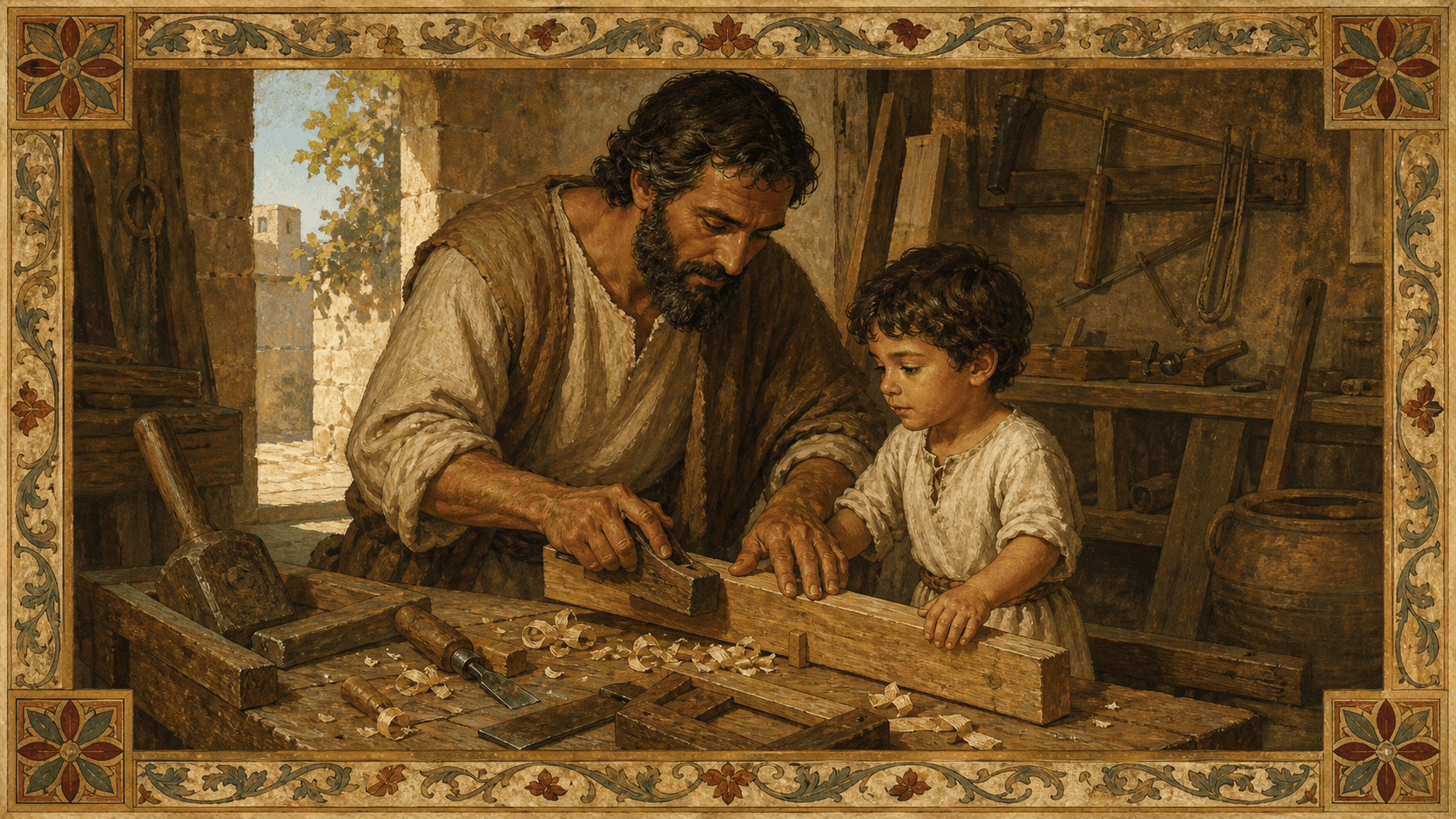
St. Joseph in a Nazareth workshop with the young Christ Child, rendered as a sober first-century Holy Land scene.

Saints Library

Joseph

Feast March 19 · Spouse of Mary · Patron of the Universal Church

The carpenter of Nazareth who raised the Son of God, guarded his mother, and is given not one spoken word in the Gospels — the saint whose whole greatness is in what he did, silently, every time he was asked.

The Story

The man Scripture lets us watch, not hear.

Everything we know about Joseph from Scripture would fit on a single page. He was a craftsman from Nazareth, descended from King David. He was betrothed to a young woman named Mary. Before they lived together he discovered she was pregnant, and because he was a just man and did not want to expose her, he decided to divorce her quietly — until an angel told him, in a dream, that the child was from the Holy Spirit, and that he should take Mary as his wife and name the boy Jesus.

He did. He took her into his home. He gave the child the name he was told to give him, which made him, in the eyes of the law and the village, the boy's father. He took mother and child to Bethlehem for the census, and then, warned again in a dream, he took them out of the country in the middle of the night to escape a king who wanted the child dead. He raised Jesus in Nazareth, taught him a trade, and brought him up and down to Jerusalem for the feasts.

Then he disappears from the record. The last time we see him, Jesus is twelve. By the time Jesus begins to preach, Joseph is gone, and the tradition of the Church is that he died before it began — quietly, at Nazareth, with his wife and his foster-son beside him.

In all of it, the Gospels give Joseph not one word. He never speaks. He listens, and he obeys, and he protects, and he says nothing. That silence is not an absence. It is the shape of the man.
Nazareth

The world he came from.

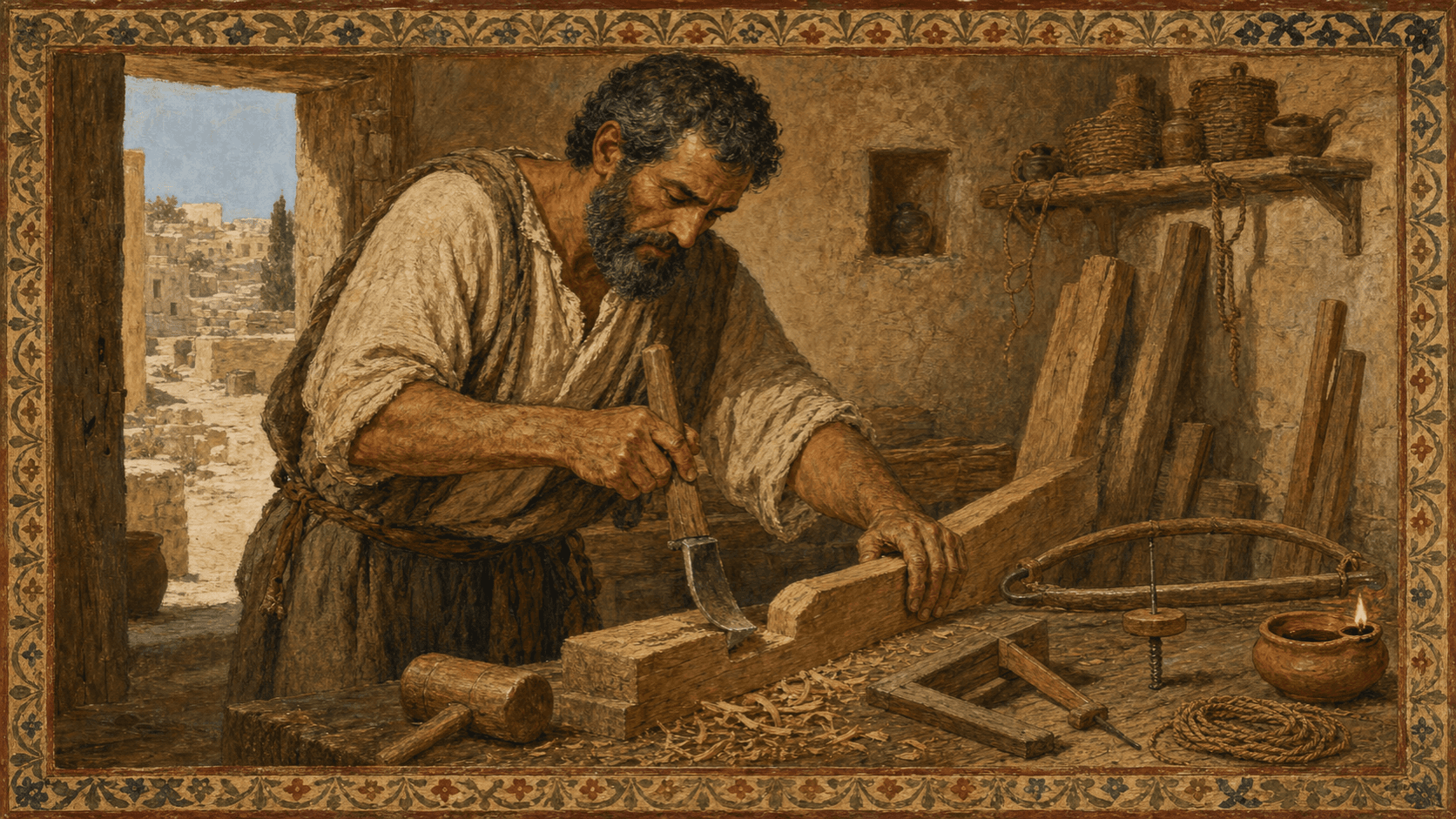
The workshop at Nazareth with Joseph teaching the young Jesus the work of wood and stone.
Nazareth, a workshop, and the hidden years of labor.

He lived in Nazareth, a small and unremarkable village in Galilee, in the northern part of the land, under Roman occupation and the local rule of Herod and his sons. It was a hard country for working people — taxed heavily, watched closely, far from the centers of power.

Joseph was a tekton— the Greek word covers the carpenter, the builder, the worker in wood and stone. It was honest, physical, ordinary work, the trade of a man who made and repaired the things a village needed: doors, yokes, roof beams, plows. The Gospels call Jesus "the carpenter's son," and later "the carpenter," because that is the trade Joseph taught him. For most of his life the Son of God worked with his hands in Joseph's shop.

Joseph was also of the house of David. This matters more than it first appears. The promises God had made to David — that his line would not fail, that a king would come from it whose reign would not end — ran through Joseph. When Jesus is called Son of David in the Gospels, it is through Joseph's legal fatherhood that the title comes. The descendant of a king worked as a village carpenter and never said a word about it.

Matthew 1

A just man.

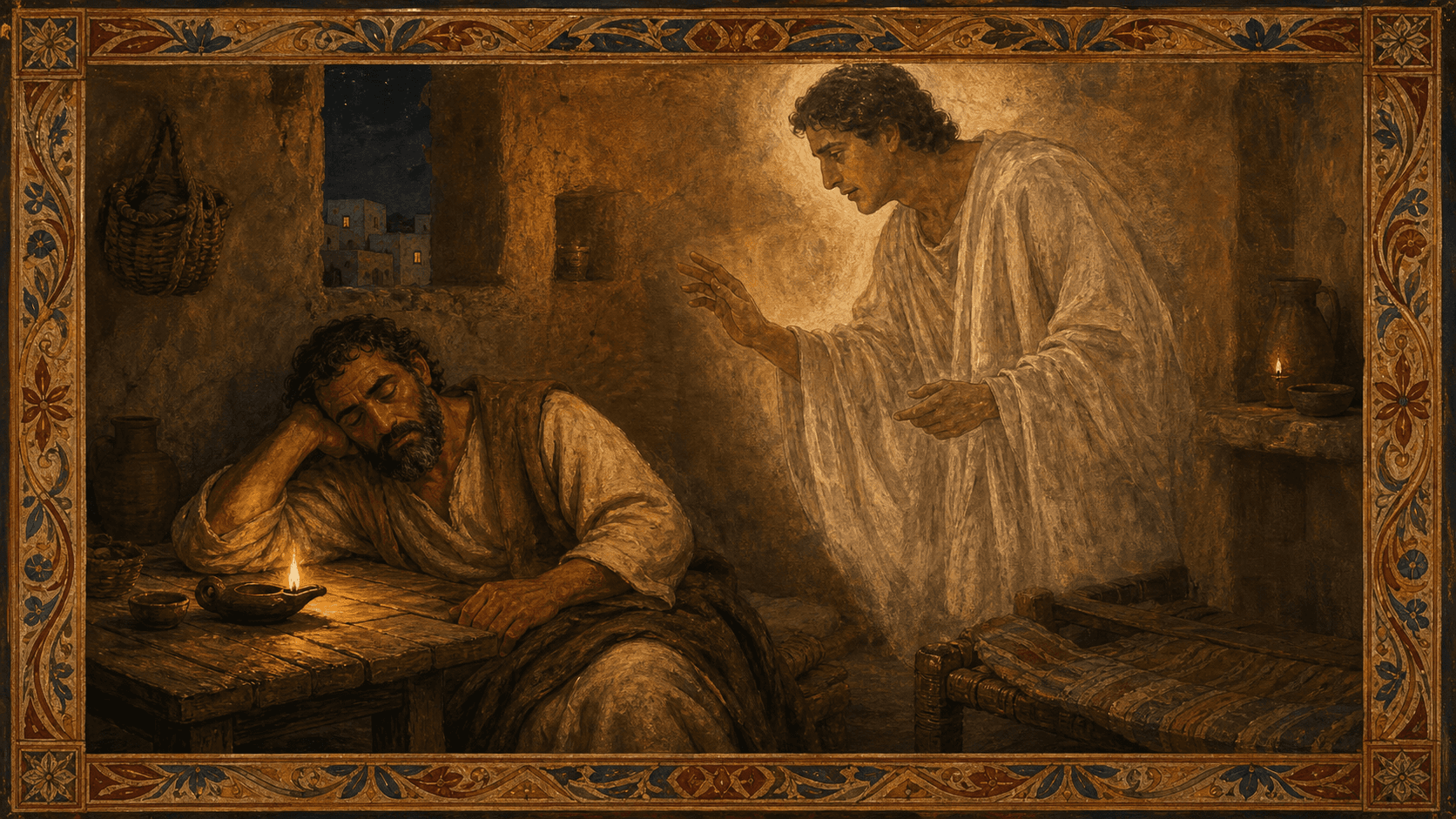
Joseph asleep by lamplight as an angel appears in a dream, the moment Matthew describes before Joseph takes Mary into his home.
The angel comes to Joseph in a dream.

The Gospel of Matthew gives Joseph one defining sentence before anything else: he was a just man.

It comes at the hardest moment of his life. He is betrothed to Mary — in that culture a binding commitment, as serious as marriage — and he learns she is pregnant, and he knows the child is not his. The law gave him the right to expose her publicly. Matthew tells us what the just man chose instead: not willing to make her a public example, he resolved to divorce her quietly, to absorb the situation himself rather than destroy her.

That is the first thing Scripture shows us about Joseph's justice — that it bent toward mercy before he knew the whole truth. He was prepared to be wronged quietly rather than to ruin her loudly.

Then the angel came to him in a dream: Joseph, son of David, do not be afraid to take Mary as your wife, for the child conceived in her is of the Holy Spirit. When Joseph woke, Matthew says simply that he did what the angel had commanded. No speech. No recorded hesitation. He took his wife into his home and named her son.

It is the pattern of his whole life, set down at the start. God speaks; Joseph obeys; Joseph says nothing.

Obedience

The silence of Joseph.

Four times in the Gospel of Matthew, Joseph is given a command in a dream. Four times he obeys it the same way: he gets up, and he does it, and he does not speak.

Take Mary as your wife. He does. Take the child and his mother and flee to Egypt. He gets up in the night and goes. Return to the land of Israel. He returns. Withdraw to Galilee. He withdraws, and settles in Nazareth.

Not once does the Gospel record Joseph saying a single word — not to the angel, not to Mary, not to the shepherds or the magi, not in the Temple, not anywhere. He is the most important human guardian in the history of the world, and Scripture gives him no speech at all.

The Church has never read this as Joseph having nothing to say. It has read it as the portrait of a particular kind of holiness — the holiness of the man who does what is asked, immediately and completely, without needing to be heard. Joseph's obedience is not dramatic. He does not argue with God like Job, or bargain like Abraham, or sing like Mary. He simply does the next thing he is told, every time, all the way, and lets his life say what his mouth never does.

For most people, most of the time, that is what holiness actually looks like. Not words. The next right thing, done quietly.

Matthew 2

The flight into Egypt.

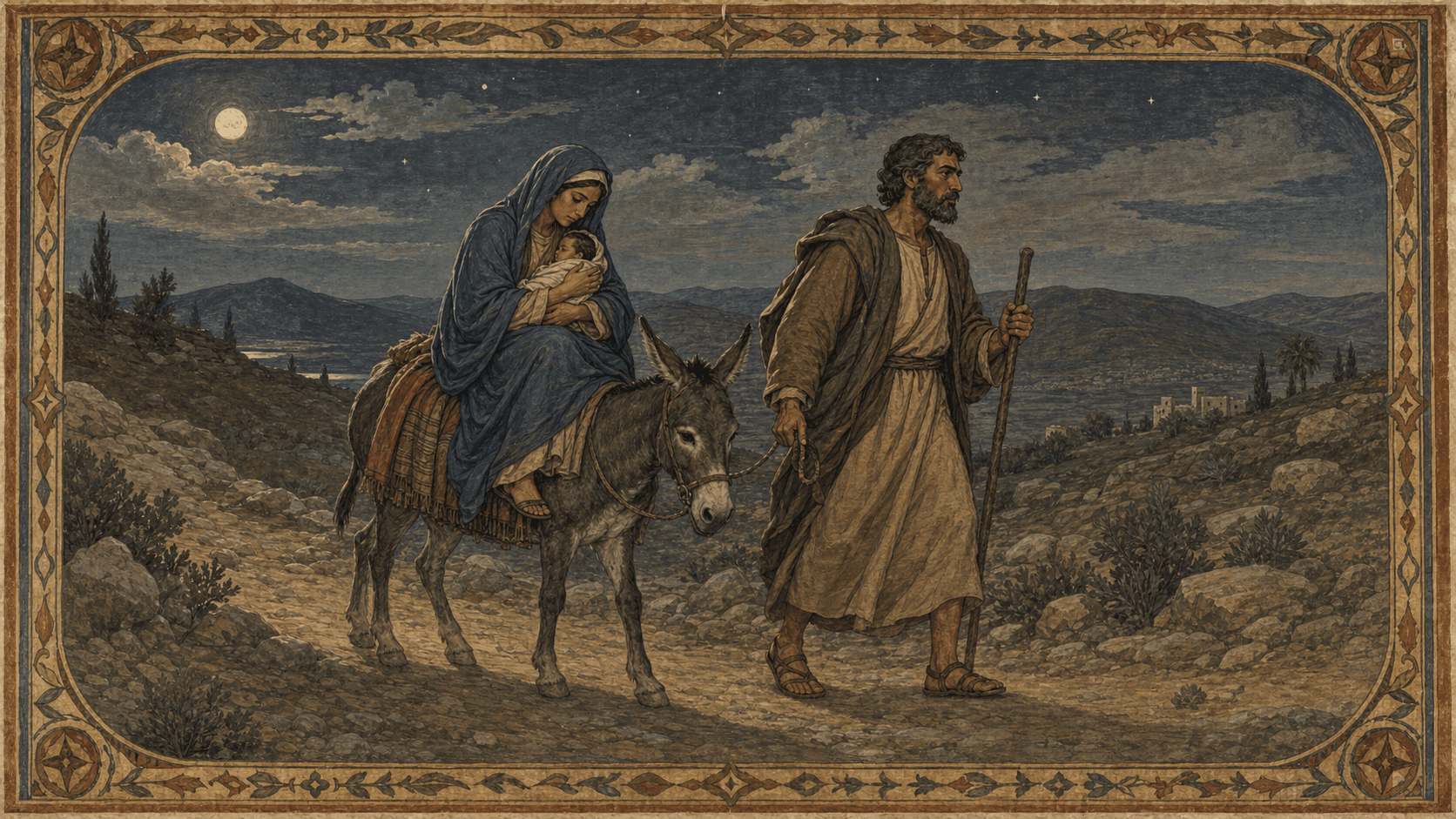
Joseph leading Mary and the Christ Child into Egypt by night after Herod's threat against the child.
Joseph leads the Holy Family into Egypt by night.

The sharpest test came early. After the magi had come and gone, the angel woke Joseph again: Herod was going to search for the child to destroy him. Take the child and his mother and flee to Egypt.

Joseph got up that night — Matthew is specific that it was night — and took the mother and the child and left the country. They became refugees, fleeing a king's violence into a foreign land, with no resources named and no promise of how long. Herod, when he understood he had been outmaneuvered, killed the boys of Bethlehem in his rage. The child Joseph was protecting was the one who got away, because a carpenter took a warning in a dream seriously enough to walk into the dark with his family and not stop.

They stayed in Egypt until Herod was dead and the angel told Joseph it was safe to return. This is why Joseph is, among other things, the saint the Church has long associated with the protection of families and with those forced to flee — the man who carried the Holy Family out of danger and held them together in exile.

Nazareth

The hidden years.

They came back and settled in Nazareth, and the Gospels go nearly silent on the next two decades. We are given one scene. When Jesus is twelve, the family goes up to Jerusalem for Passover, and on the way home Mary and Joseph realize the boy is not with the caravan. They go back and search for three days. They find him in the Temple, sitting among the teachers.

It is the last time Joseph appears in Scripture. Mary speaks to the boy — your father and I have been searching for you in great anxiety — and Joseph, as always, says nothing. Then they go home to Nazareth, and Luke tells us the boy was obedient to them, and grew.

That is the whole of the hidden years: a workshop, a household, the feasts in Jerusalem, a son growing up under a father who taught him a trade and a faith. The Son of God spent roughly thirty years in Joseph's house and Joseph's care, and almost all of it is hidden, ordinary, undocumented — the long, unglamorous work of raising a child well. The Church has always found that hiddenness to be part of the point. Most lives are lived there.

Tradition

His death.

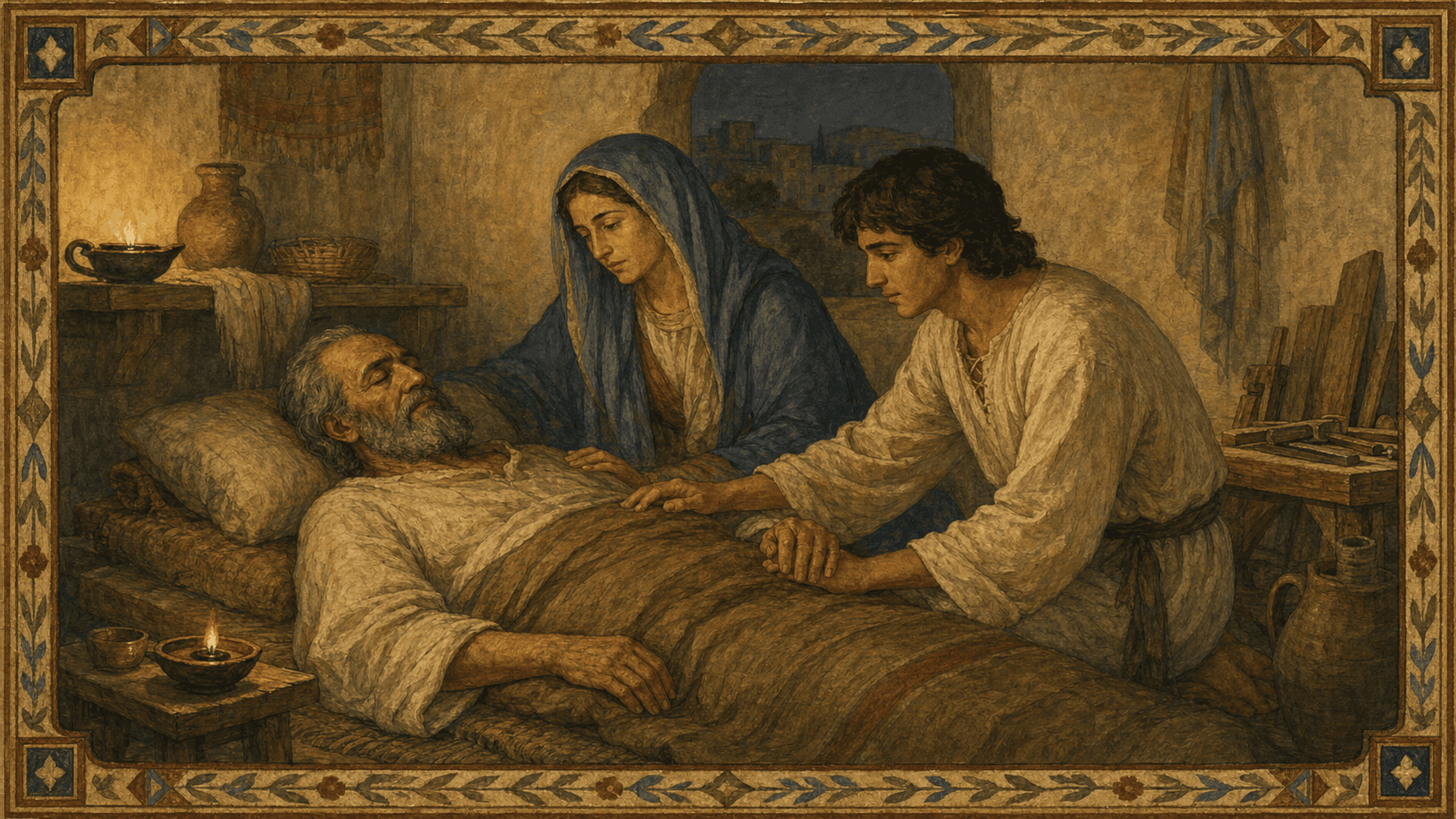
The traditional death of Joseph in the presence of Mary and Jesus, treated as a quiet devotional scene.
A devotional tradition: Joseph dies in the presence of Jesus and Mary.

Joseph is not mentioned during Jesus's public ministry. At the wedding at Cana, at the cross, in the years of preaching, Mary is present and Joseph is not. The Church's settled tradition is that Joseph had died by then — at Nazareth, during the hidden years, before his foster-son began the work he had been raised to do.

Scripture does not describe his death, and the apocryphal stories that do — giving him an age of ninety or a hundred and eleven — carry no authority and the Church does not rely on them. What the Church does hold, by long tradition, is the quiet conviction that Joseph died as few men have: in the presence of Jesus and Mary, the Son of God and the Mother of God at his bedside. From that tradition comes one of his great titles. Joseph is the patron of a happy death — of dying in the company of Christ, at peace, prepared. Catholics have prayed to him for that grace for centuries.

He had finished his work. He had brought the child safely to manhood. He could go.

Patronage

Patron of the Universal Church.

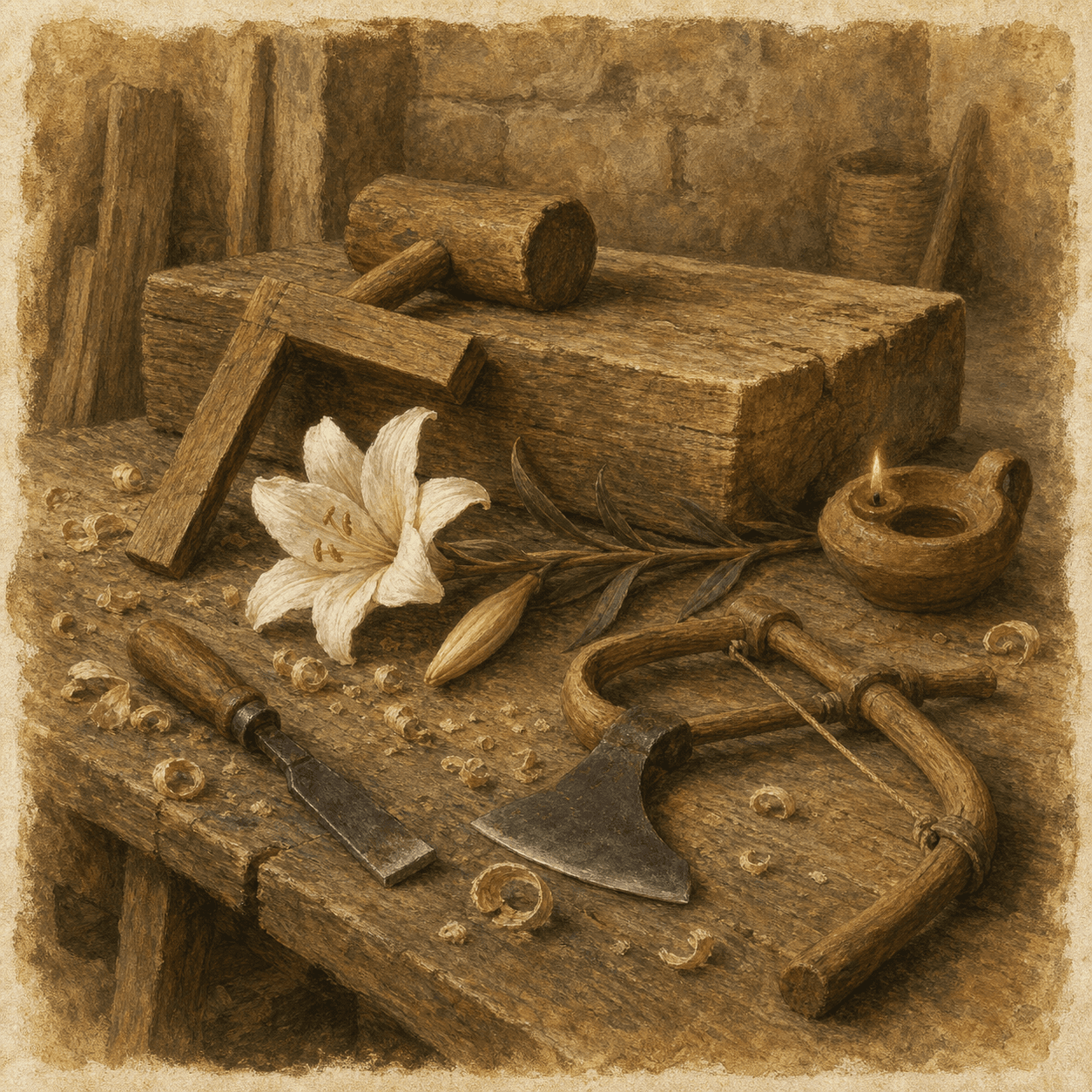
A symbolic still life for Joseph with carpenter's tools, wood shavings, a lamp, and a white lily.
Tools, lily, lamp: Joseph's iconography.

For most of the Church's first thousand years, devotion to Joseph was quiet — fitting, for a quiet man. It grew slowly through the medieval period and then steadily in the modern Church, until it arrived somewhere remarkable.

On December 8, 1870, Blessed Pope Pius IX declared Joseph the Patron of the Universal Church — guardian not only of the Holy Family but of the whole household of faith. In 1889, Pope Leo XIII devoted an entire encyclical, Quamquam Pluries, to Joseph and to his protection of the Church. In 1955, Pope Pius XII established the feast of Joseph the Worker on May 1, setting the carpenter of Nazareth before the modern question of labor and giving the dignity of work a saint. In 1989, Pope John Paul II wrote Redemptoris Custos— Guardian of the Redeemer — a sustained meditation on Joseph's mission. In 2013, Joseph's name was added to Eucharistic Prayers II, III, and IV, after John XXIII had already added him to the Roman Canon in 1962. And in 2020, Pope Francis proclaimed a Year of Saint Joseph with the letter Patris Corde, With a Father's Heart.

The trajectory is worth noticing. The man Scripture gives no words to has, over the centuries, been given more and more of the Church's attention, until he stands as the patron of the whole Church and is named at every Mass. The silence was never emptiness. The Church kept discovering how much was in it.

For Today

Why he matters now.

He matters now because most people will never be the one who speaks. Most people are not the founder, the leader, the voice in the room. Most people are the one who shows up, does the work, protects what they have been given, and is never thanked in the record. Joseph is their saint. He is the proof that this life — the quiet, faithful, hidden, dutiful life — is not a lesser holiness. It may be the truest kind.

He matters for fathers especially. Joseph is the model of fatherhood that the culture keeps insisting is unnecessary: the man who stays, who provides, who protects, who teaches a trade and a faith, who puts the people in his care ahead of himself without being asked and without being praised. He raised the Son of God by getting up in the night, more than once, and doing the hard thing without a speech. Fathers who wonder whether the daily, unglamorous work of providing and protecting matters have, in Joseph, a saint who did exactly that and nothing else, and is honored above almost all others for it.

And he matters for anyone afraid of an ordinary life. Joseph's life was ordinary in every external way — a village, a trade, a family, a death at home. What made it the most important hidden life in history was not its scale but its faithfulness. He did small things, completely, for the people God gave him. The Church has spent two thousand years discovering that this is not small at all.

Reading Trail

Where to read about him.

Joseph wrote nothing and said nothing that was written down. His life is in the opening chapters of two Gospels, and the Church's reflection on him is in a handful of modern documents.

  1. Matthew 1-2 — the betrothal, the first dream, the nativity, the magi, the flight into Egypt, and the return. This is the heart of Joseph in Scripture.
  2. Luke 1-2 — the journey to Bethlehem, the birth, the Presentation in the Temple, and the finding of the boy Jesus at twelve.
  3. St. John Paul II, Redemptoris Custos — the fullest magisterial reflection on Joseph's person and mission.
  4. Pope Francis, Patris Corde — short, warm, and modern; Joseph as father, worker, and protector, read for today.
  5. Pope Leo XIII, Quamquam Pluries — the older encyclical that set Joseph's patronage of the Church on a firm footing.

A Word of Scripture

The verdict, not the speech.

This is the closest thing to a portrait the Gospels give him, and it is a verdict, not a speech: a just man. Matthew 1:19

Everything else about Joseph in Scripture is action — he rose, he took, he went, he returned, he named the child — but never a recorded word. The one summary judgment the Gospel makes is this one, and it is enough. He was just. He chose mercy before he knew the truth, and obedience after he did, and he never needed to be heard doing either.

The Church has spent two thousand years listening to the silence of a just man, and finding it full.

Connected Figures

A family of holiness.

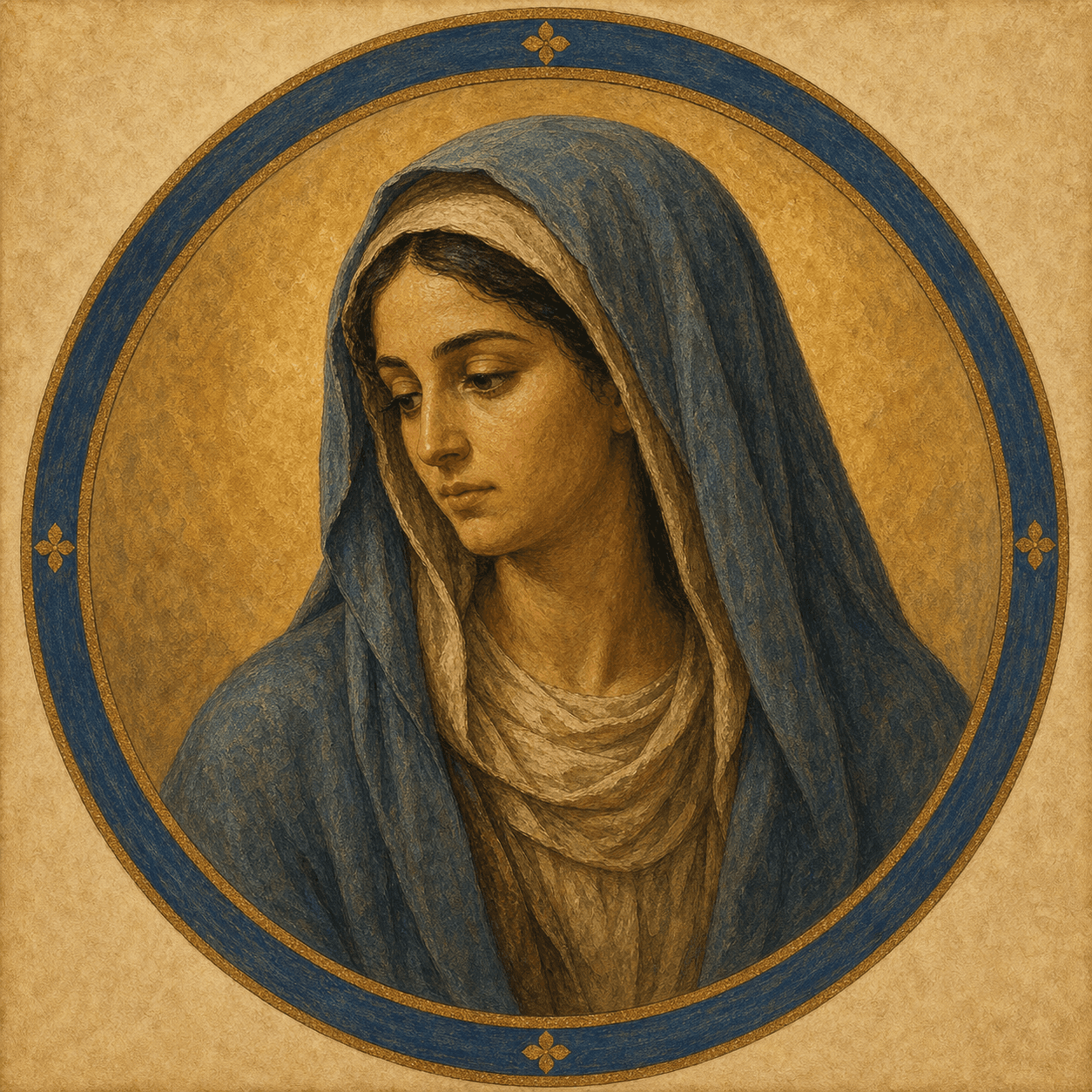
Portrait medallion of the Blessed Virgin Mary as a young first-century Judean woman in a muted blue mantle.

The Blessed Virgin Mary

His wife. The Mother of God, whom Joseph guarded, sheltered, and served. The two of them together are the Holy Family.

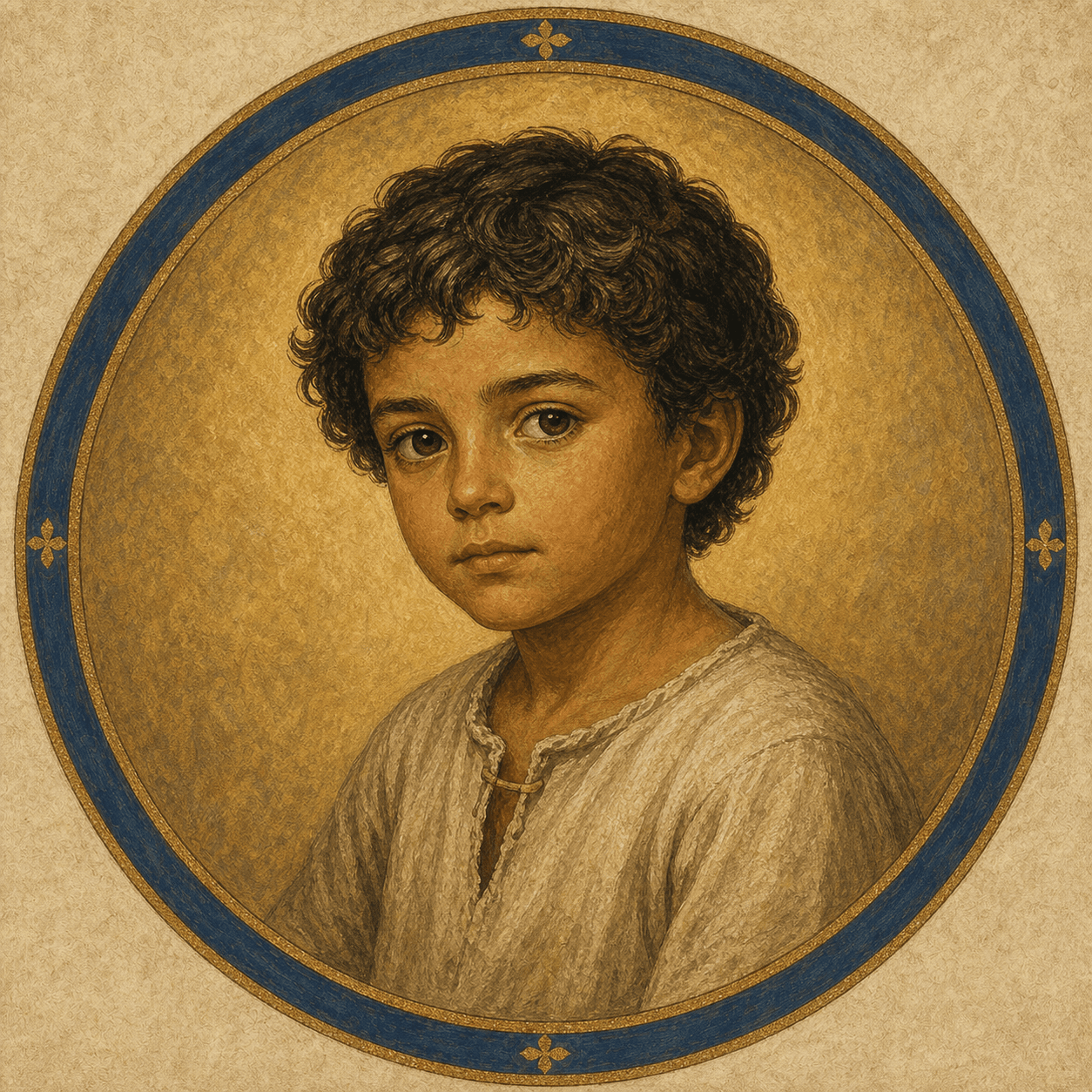
Portrait medallion of the Christ Child as a first-century Judean boy in a simple undyed tunic.

The Christ Child

His foster-son. The Son of God, whom Joseph named, raised, taught, and protected, and in whose presence tradition says he died.

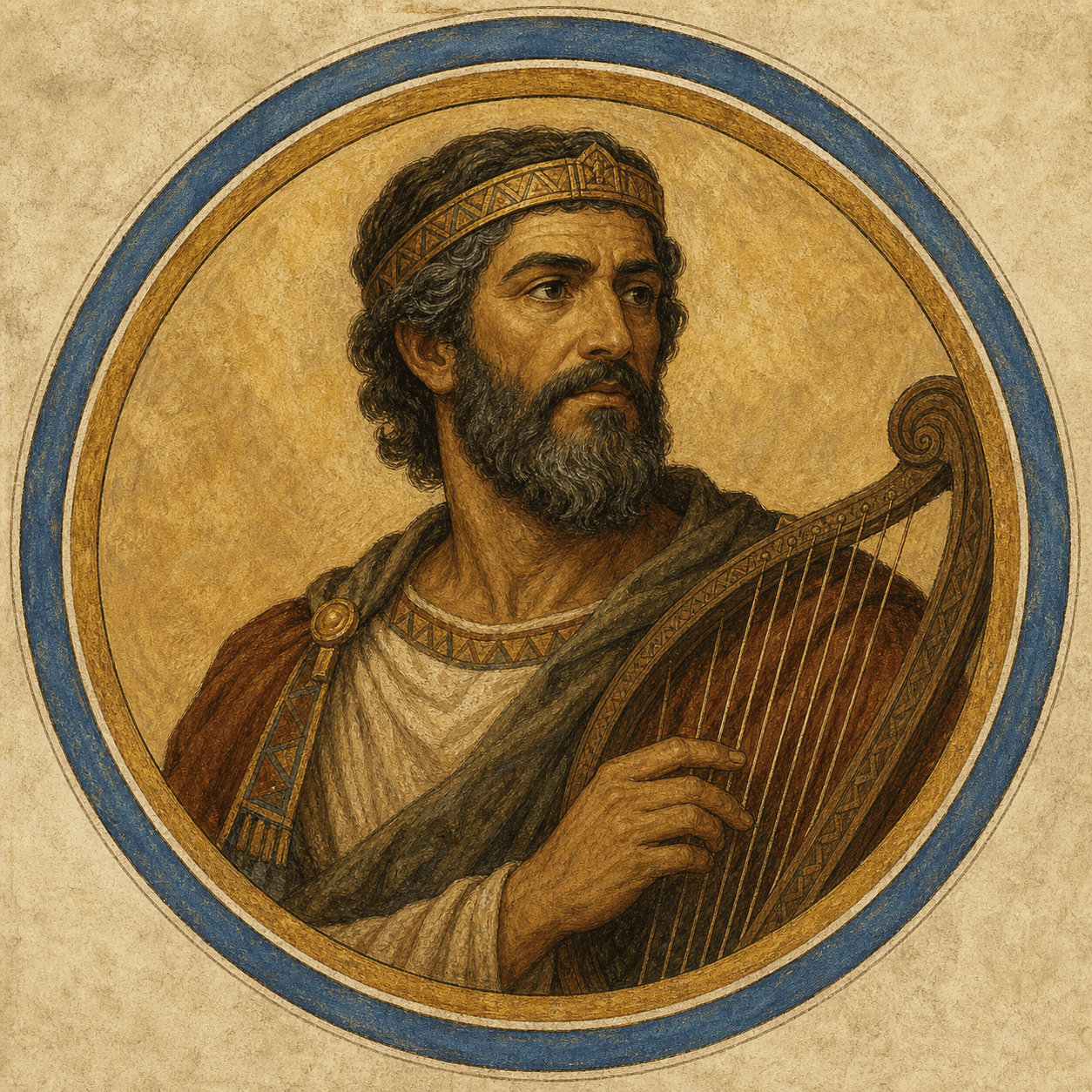
Portrait medallion of King David with a lyre, rendered as an ancient Israelite royal ancestor.

King David

His ancestor. The king to whose line God promised an everlasting throne, fulfilled in Jesus, the Son of David.

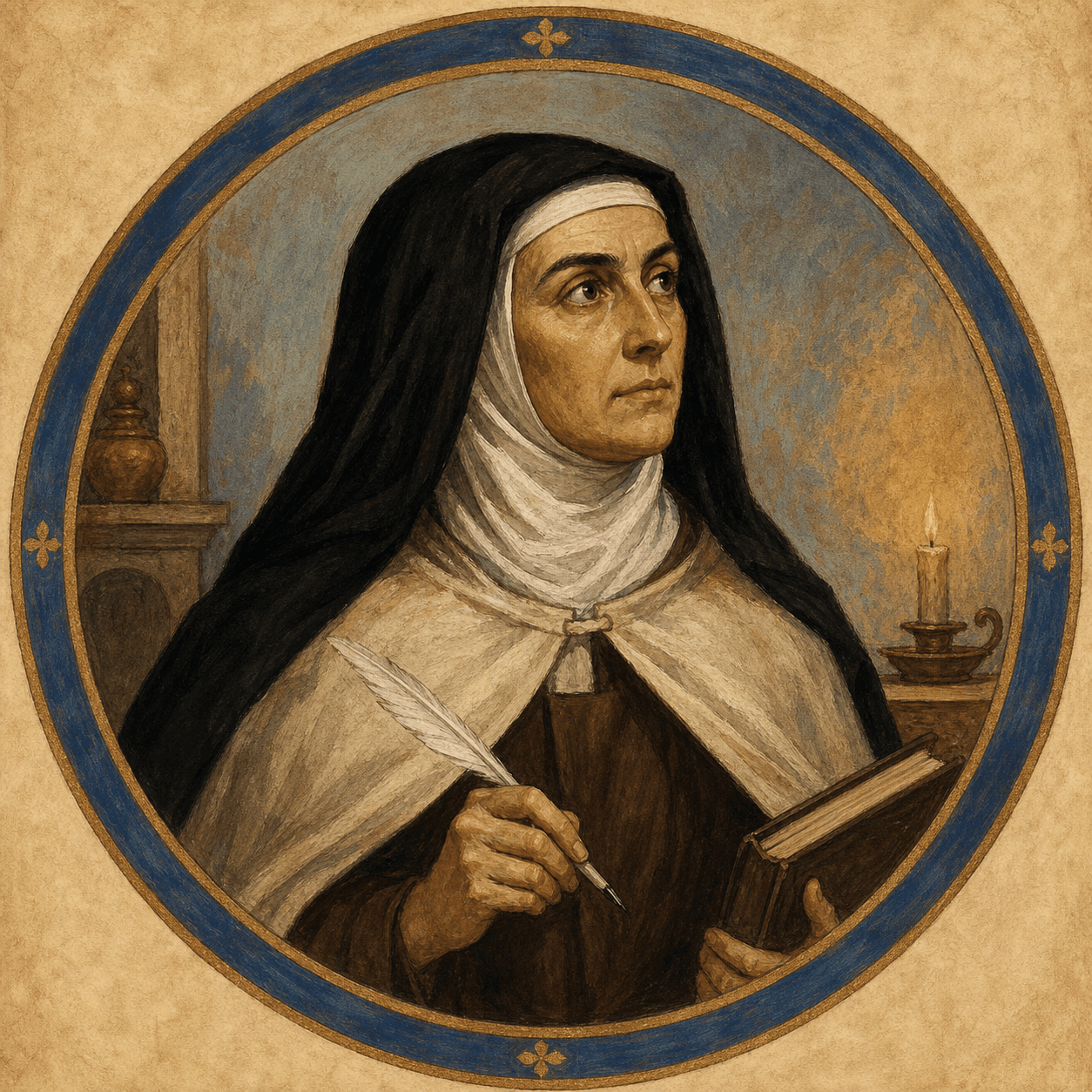
Portrait medallion of St. Teresa of Avila in a Carmelite habit with book and quill.

St. Teresa of Avila

The Carmelite Doctor of the Church who did more than almost anyone to spread devotion to Joseph and his intercession.

Frequently Asked

Joseph, plainly.

Who was St. Joseph?+
He was the husband of the Blessed Virgin Mary and the foster-father and legal father of Jesus — a first-century craftsman from Nazareth, descended from King David. The Gospels of Matthew and Luke show him protecting and providing for the Holy Family: taking Mary as his wife, naming Jesus, leading the flight into Egypt, and raising Jesus in Nazareth. He is honored as Patron of the Universal Church. His principal feast is March 19.
Why does St. Joseph never speak in the Bible?+
Scripture records no words of Joseph at all, only his actions. He is given commands in dreams and obeys them without a recorded word. The Church has read this not as emptiness, but as the portrait of a particular holiness: the man who does what God asks, immediately and completely, without needing to be heard. His obedience is shown entirely in what he does.
Why are there two feasts of St. Joseph?+
March 19 is his principal feast, honoring him as the Spouse of the Blessed Virgin Mary; it is a Solemnity. May 1, the feast of St. Joseph the Worker, was added by Pope Pius XII in 1955 to honor the dignity of human labor and to set the carpenter of Nazareth as a Christian patron of workers on the international workers' day.
When did St. Joseph die?+
Scripture does not record his death, but he is absent from the accounts of Jesus's public ministry while Mary is present at Cana and at the cross. The Church's settled tradition is that Joseph died during the hidden years at Nazareth, before Jesus began to preach. By long tradition he died in the presence of Jesus and Mary, which is why he is honored as the patron of a happy death.
Why is St. Joseph the patron of a happy death?+
Because of the tradition that he died at Nazareth with Jesus and Mary at his side — the Son of God and the Mother of God present at his deathbed. Catholics have long asked his intercession for the grace of dying well: at peace, prepared, and in the company of Christ. The tradition is devotional rather than scriptural, and the page treats it that way.
Is St. Joseph the patron of the whole Church?+
Yes. On December 8, 1870, Blessed Pope Pius IX declared St. Joseph the Patron of the Universal Church. The honor has only grown since: Leo XIII, Pius XII, John Paul II, and Francis all taught on him, and Joseph is now named with Mary in the Eucharistic Prayers of the Mass.
Was St. Joseph an old man?+
Scripture does not say. The image of a very old Joseph comes from later apocryphal writings, often used to safeguard the Church's teaching on Mary's perpetual virginity, but those writings carry no authority. Much modern devotion presents Joseph as a vigorous working father in the prime of life. The Church does not require either picture; what it holds is his role as the chaste guardian of Mary and Jesus.

Sources

Read beyond summaries.

Joseph's life is treated from Scripture first. Devotional traditions are named as traditions, and apocryphal claims are not used as factual anchors.

Primary

  • The Gospel of Matthew 1 and Matthew 2 — the betrothal, dreams, naming of Jesus, flight into Egypt, and return to Nazareth.
  • The Gospel of Luke 2 — Bethlehem, the Presentation, and the finding of Jesus in the Temple.
  • Direct Scripture quotation uses the public-domain Douay-Rheims text of Matthew 1:19.

Magisterial

  • Blessed Pope Pius IX, decree Quemadmodum Deus declaring St. Joseph Patron of the Universal Church (8 December 1870).
  • Pope Leo XIII, Quamquam Pluries (15 August 1889).
  • Pope St. John Paul II, Redemptoris Custos (15 August 1989).
  • Pope Francis, Patris Corde (8 December 2020), on the 150th anniversary of Joseph's proclamation as Patron of the Universal Church.
  • Congregation for Divine Worship, decree Paternas vices (2013), adding St. Joseph to Eucharistic Prayers II, III, and IV.

Tradition

  • Joseph's death in the presence of Jesus and Mary is treated as Catholic devotional tradition, not as a Scriptural scene.
  • Apocryphal claims about Joseph's age or detailed death narrative are named as apocryphal and are not used as factual anchors.
  • Patronages are listed conservatively: the Universal Church, workers, fathers, families, and a happy death.

Last reviewed: June 3, 2026

On this page+