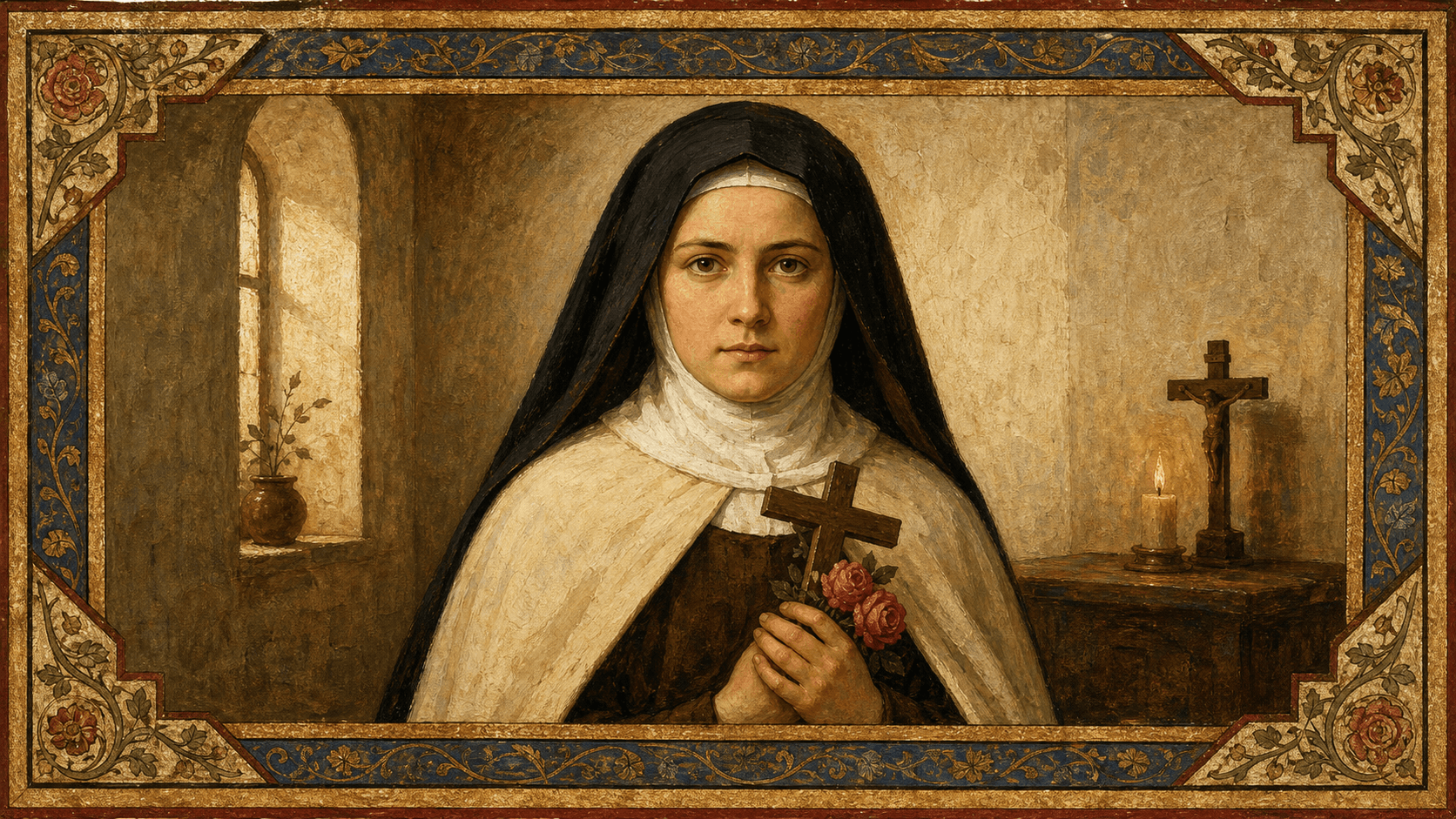
St. Thérèse of Lisieux in the Carmelite habit, holding a crucifix and roses.

Saints Library

Thérèse of Lisieux

Feast October 1 · Doctor of the Church · 1873-1897

The young Carmelite who never left her convent, worked no public miracle in her life, and found a path to God so small and true that the Church made her one of its great teachers.

The Story

The Little Flower was steel.

By every external measure, almost nothing happened in Thérèse Martin's life. She was born into a devout French family, lost her mother at four, entered the Carmelite convent at Lisieux at fifteen, lived there for nine years doing laundry and small chores, got tuberculosis, and died at twenty-four.

And she is now one of the most loved saints in the Church, a Doctor beside Augustine and Aquinas, and a patroness of the missions she never saw.

The reason is a small book and a great idea. Under obedience, Thérèse wrote the story of her soul, and in it she described the Little Way: ordinary duties, hidden kindnesses, and small sacrifices done with great love and complete confidence in God.

It sounds soft. It is not. Her last months were tuberculosis, pain, and a darkness of faith in which heaven itself seemed to disappear. She went on loving in the dark. That is the steel under the flowers.
Alençon

The world she came from.

She was born in 1873 in Alençon, in Normandy, the youngest surviving daughter of Louis Martin, a watchmaker, and Zélie Martin, a lace-maker with a successful business. They were serious nineteenth-century French Catholics: pious, hard-working, and practical.

Zélie died of breast cancer when Thérèse was four. The loss marked the child deeply. She had been affectionate and headstrong; after her mother's death she became hypersensitive, tearful, and fragile. When her older sister Pauline later entered Carmel, Thérèse felt abandoned again.

Nothing in that childhood made a Doctor of the Church seem likely. That is part of the point.

Conversion

A tiny Christmas wound changed her.

The turn came on Christmas Eve, 1886, when she was thirteen, and it came through something almost absurdly small. Coming home from Midnight Mass, she overheard her tired father say that this should be the last year for the childish custom of gifts in her shoes.

The old Thérèse would have collapsed into tears and ruined the evening. Instead, by a grace she later called her complete conversion, she mastered herself, came downstairs cheerful, and made the evening happy for him.

She was freed from the prison of her own oversensitivity. From that Christmas she was still small, but no longer ruled by her feelings. She was ready to begin the work.

Carmel

She went to the Pope at fourteen.

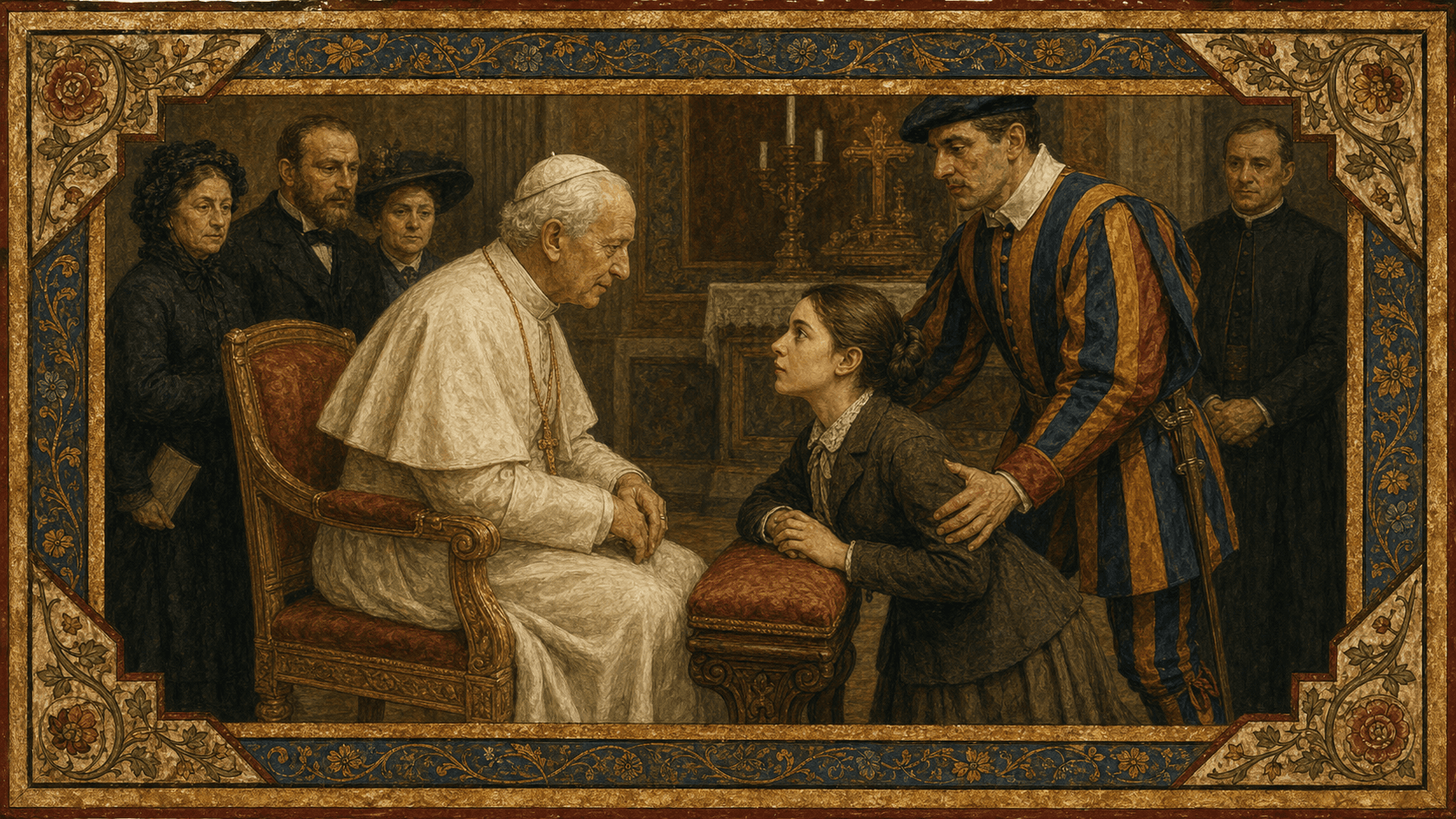
The young Thérèse Martin kneeling before Pope Leo XIII in 1887, asking to enter Carmel at fifteen.
Thérèse appeals to Pope Leo XIII in Rome, asking to enter Carmel at fifteen.

Thérèse decided that she would enter the cloistered Carmelite convent at Lisieux, and the Church told her she was too young. She asked the convent, the local priest, and the bishop of Bayeux.

Then, on a pilgrimage to Rome with her father in 1887, she knelt before Pope Leo XIII at a public audience and begged him directly to let her enter Carmel at fifteen. The guards had to lift her away.

The Pope told her she would enter if it was God's will. It was. On April 9, 1888, at fifteen years old, Thérèse Martin entered the Carmel of Lisieux, the cloister she would never leave.

The Little Way

Holiness in the ordinary.

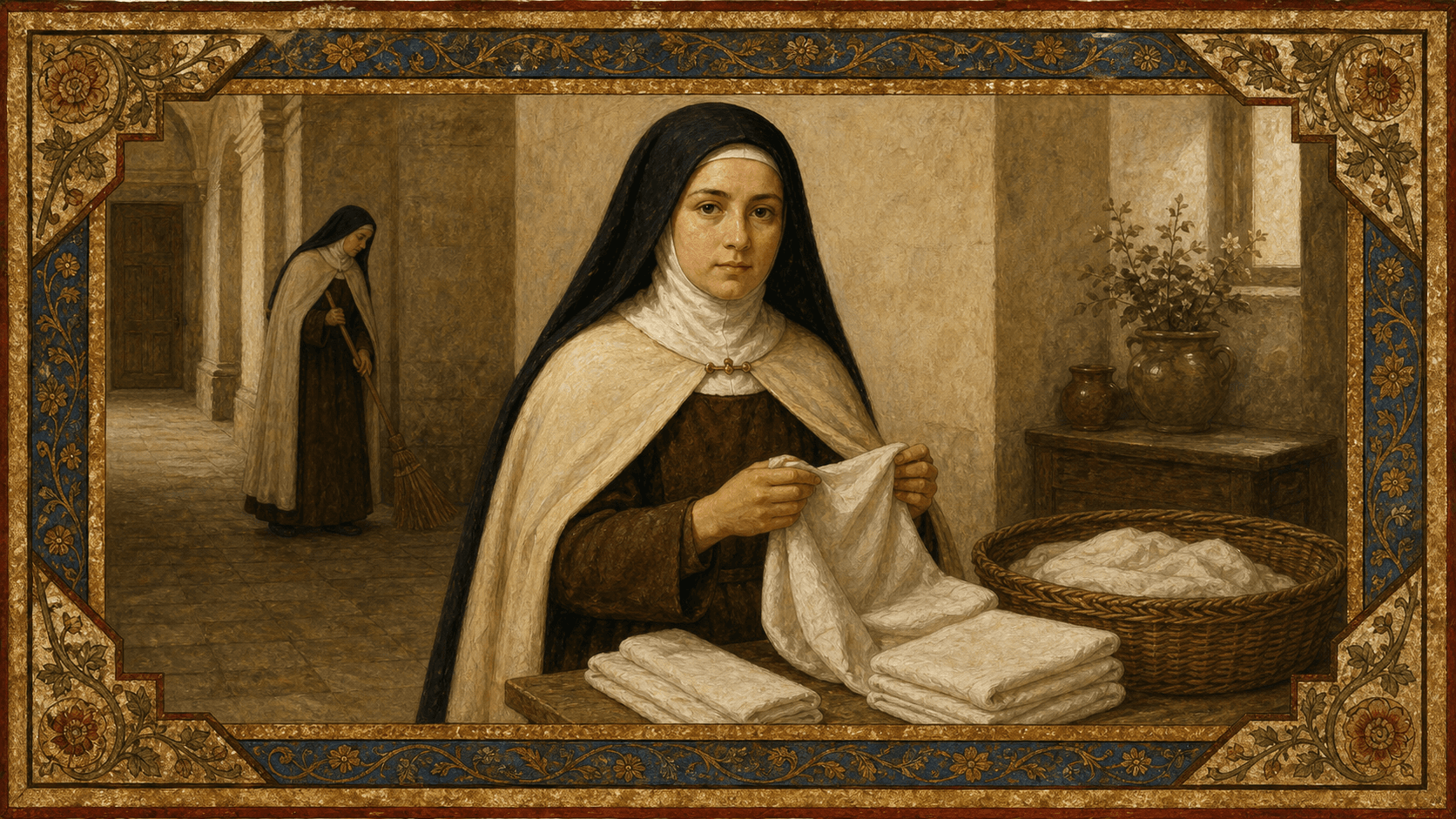
St. Thérèse doing ordinary laundry work in the Carmel of Lisieux.
The Little Way is made of ordinary duties done with love.

Inside the Carmel, Thérèse faced the secret problem at the center of her teaching. She wanted to be a great saint, to love God like the martyrs and missionaries and mystics. And she knew she could not. She was a young nun in an ordinary convent with no opportunities for visible heroism.

Instead she found the way through: God does not require great deeds. He requires great love, and great love can be poured into the next chore, the next irritation, the next hidden kindness no one will ever see.

Her image was a child at the bottom of a staircase, too small to climb, who does not pretend to be large but simply lifts up her arms to be carried. Her sanctity was built not on her strength but on her smallness, and on trust in God's love.

Love

Her vocation was love.

Thérèse had wanted every vocation at once: missionary, martyr, priest, doctor. Reading St. Paul, she saw that without love all gifts were nothing, and that love was the vocation underneath every other vocation.

She could not travel the world, preach, or shed her blood. But she could love, hidden in the heart of the Church, and that love could animate every other work.

A hidden nun in a French provincial convent found a vocation as wide as the whole Body of Christ.

Darkness

The roses hide a dark night.

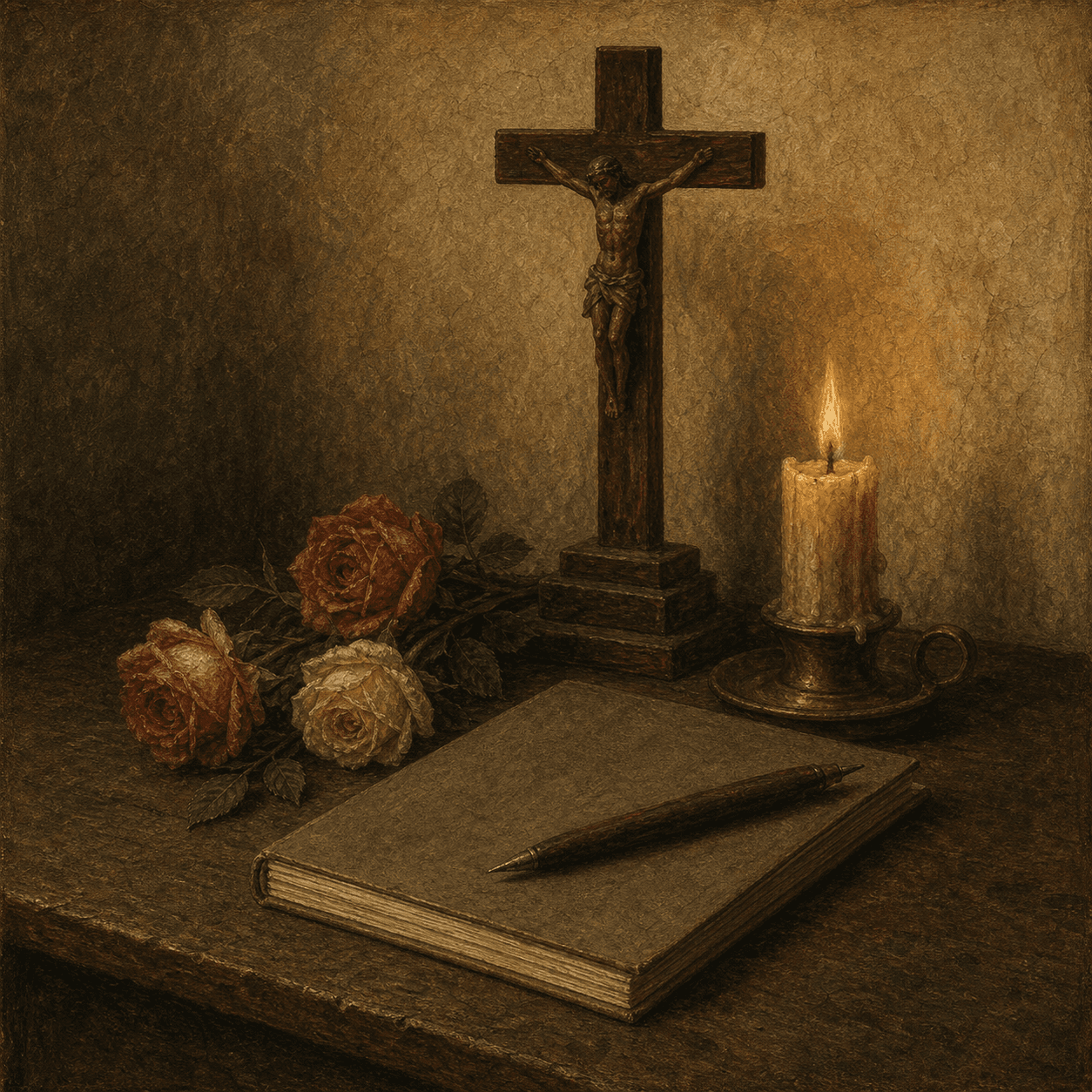
A still life of a crucifix, roses, candle, pen, and blank notebook for St. Thérèse.
Crucifix, notebook, candle, and roses in the dark.

In the last year and a half of her life, her body began to die of tuberculosis, and her faith went dark. Heaven, eternal life, and the felt love of God seemed to fall silent.

She did not lose her faith. She suffered it. She described herself as sitting at the table of unbelievers, eating their bread, so that one day they might see the light. She offered even her loss of all consolation for those who had none.

The Little Way is not a sweet path for sensitive souls. It is a way of loving God that holds when God cannot be felt at all.

The Book

A convent obituary detonated.

Thérèse would have died unknown except for obedience. Her prioress, who was also her sister Pauline, told her to write down her childhood memories and then the story of her spiritual life.

After her death, the nuns edited the notebooks into Story of a Soul and sent it to other Carmelite convents as an obituary. The book spread through France and then the world.

Ordinary Catholics recognized in her Little Way something they could actually live. The book worked because the hidden life inside it had been real all the way down.

Lisieux

She promised to keep working.

She died on September 30, 1897, after months of terrible suffering. Her last words, gazing at her crucifix, were a simple act of love: “My God, I love you.”

Before she died, she promised that she would spend her heaven doing good upon earth and let fall a shower of roses. She meant that her mission would continue from heaven through graces obtained for those who asked.

The Church canonized her in 1925 and, in 1997, Pope St. John Paul II named her a Doctor of the Church. A girl who died at twenty-four, having done nothing the world would notice, stands among the great teachers of the faith.

Why Now

She is the saint for people who are not great.

Most saints can seem discouraging. They found orders, convert nations, write masterpieces, work miracles, or die martyrs. The ordinary believer quietly concludes that holiness is for larger people.

Thérèse demolished that. She insisted that ordinary work, daily irritation, unseen patience, and small acts of love are exactly where most saints are made.

She matters, too, because of the dark. She is the patron of everyone who has prayed into silence, kept believing without comfort, and loved God in the night.

Reading

Where to read her.

Start with Story of a Soul. It is short, direct, and the book that made her known. Notice that the sweetness is on the surface and the steel is underneath.

Then read Last Conversations, the words recorded by her sisters during her final months, followed by her letters, poems, and prayers. The modern ICS translations by John Clarke, O.C.D. are the standard for study; older public-domain English versions also exist.

A Word of Thérèse

Love is the hidden vocation.

Thérèse wrote these words after a long search. She had wanted to be everything and had discovered that love was the vocation that contained all the others.

It is the whole Little Way in one line. Not visible greatness. Love, hidden in the ordinary, all the way down. That is exactly why she could teach it to everyone.

Connected Saints

A family of holiness.

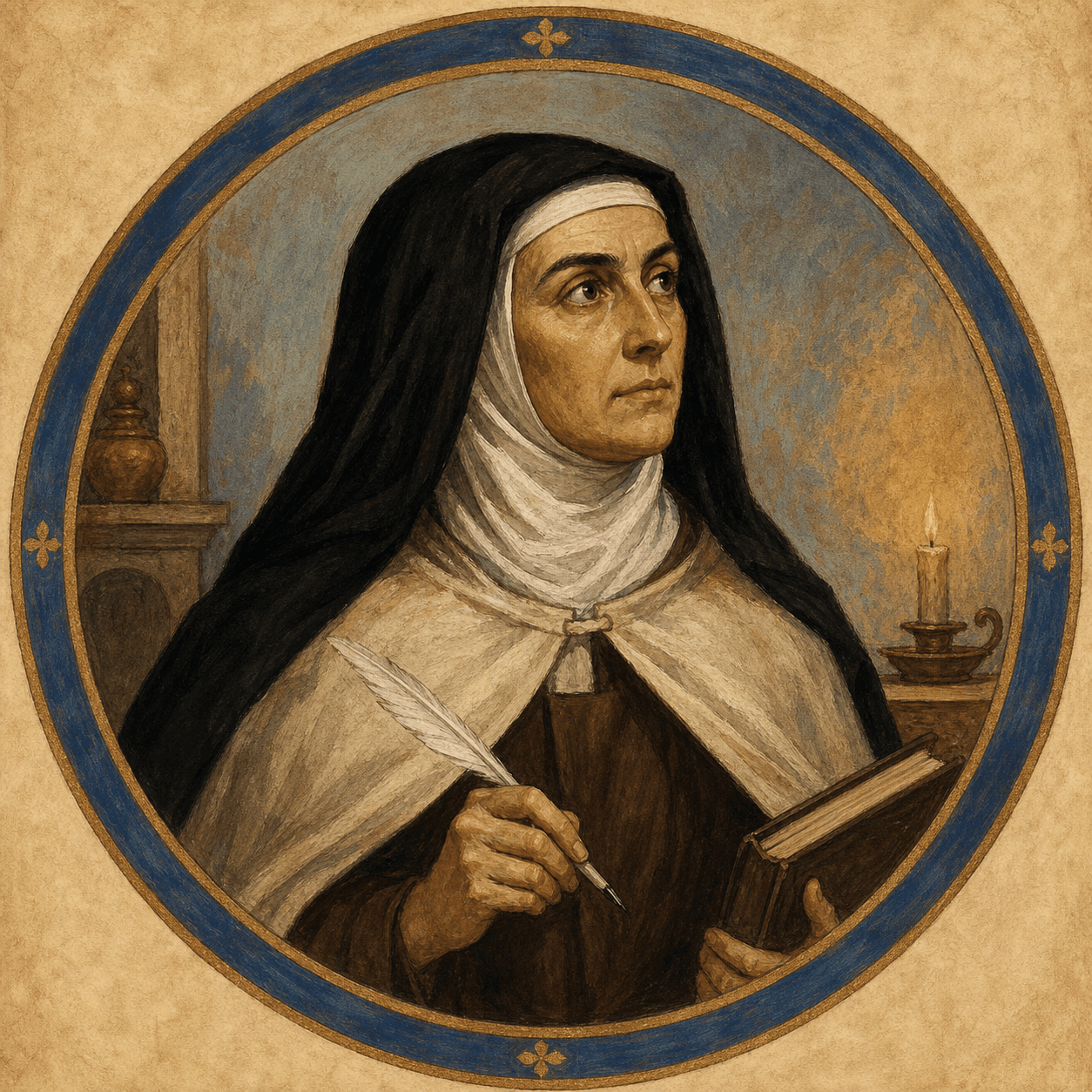
Portrait medallion of St. Teresa of Avila in a Carmelite habit.

St. Teresa of Ávila

The great reformer of the Discalced Carmelites, the order Thérèse entered.

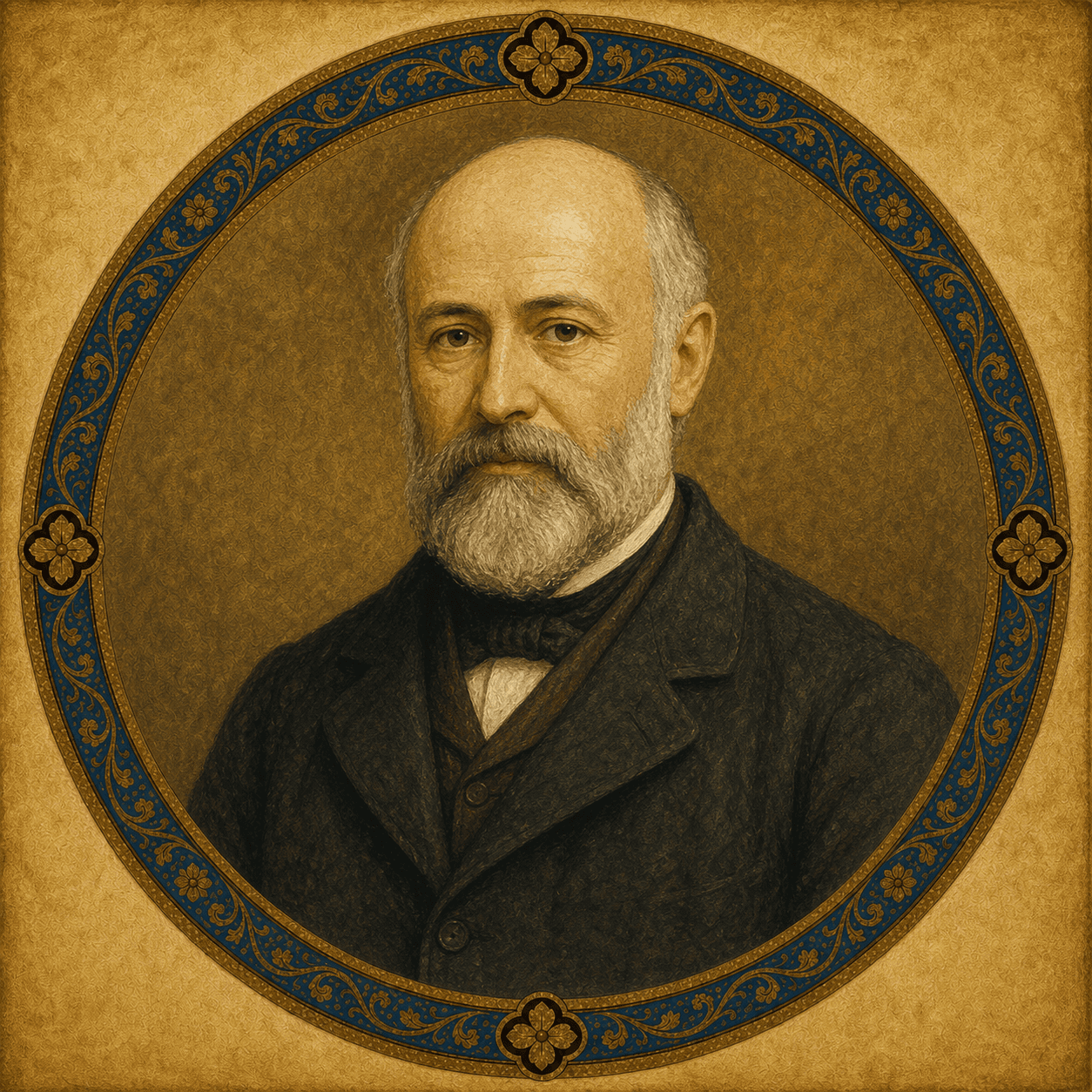
Portrait medallion of St. Louis Martin, father of St. Thérèse.

St. Louis Martin

Her father, the devout watchmaker who let his daughter go to Carmel at fifteen.

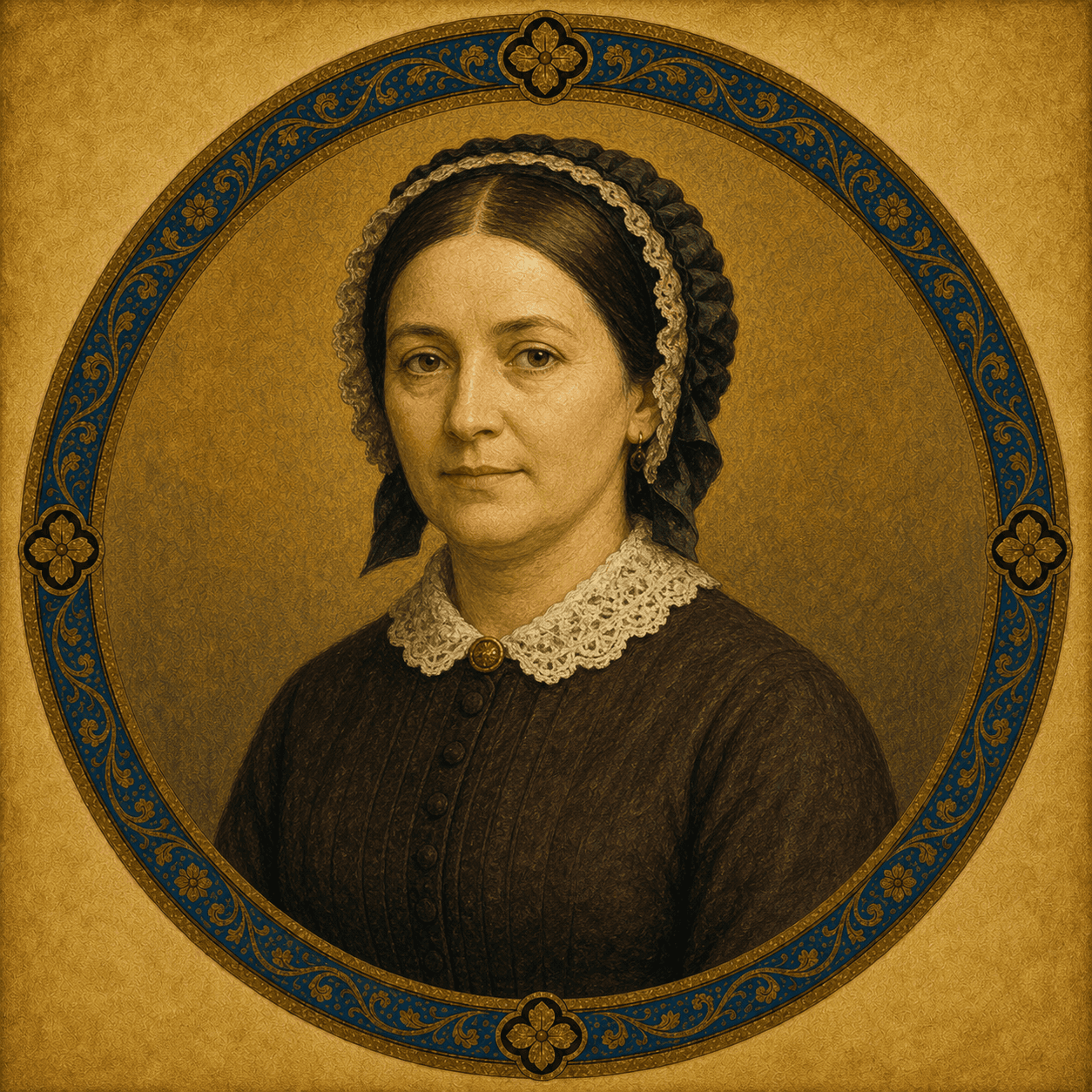
Portrait medallion of St. Zélie Martin, mother of St. Thérèse.

St. Zélie Martin

Her mother, the lace-maker whose death marked Thérèse deeply as a child.

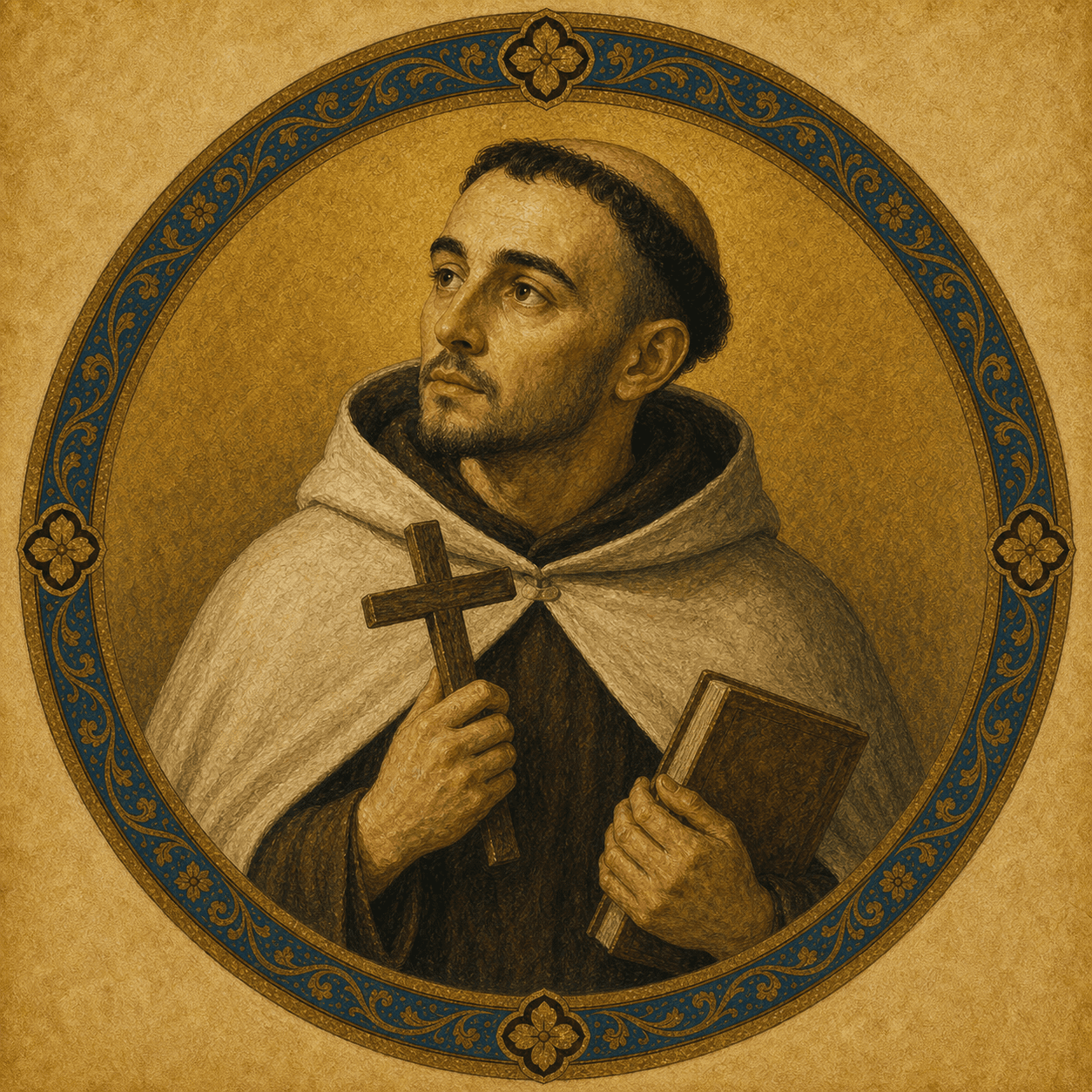
Portrait medallion of St. John of the Cross in a Carmelite habit.

St. John of the Cross

The Carmelite Doctor whose teaching on the dark night Thérèse lived in her own flesh.

Frequently Asked

Questions that keep Thérèse real.

Who was St. Thérèse of Lisieux?+
She was a French Discalced Carmelite nun who lived from 1873 to 1897 and died at twenty-four. Her hidden convent life produced nothing the world would notice, but her autobiography, Story of a Soul, taught the Little Way of holiness through small acts done with great love. She is a Doctor of the Church, a patroness of the missions, and her feast is October 1.
What is the Little Way of St. Thérèse?+
It is her path to holiness for ordinary people. Thérèse realized she could not do the great deeds of heroic saints, so she found a different way: daily duties, hidden kindnesses, acts of patience, and small sacrifices done with great love and total trust in God. The Little Way teaches that sanctity depends not on greatness but on love.
Why is St. Thérèse a Doctor of the Church?+
Pope St. John Paul II named her a Doctor in 1997 because her teaching on the Little Way is a sure and profound guide for the whole Church. The title honors the depth and universality of her doctrine, not the length of her life or the scale of her external works.
Was St. Thérèse's life really all sweetness and roses?+
No. The sentimental Little Flower image hides the truth. Her final months were marked by tuberculosis, physical agony, and a severe darkness of faith in which God seemed absent. She kept loving and trusting in that darkness. The roses are real, but the steel underneath them is the point.
What is the shower of roses?+
Before she died, Thérèse promised that she would spend her heaven doing good on earth and would let fall a shower of roses. She meant that her mission would continue from heaven through graces obtained for those who asked her intercession.
Were St. Thérèse's parents really saints too?+
Yes. Louis and Zelie Martin were canonized together by Pope Francis in 2015, the first married couple canonized together. They were a devout nineteenth-century French couple, a watchmaker and a lace-maker, who raised five daughters who all became nuns.
Is St. Thérèse the same as St. Teresa of Ávila?+
No. Teresa of Avila was the sixteenth-century Spanish reformer who founded the Discalced Carmelites. Thérèse of Lisieux was the nineteenth-century French nun of that same order, three centuries later. They are both Carmelites and Doctors of the Church, but they are different saints.

Sources

Read beyond summaries.

This page treats Thérèse's roses through her real writings, her photographed likeness, and the dark night beneath the Little Way.

Primary

  • St. Thérèse of Lisieux, Story of a Soul (Histoire d'une âme), especially Manuscripts B and C for the Little Way, her vocation of love, and the trial against faith.
  • St. Thérèse of Lisieux, Last Conversations, letters, poems, and prayers for her final words and her promise to spend heaven doing good on earth.
  • Older public-domain English editions and project renderings from the public-domain French are used for short quotations; modern ICS translations are treated as copyrighted and are not copied at length.

Historical

  • The documented Martin family chronology: Alençon, Lisieux, the death of Zélie Martin, the five surviving daughters, and Thérèse's entry into Carmel on April 9, 1888.
  • Accounts of the November 1887 pilgrimage to Rome and her appeal to Pope Leo XIII before entering Carmel at fifteen.
  • The photographic record preserved by Céline Martin, Sister Geneviève, which keeps Thérèse from being treated as an imagined holy-card figure.

Magisterial

  • Pope St. John Paul II, Divini Amoris Scientia (1997), declaring St. Thérèse a Doctor of the Church.
  • Pope Pius XI's 1925 canonization of St. Thérèse and his later naming of her as patroness of the missions with St. Francis Xavier.
  • Pope Francis's 2015 canonization of Sts. Louis and Zélie Martin, the first married couple canonized together.

Last reviewed: June 5, 2026

On this page+