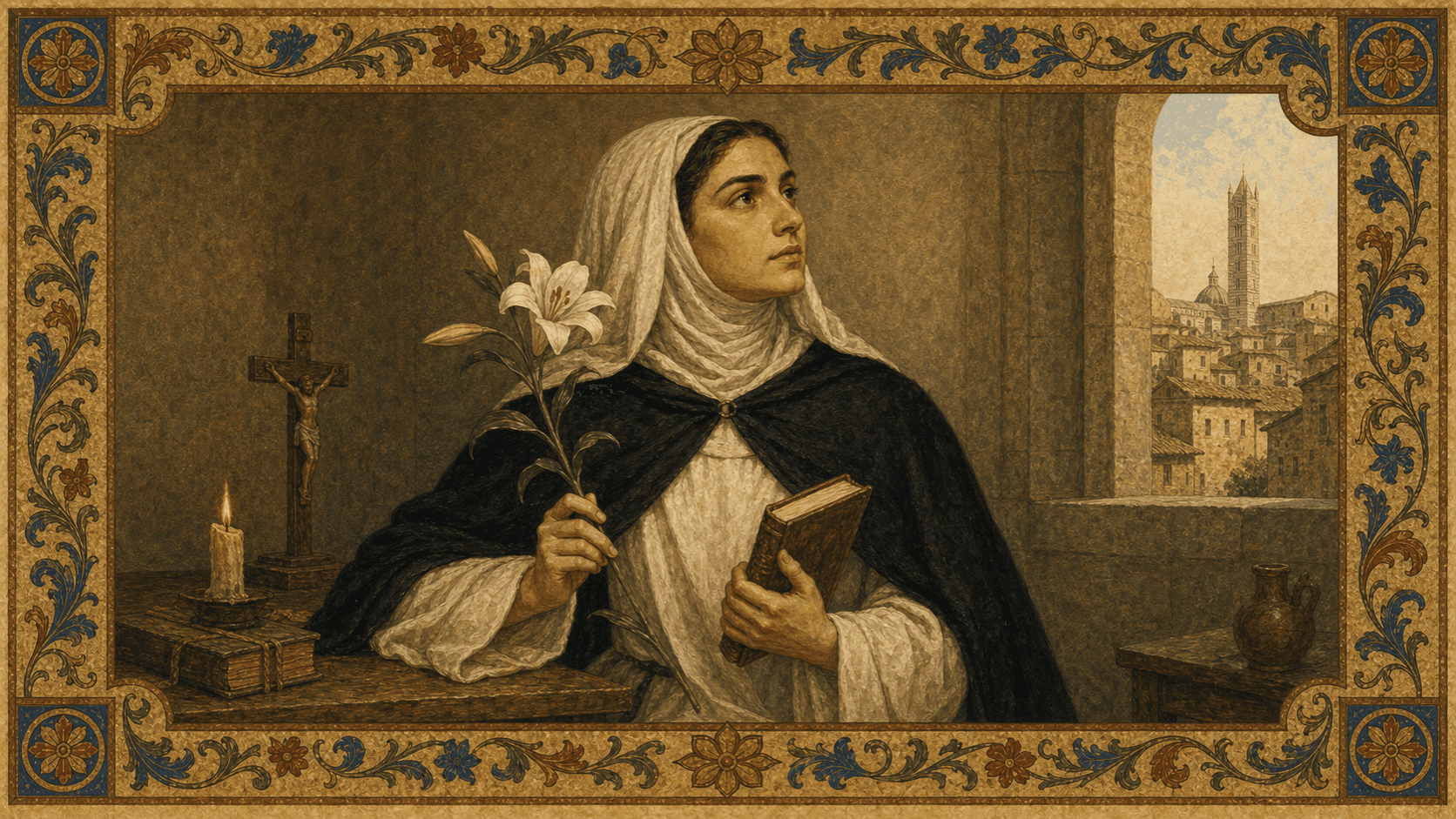
St. Catherine of Siena in the Dominican tertiary habit, holding a lily and book.

Saints Library

Catherine of Siena

Feast April 29 · Doctor of the Church · 1347-1380

The dyer's daughter who could barely write — and who, before she died at thirty-three, nursed the plague-stricken, filled Europe with letters, and urged the Pope to come home to Rome.

The Story

The laywoman who moved Europe.

Catherine was born in Siena in 1347 — the year before the Black Death swept through and killed perhaps half the city — the twenty-third or twenty-fourth child of a wool-dyer and his wife. She was a laywoman her whole life. She never entered a convent, never held any office, never learned to write until near the end, and died at thirty-three. And she was, by the time she died, one of the most influential people in Europe.

At sixteen she joined the Dominican Tertiaries — laywomen who took vows but lived in the world — and spent three years in near-total solitude in a small room in her father's house. Then she did the unexpected thing. She came out. She started nursing the sick in the hospitals, serving the poorest of the poor, and gathering around her a circle of followers who recognized in this young, unlettered woman a wisdom and holiness they could not explain.

And then she went further than any laywoman of her age had any business going. She began dictating letters — hundreds of them — to bishops, princes, mercenary captains, and the Pope himself, telling each of them, with complete fearlessness and complete charity, what they needed to do. The papacy had been sitting in Avignon for nearly seventy years. Catherine told the Pope to go home to Rome. And he went.
Siena

The city of plague and exile.

She was born into a proud Italian city-state, in the crowded, ordinary house of Giacomo Benincasa, a wool-dyer of comfortable middling means. Nothing about the house predicted what she would become.

The defining catastrophe of her age arrived when she was an infant. The Black Death reached Siena in 1348 and killed a vast portion of its people. Catherine grew up in a city gutted by plague, saturated with death, fear, and the question of what any of it meant. She would spend a good part of her short life nursing its victims.

It was also a bad time for the Church. Since 1309 the popes had been living in Avignon, in the south of France — closer to the French crown, far from the see of St. Peter, in what came to be called the Babylonian Captivity of the papacy. Into this — a city of the dead and a Church in exile — Catherine was born.

Solitude

The cell of self-knowledge.

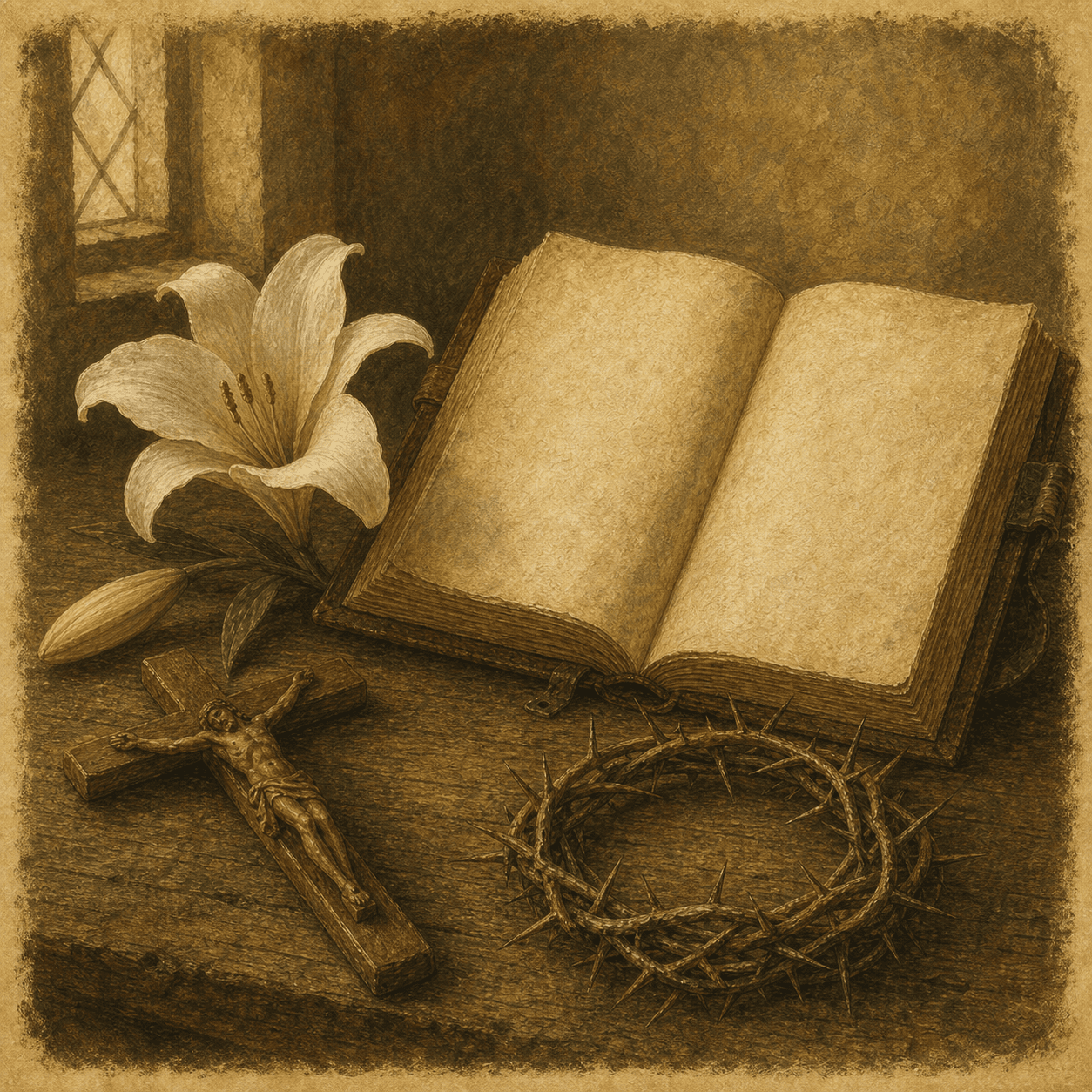
A symbolic still life for Catherine with a lily, crucifix, crown of thorns, and book.
Lily, crucifix, crown of thorns, and book.

From childhood Catherine wanted only God. She resisted her family's plans to marry her off, cut off her hair to make herself less marriageable, and held out until they gave up. At sixteen she received the habit of the Dominican Tertiaries — the Mantellate, laywomen who wore the Dominican habit, took private vows, and lived not in a convent but in their own homes and in the world.

Then she withdrew into a small room in her father's house and stayed there, in near-total silence and solitude, for about three years. This hidden interior period became the foundation of everything that followed. She called the place she had learned to dwell the cell of self-knowledge: the place where a soul sees its nothingness and God's mercy together.

That last point mattered, because solitude was not the destination. After three years, Catherine understood that God was sending her out of the cell and into the streets.

Mercy

The mystic went to the sick.

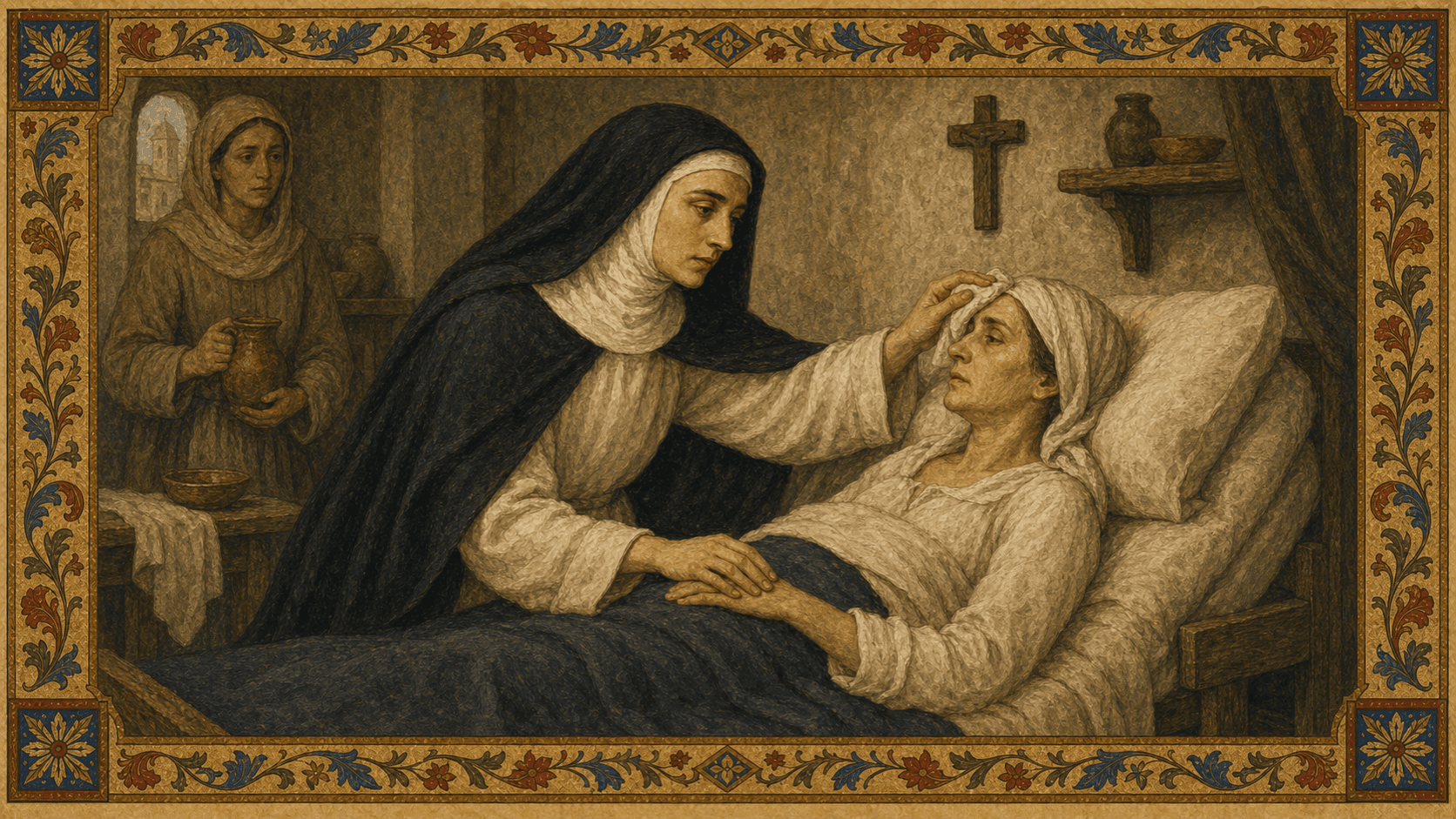
St. Catherine of Siena tending a sick woman with dignity and care.
The plague ward and the cell of prayer were one vocation.

She came out, and she spent herself on the suffering. She nursed patients others avoided: the terminally ill, the poor, and victims of plague when it returned. She visited prisoners, including condemned men, and accompanied at least one young nobleman to execution so that he died at peace.

The interior mystic turned out to be ferociously practical, with a strong stomach and an iron will. Around her a circle gathered: Dominican friars, priests, nobles, artists, ordinary Sienese, men and women both. They called her Mamma, though many were older than she was.

She had no official standing of any kind. She was a young laywoman with no title. And her influence kept widening.

Mysticism

Hidden wounds, visible charity.

Catherine's interior life was extraordinary, and the Church has always treated it with both reverence and care. She reported visions, locutions, ecstasies, a mystical marriage to Christ, and the exchange of hearts — vivid images of a soul conformed to God.

Her stigmata require careful telling. The tradition is that in 1375, at Pisa, Catherine received the wounds of Christ, but at her own prayer the marks remained invisible during her lifetime. Unlike St. Francis, whose stigmata were seen, Catherine bore hers hidden. They are said to have appeared only after her death.

Catherine herself was sober about such things. She distrusted spiritual experiences sought for their own sake and insisted that the test of any vision was whether it produced humility and love. The proof of her mysticism was not in ecstasy. It was in the plague wards and prison cells.

Avignon

She told the Pope to come home.

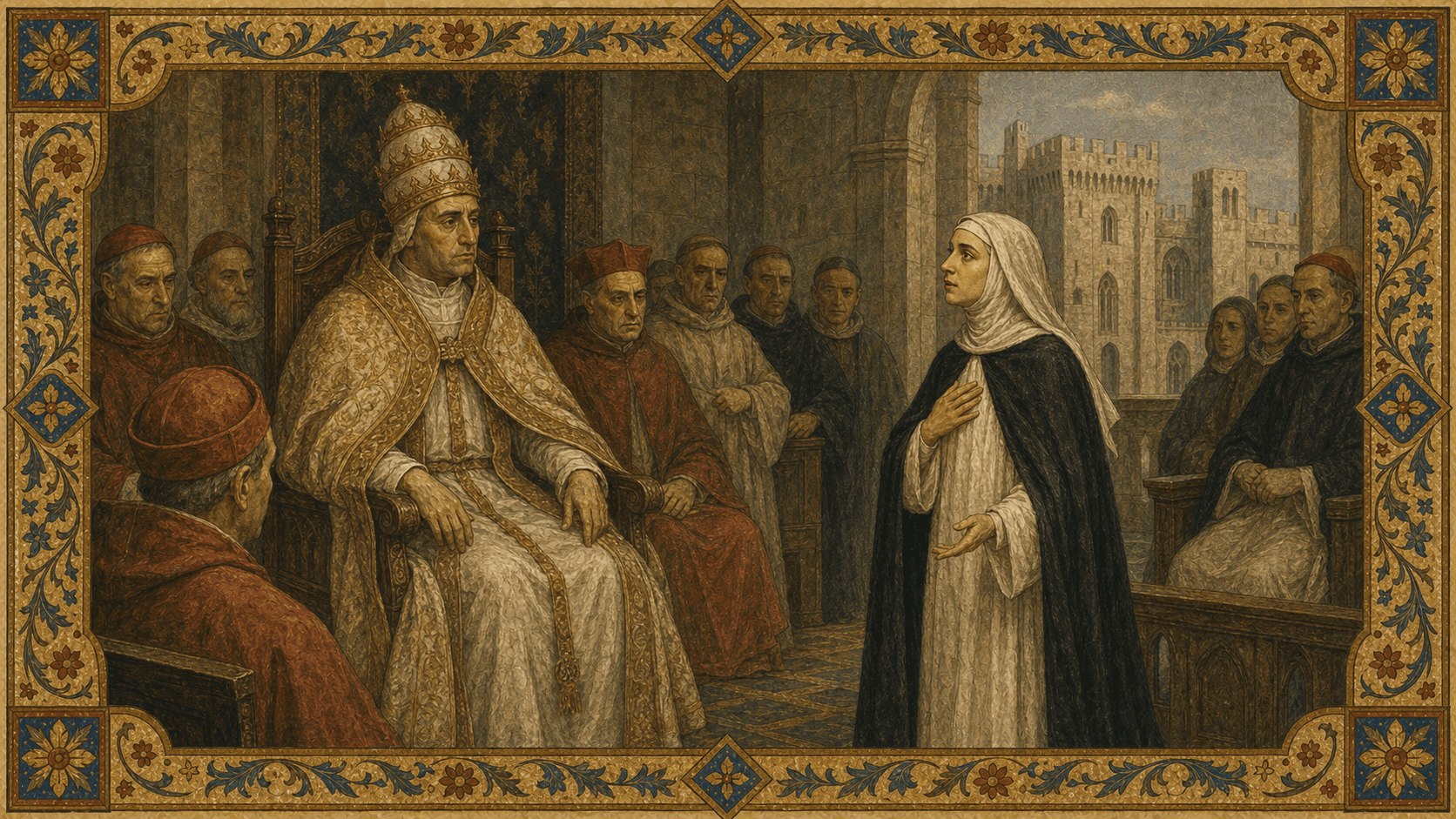
St. Catherine of Siena before Pope Gregory XI at Avignon, urging the return to Rome.
Catherine before Gregory XI at Avignon.

Catherine's letters are one of the wonders of the fourteenth century. She dictated hundreds of them to every kind of person, in a voice that was at once utterly humble and utterly without fear. She would address a mercenary captain, a queen, or the Vicar of Christ with the same blunt tenderness.

Her great public cause was the return of the papacy to Rome. For nearly seventy years the popes had lived in Avignon, and Catherine was convinced that this was a wound in the Church that had to be healed. She wrote to Pope Gregory XI again and again, urging him to act with courage, to fear nothing but God, and to come home to Rome.

In 1376 she went to Avignon herself and pressed the case in person. In January 1377, against the fierce opposition of the French king and much of the College of Cardinals, Gregory XI left Avignon and brought the papacy back to Rome. The seventy-year exile was over.

Schism

The wound reopened.

Her victory did not last in the way she hoped. Gregory XI died soon after returning to Rome, and the disputed election that followed split the Church in two. Suddenly there were two men claiming to be pope, one in Rome and one back in Avignon, each with supporters among the nations. It was the Great Western Schism, and it would last for decades.

Catherine threw herself entirely into supporting the Roman claimant, Urban VI, whom she judged to be the true pope. She moved to Rome at his summons and spent the last two years of her life writing furious, pleading letters to cardinals, kings, and cities, begging them to return to unity.

The strain destroyed her. She had fasted and labored and suffered for the Church past the limit of what her body could bear.

The Dialogue

The unlettered Doctor dictated a masterwork.

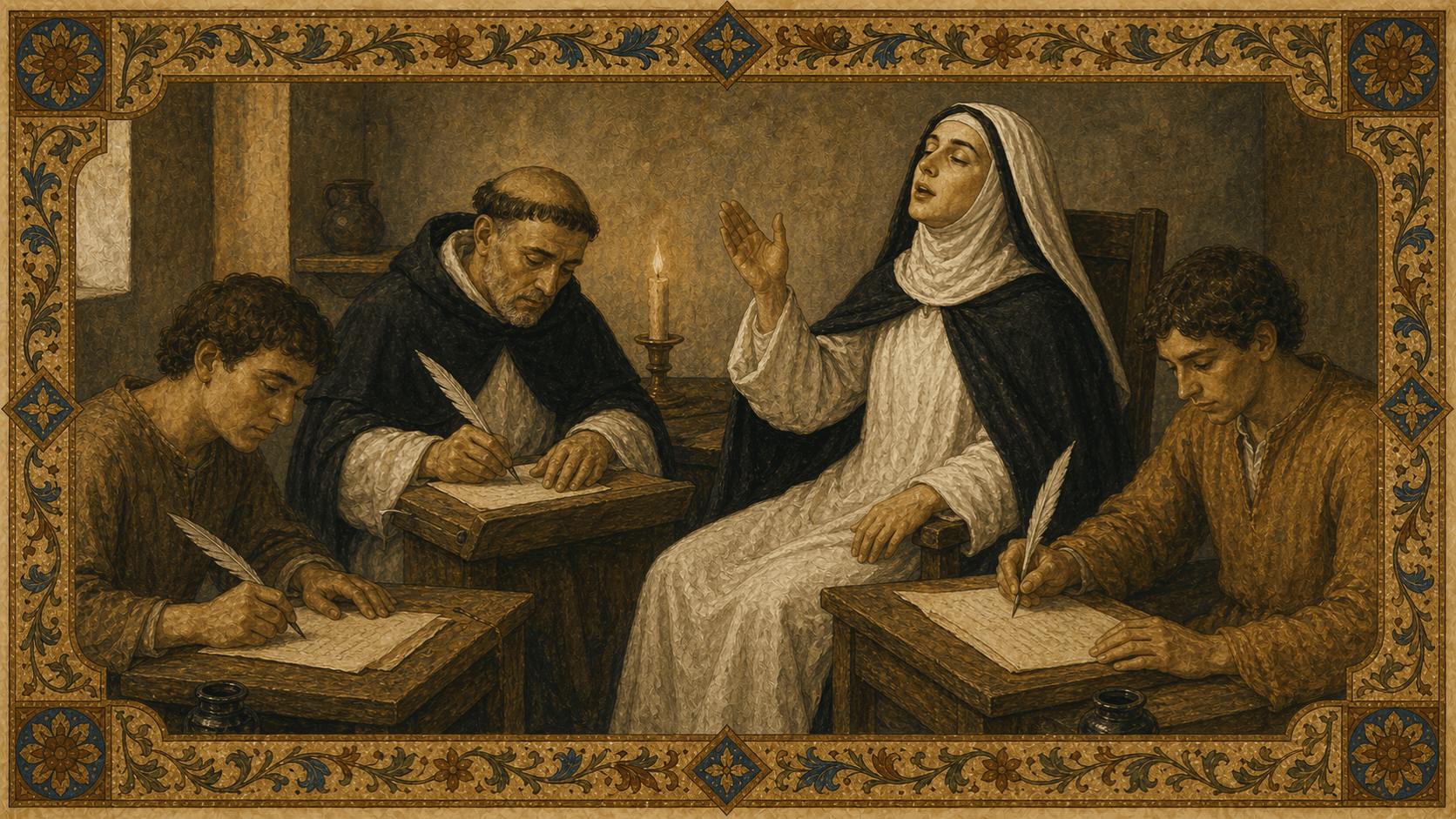
St. Catherine of Siena dictating The Dialogue in ecstasy to male secretaries.
Catherine dictates The Dialogue to her secretaries, much of it while she is in ecstasy.

This is the most astonishing fact about Catherine, and it is why she is a Doctor of the Church. She was, for most of her life, unlettered — she could not write, and may only have learned to read with difficulty. And she produced one of the spiritual masterpieces of the Middle Ages.

Her great book, The Dialogue of Divine Providence, she dictated — much of it, according to her secretaries, while she was in ecstasy. It is a sustained conversation between a soul and God the Father, ranging across providence, Christ as the bridge between earth and heaven, the cell of self-knowledge, discernment, prayer, and the Church.

A laywoman who could barely write, dictating in ecstasy, produced a body of teaching that the Church, six centuries later, would rank among the authoritative voices of the faith.

Rome

She died for unity.

By the spring of 1380 Catherine was dying — worn out, barely able to eat, her body broken by years of severe fasting and ceaseless labor for a Church tearing itself apart. She offered her suffering, to the end, for the unity of the Church under the true pope.

She died in Rome on April 29, 1380. She was thirty-three years old. She left behind The Dialogue, the letters, the prayers, and a circle of disciples who would spend their lives spreading her memory and teaching.

Chief among them was Blessed Raymond of Capua, her confessor and biographer, who wrote the great early Life of her and later led the Dominican Order.

Doctor

The Church recognized her authority.

For most of history, the title Doctor of the Church — given to the saints whose teaching is held up as a sure guide for the whole Church — had gone only to men. In 1970, Pope Paul VI changed that, naming the first two women Doctors within a week of each other: St. Teresa of Avila first, and then St. Catherine of Siena on October 4.

The honors kept coming. She had already been named, with St. Francis, a patron saint of Italy in 1939. In 1999, Pope St. John Paul II named her a co-patron of all Europe in recognition of a woman who had given everything for the unity of Christendom.

It is a remarkable trajectory for the dyer's daughter. She held no office in her lifetime; her only authority was the authority of holiness. The Church has spent the centuries since deciding that this authority was real.

Why Now

Holiness gives a person weight.

Catherine had nothing the world counts. She was a woman in a man's age, a laywoman among clerics, unlettered among scholars, young among the powerful, with no office, no wealth, and no platform. By every measure that the world uses to decide whose voice matters, hers should not have. And she changed the course of the Church.

She matters, too, for the unity of the inner and outer life. The deepest mystic of her century was also one of its most practical activists. The cell of self-knowledge and the plague ward were the same vocation. She went out to nurse the dying because she had gone in to find God.

In an age of cowardice, ecclesiastical and otherwise, Catherine did not flinch. She saw what needed to be done and said so, to the highest power in the world, without fear.

Reading

Where to read her.

Catherine's voice is unusually direct and alive on the page. Start with selected letters, especially the letters to Gregory XI on returning to Rome. They are vivid, fearless, and personal; you meet the woman immediately.

Then read The Dialogue of Divine Providence, especially the sections on Christ as the bridge and the cell of self-knowledge. After that, read her Prayersand Raymond of Capua's early Life.

A Word of Catherine

The fire is hers.

Catherine wrote this to Stefano Maconi, a young disciple she was urging toward the life God had made for him Letter 368. It is the whole of her teaching in a sentence. The way to change the world is not to grasp at power or position. It is to become, completely, what God made you to be.

The version often quoted today — “Be who God meant you to be and you will set the world on fire” — is a loose modern paraphrase, not Catherine's exact sentence. The fire is hers. The phrasing is not.

Connected Saints

A family of holiness.

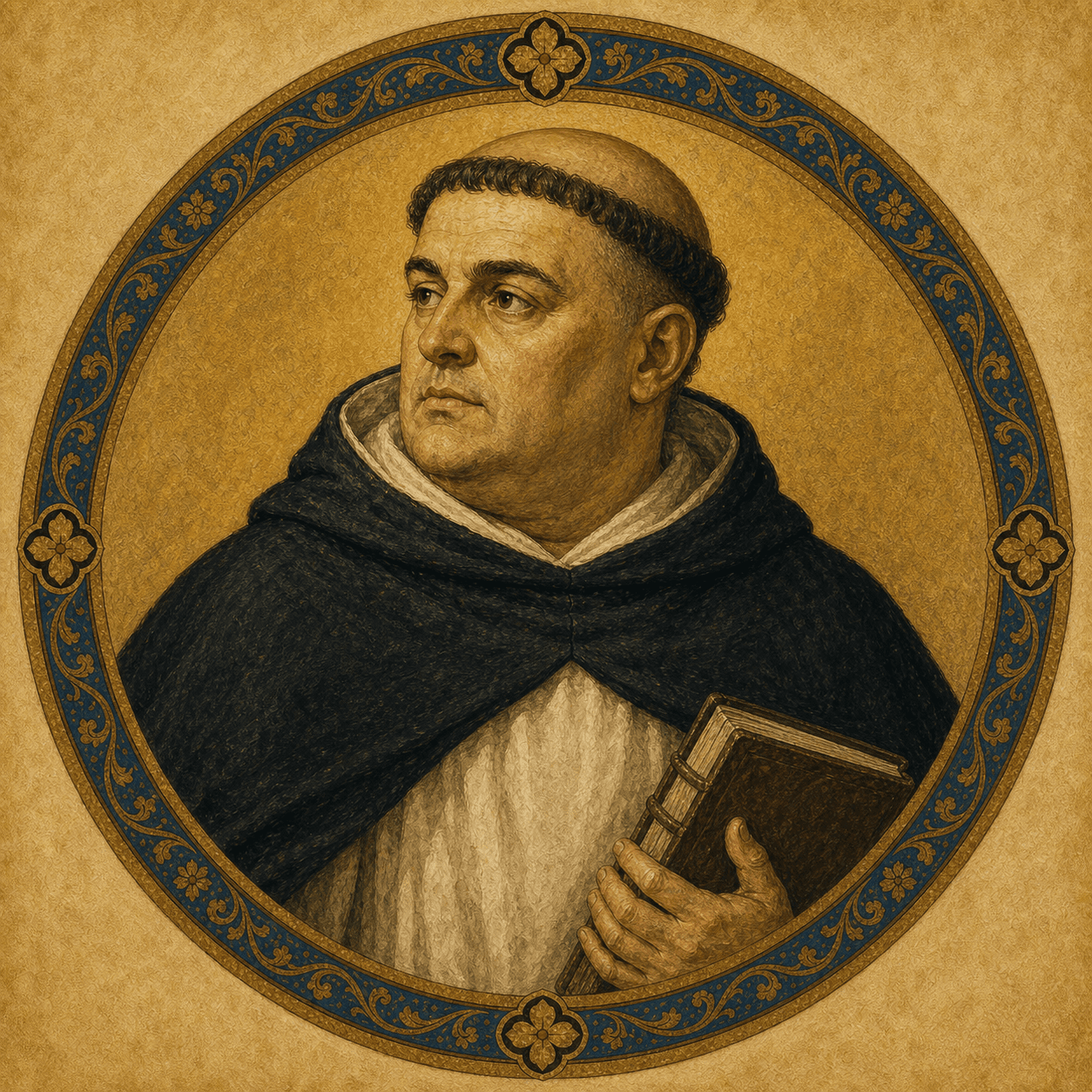
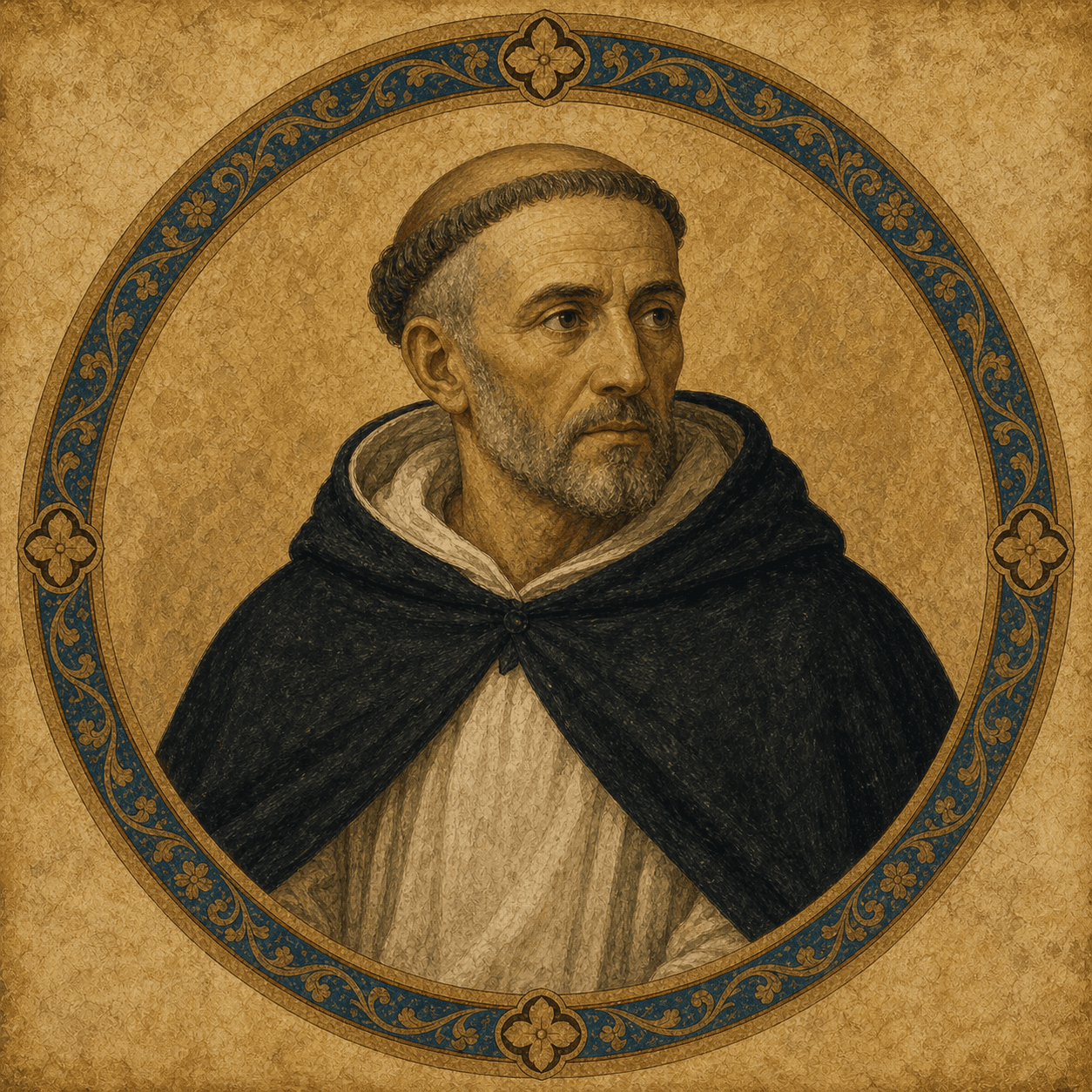
Portrait medallion of St. Thomas Aquinas in the Dominican habit.

St. Thomas Aquinas

The Dominican Doctor whose theological authority stands beside Catherine's spiritual teaching.

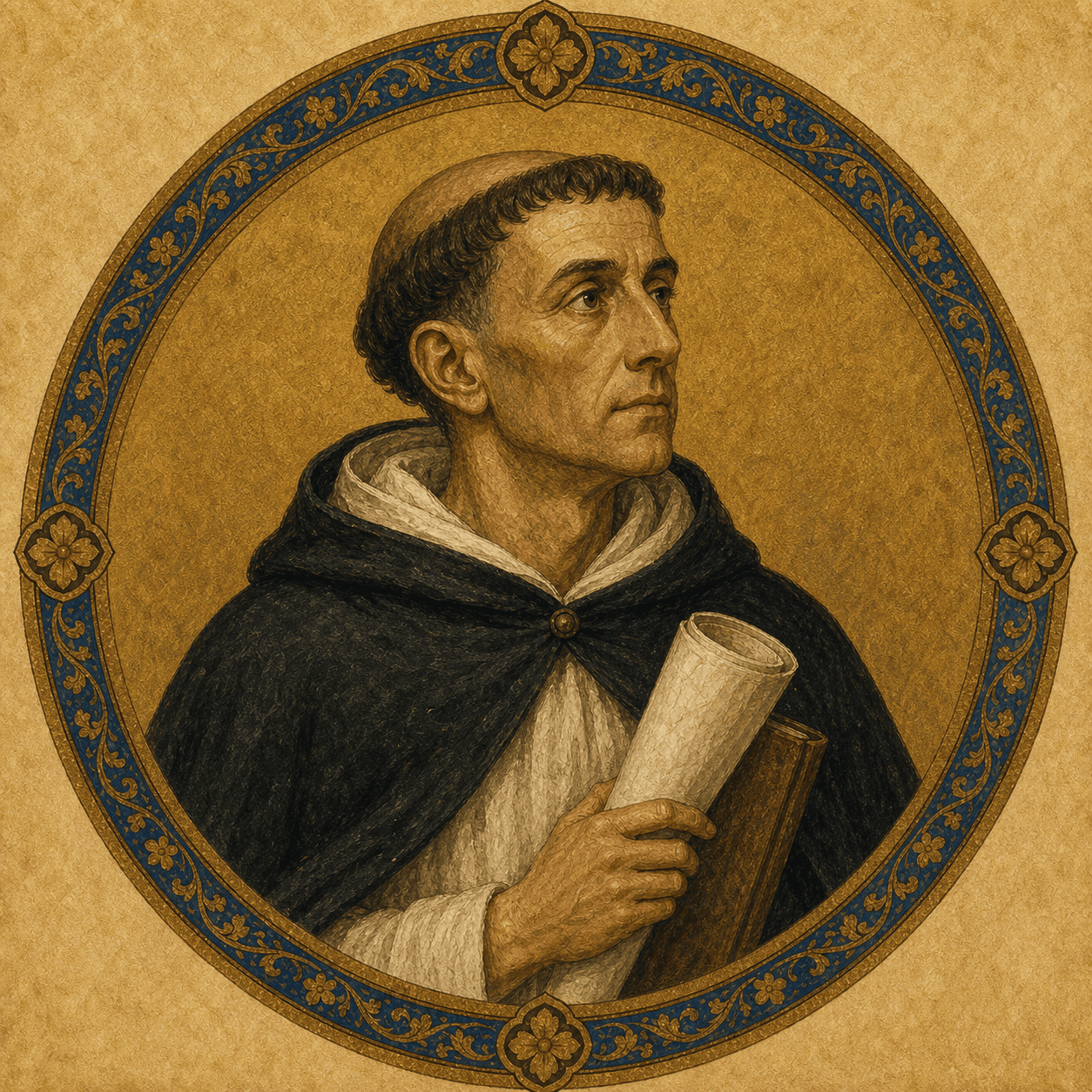
Portrait medallion of Blessed Raymond of Capua, Catherine's confessor and biographer.

Bl. Raymond of Capua

Her Dominican confessor, spiritual director, and early biographer.

Portrait medallion of St. Dominic, founder of the Order of Preachers.

St. Dominic

The founder of the Order of Preachers, whose Third Order Catherine joined.

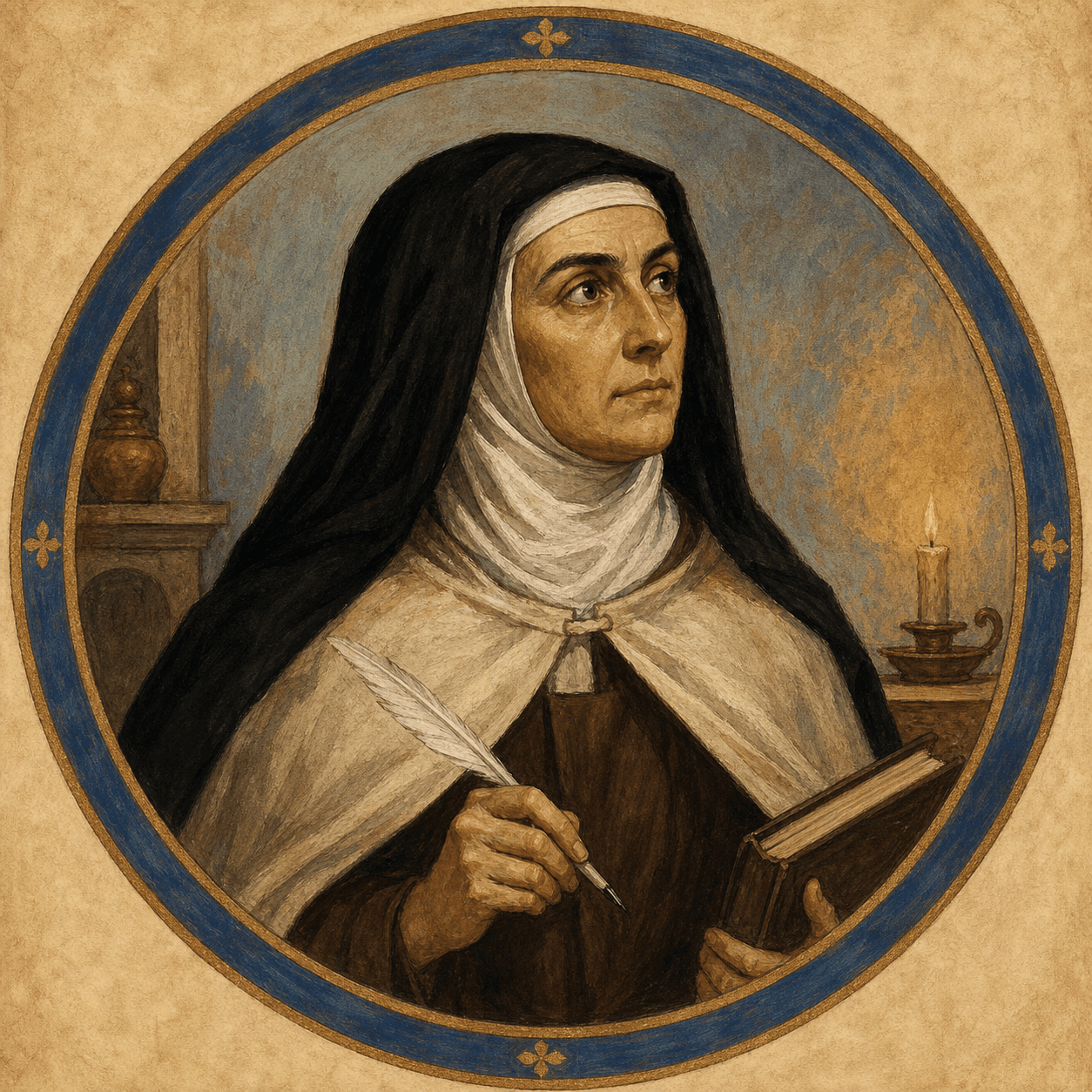
Portrait medallion of St. Teresa of Avila in a Carmelite habit with book and quill.

St. Teresa of Ávila

The Carmelite Doctor named with Catherine among the first two women Doctors of the Church.

Frequently Asked

Questions for reading Catherine clearly.

Who was St. Catherine of Siena?+
She was a fourteenth-century Italian laywoman, Dominican Tertiary, mystic, reformer, and Doctor of the Church. She nursed the sick, gathered a wide circle of disciples, dictated The Dialogue and hundreds of letters, and helped persuade Pope Gregory XI to end the papacy's long exile in Avignon and return to Rome. She died at thirty-three. Her feast is April 29.
Was St. Catherine of Siena a nun?+
No. She was a Dominican Tertiary, a member of the Third Order: a laywoman who took private vows and wore the Dominican habit but lived in the world, in her own home and in the streets. Her public life — nursing, writing, peacemaking, confronting popes — was the work of a laywoman, not a cloistered religious.
Did St. Catherine really say "Be who God meant you to be and you will set the world on fire"?+
Not in those exact words. That popular version is a loose modern paraphrase. Catherine's authentic sentence, from Letter 368 to Stefano Maconi, is: “If you are what you ought to be, you will set fire to all Italy.” The famous modern wording captures her meaning, but it is not a direct quotation.
Did St. Catherine have the stigmata?+
Yes, according to the tradition — but invisibly during her life. She is said to have received the wounds of Christ at Pisa in 1375 and to have asked that the marks remain hidden though the pain was real. Unlike St. Francis, whose stigmata were visible, Catherine bore hers unseen; they are said to have appeared only after her death.
How did a woman who could barely write become a Doctor of the Church?+
Catherine was largely unlettered and dictated her works to secretaries, much of The Dialogue while in ecstasy. The Church names a saint a Doctor when their teaching is held up as a sure guide for the whole Church. In 1970 Pope Paul VI named Teresa of Avila and Catherine of Siena the first two women Doctors of the Church.
Is St. Catherine of Siena the same as St. Catherine of Alexandria?+
No. They are different saints who are often confused because they share a name. St. Catherine of Alexandria is an early martyr associated with a spiked wheel. St. Catherine of Siena is the fourteenth-century Dominican laywoman and Doctor of the Church described here.
Why is St. Catherine a patron saint of Europe?+
Because she gave her life for the unity and renewal of the Church, above all in working to end the papacy's exile in Avignon and later to heal the Great Western Schism. In 1999 Pope St. John Paul II named her a co-patron of Europe.

Sources

Read beyond summaries.

This page identifies the popular set-the-world-on-fire wording as a paraphrase, keeps Catherine's stigmata invisible during life, and treats her mystical experiences soberly.

Primary

  • St. Catherine of Siena, The Dialogue of Divine Providence, the major spiritual work she dictated.
  • St. Catherine of Siena, the Letters and Prayers, especially Letter 368 to Stefano Maconi for the pull quote.
  • Bl. Raymond of Capua, The Life of St. Catherine of Siena, the major early biography by her confessor.

Historical

  • The Catholic Encyclopedia entry on St. Catherine of Siena for the life chronology, Third Order status, Avignon mission, writings, death, and canonization.
  • The page treats the exchange of hearts, mystical marriage, and stigmata as reported mystical experiences, not sensational proof texts.
  • The popular “set the world on fire” sentence is identified as a paraphrase, not Catherine's exact wording.

Magisterial

  • Pope Paul VI, proclamation of St. Catherine as a Doctor of the Church on October 4, 1970.
  • Pope St. John Paul II, Spes Aedificandi (1999), naming the women co-patronesses of Europe.
  • Pope Pius II, canonization of Catherine in 1461, and the Catechism of the Catholic Church on prayer, the Church, and the communion of saints.

Last reviewed: June 4, 2026

On this page+