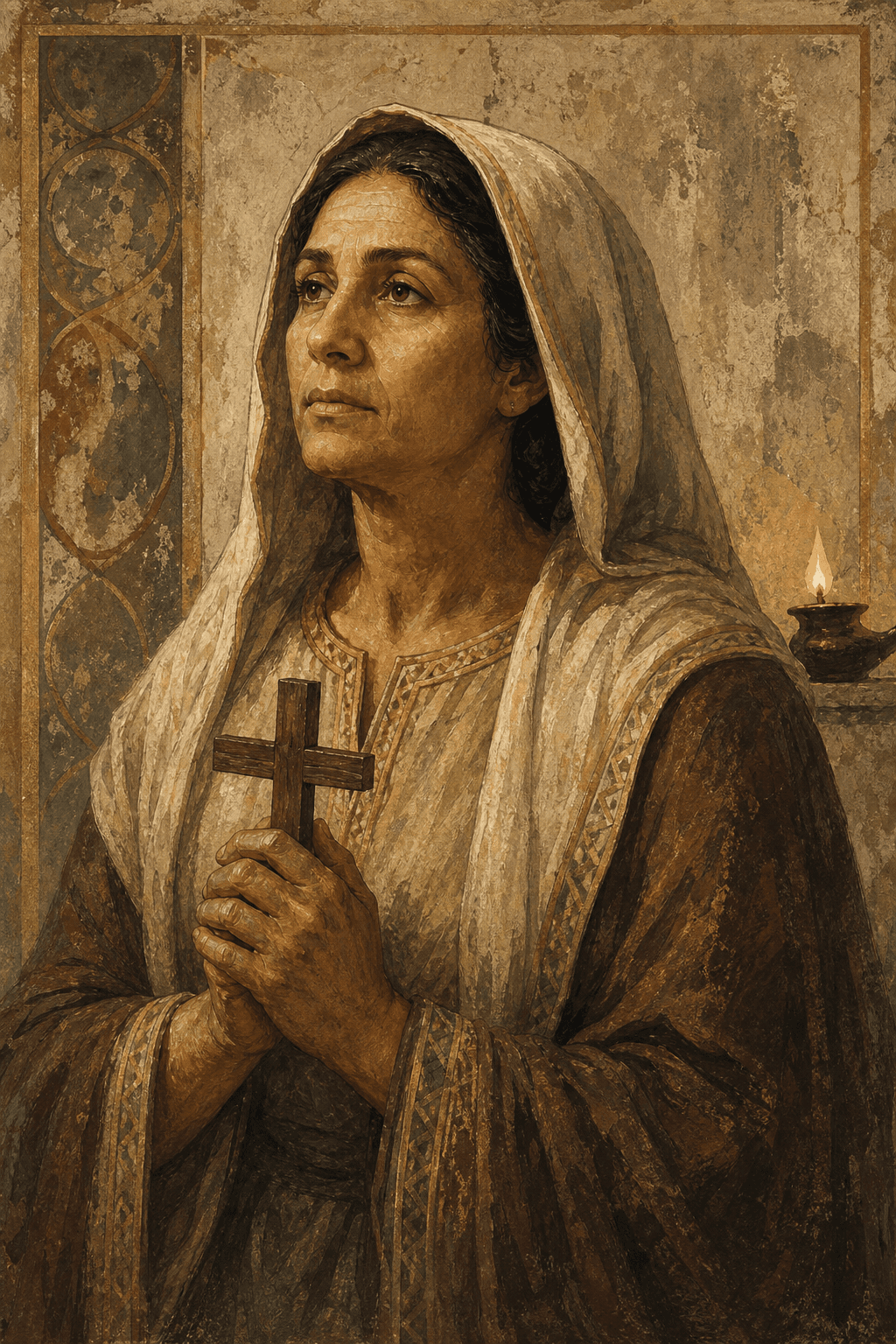
St. Monica in prayer, mother of Augustine, painted in the editorial style of the Saints Library.

Saints Library

Monica

Feast August 27 · Mother of St. Augustine · c. 332-387

A North African mother whose decades of prayer for her wayward son are still one of the Church's plainest proofs that intercession, sustained against every visible sign, is not in vain.

The Story

The mother who prayed her son into the Church.

Monica spent the better part of two decades praying for her son's conversion. She followed him across the Mediterranean to keep doing it. She did not live to see what he would become — the Bishop of Hippo, the Doctor of the Church, the most-cited theologian in the Western tradition. She lived to see one thing only: him kneeling at the Easter Vigil in 387 as St. Ambrose lifted the water of baptism over his head. Then she told him she had nothing left to live for. She died a few months later in a port town in Italy, far from the African home she had wanted to see again. She had finished her work.

She is the patron saint of mothers, of difficult marriages, of conversion, and of every person who is praying for someone they love.

Her life is the most concrete proof the Church has that intercessory prayer, sustained across years, sometimes against every visible sign, sometimes against the person it is offered for, is never wasted.
North Africa

The world she came from.

She was born around 332 in Thagaste, the same small Roman town in the province of Numidia where her son would be born twenty-two years later. North Africa in her lifetime was Latin-speaking, agriculturally rich, and full of olive groves and wheat fields that fed Rome itself. The Berber people had been there since before the Romans. Christianity was already centuries old in those provinces, but it sat alongside paganism, Manicheism, and the older Punic religion in a population that was used to choosing.

She was raised Christian. Augustine credits her formation to an elderly servant woman in the household, a woman who had once cared for the children of Monica's own grandfather, and who had grown old in the family's service. That servant taught Monica plain habits: not to drink water between meals so she would not learn to crave wine, not to indulge appetites she would later have to fight. Confessions 9.8.17

She was married young, by arrangement, to Patricius. He was a pagan, a minor municipal official, hot-tempered, sometimes unfaithful. The marriage lasted until his death and produced at least three children. He was baptized only at the end, a year or two before he died.

Patricius

A difficult marriage, borne well.

Augustine devotes the better part of one chapter in the Confessionsto his mother's marriage. He does not pretend it was easy. Patricius had a temper. Other women in Thagaste used to compare bruises and ask Monica how she alone seemed to live in a peaceful house with a husband everyone else thought ill-tempered. Augustine reports her answer in plain Latin: she never quarreled with him when he was angry. She waited until his anger had passed and then, if there was something to say, she said it. Confessions 9.9.19-22

It is not a doctrine. It is not a strategy. It is the practical wisdom of a woman who had decided that her husband's soul was more important than her satisfaction.

Augustine is careful with his mother's witness here. He does not romanticize her patience or the cost of it. He simply notes that she lived with Patricius through years of his anger and his other women, that the house she kept stayed quiet, that the neighbors came to her for counsel, and that, at the end, he was received into the Catholic Church before his death.

She was alone for fifteen years before she followed her son to Italy.

The Long Prayer

The mother who would not stop praying.

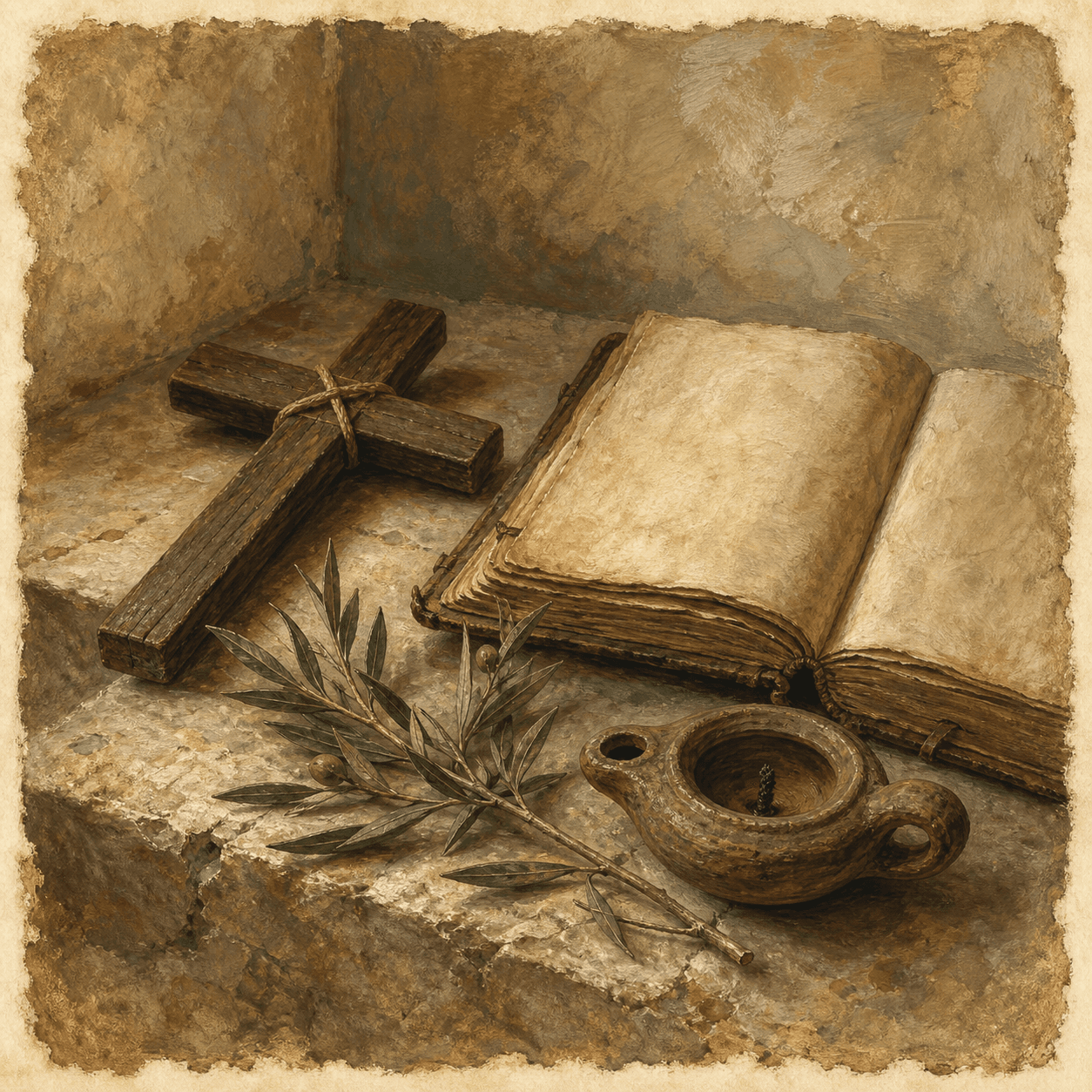
A simple still life of a wooden cross, an open Roman codex, and a small clay oil lamp, a visual reference to Monica's life of prayer.

Augustine took his time. He left home for school in Madauros, then Carthage. He drifted into the Manichees, a Persian religious movement that taught the universe was a battleground between equal powers of Light and Darkness, and that conveniently told a young man like Augustine he was not really responsible for his sins. He took a long-term concubine; their son Adeodatus was born when Augustine was about seventeen. He built a career as a rhetorician.

Monica prayed.

She wept openly, often, and across years. Augustine does not give a tidy count of how long; he calls it many years and trusts the reader to take the duration seriously. What he does report is that one night she dreamed she was standing on a wooden rule, weeping, and that a young man, radiant, came to her and asked her why she wept. She told him: she was weeping for the ruin of her son. The young man told her to look where she stood. She looked. Augustine was standing there beside her. Confessions 3.11.20

She told her son the dream. He answered, smugly, that perhaps it meant she would become a Manichean like him. She corrected him, gently. The young man in her dream had not said where he is, there shall you be but where you are, there shall he be. Augustine remembered the correction for the rest of his life.

The Carthage Bishop

The son of so many tears.

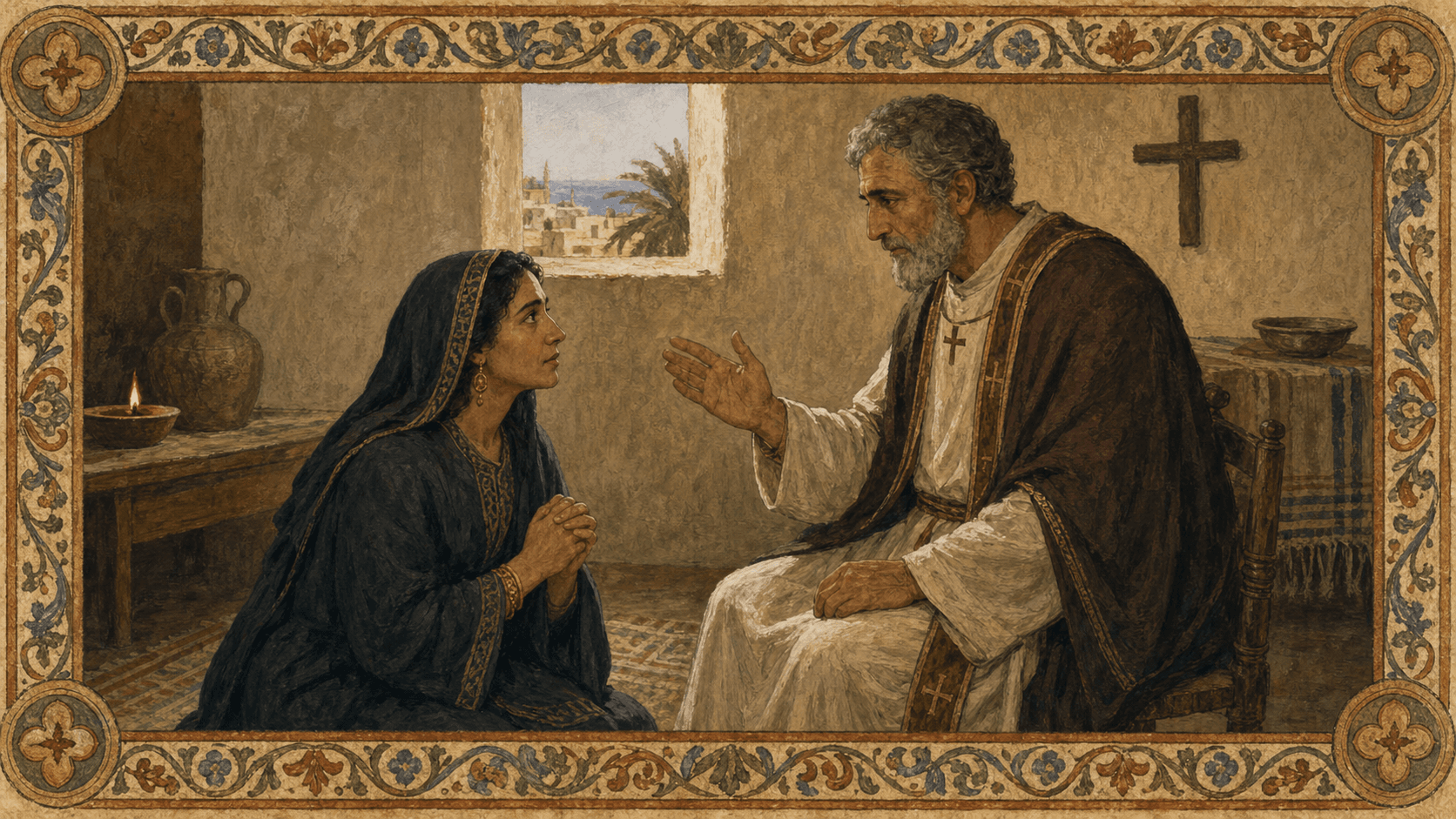
Monica kneeling before a North African bishop who tells her that the son of so many tears could not perish.
The bishop's promise in Carthage

There was a period — Augustine does not date it tightly — when Monica went to a Catholic bishop in Carthage and asked him to argue with her son. The bishop refused. Augustine was too far gone in the Manichees, he said; argument would only entrench him. He told her, instead, to pray and to wait. He had been a Manichean himself once; he had come out the other side. He suggested her son would too.

She would not let him go. She kept asking, day after day. Finally, exhausted, the bishop turned to her, Augustine thinks it was almost with annoyance, and gave her the sentence she would remember for the rest of her life:

She took it as a promise from God. She was right.

Crossing the Sea

She would not be left behind.

When Augustine was twenty-eight, he decided to leave Carthage for Rome. The teaching there was more disciplined, the students more serious, the career path more promising. He did not want his mother to follow him. He lied to her about the departure time. He told her he was only seeing a friend off and that he would be back. He waited until she was at a small chapel near the harbor, praying, and then he sailed without telling her.

She found out at dawn. Augustine, writing decades later, does not soften the deception. She wept by the shore, accusing him of perfidy and cruelty. Confessions 5.8.15

Then she followed him. By the next available ship, alone, to a city she had never seen. When she found him in Rome, he had already moved on to Milan. She followed him to Milan.

Milan

Ambrose, and a son who finally listened.

Monica had been raised in the African Catholic tradition. The customs in Milan were different — the fast days, the way the saints were honored, the rhythm of the liturgy. She was the kind of devout woman who could have made an issue of it. She did not. She asked Ambrose what to do, and when he told her to follow the local custom, she did. Augustine remembered this too. He thought it was one of the small disciplines that earned her the friendship of a bishop most laypeople could not approach.

Ambrose returned the affection. He told Augustine that he was lucky to have such a mother. Monica, for her part, watched her son slowly begin to listen — not to her, but to a man whose intellect could not be dismissed. She had known, all along, that Augustine would never be won by ordinary preaching. He needed an argument he could not condescend to. In Milan, finally, he found one.

She kept praying.

Easter 387

Cassiciacum and the baptism.

After Augustine's conversion in the Milanese garden in August 386, he resigned his teaching chair and retreated with friends, his son, and his mother to the country estate of a friend at Cassiciacum, outside Milan. They spent the autumn and winter in something between a Catholic retreat and a philosophical academy. Monica was there. She was part of the conversation. Augustine includes her in the philosophical dialogues he wrote that winter; she answers questions the men in the room cannot, and Augustine, who had once been embarrassed of his mother's lack of formal education, treats her observations as wisdom that exposed the limits of his own training.

On the night of the Easter Vigil — April 24, 387 — Ambrose baptized Augustine and Adeodatus in the cathedral at Milan. Monica was in the congregation. She was about fifty-five years old. She had waited for this for almost three decades.

A few months later they began the journey home. They got as far as Ostia.

The Ostia Vision

The window.

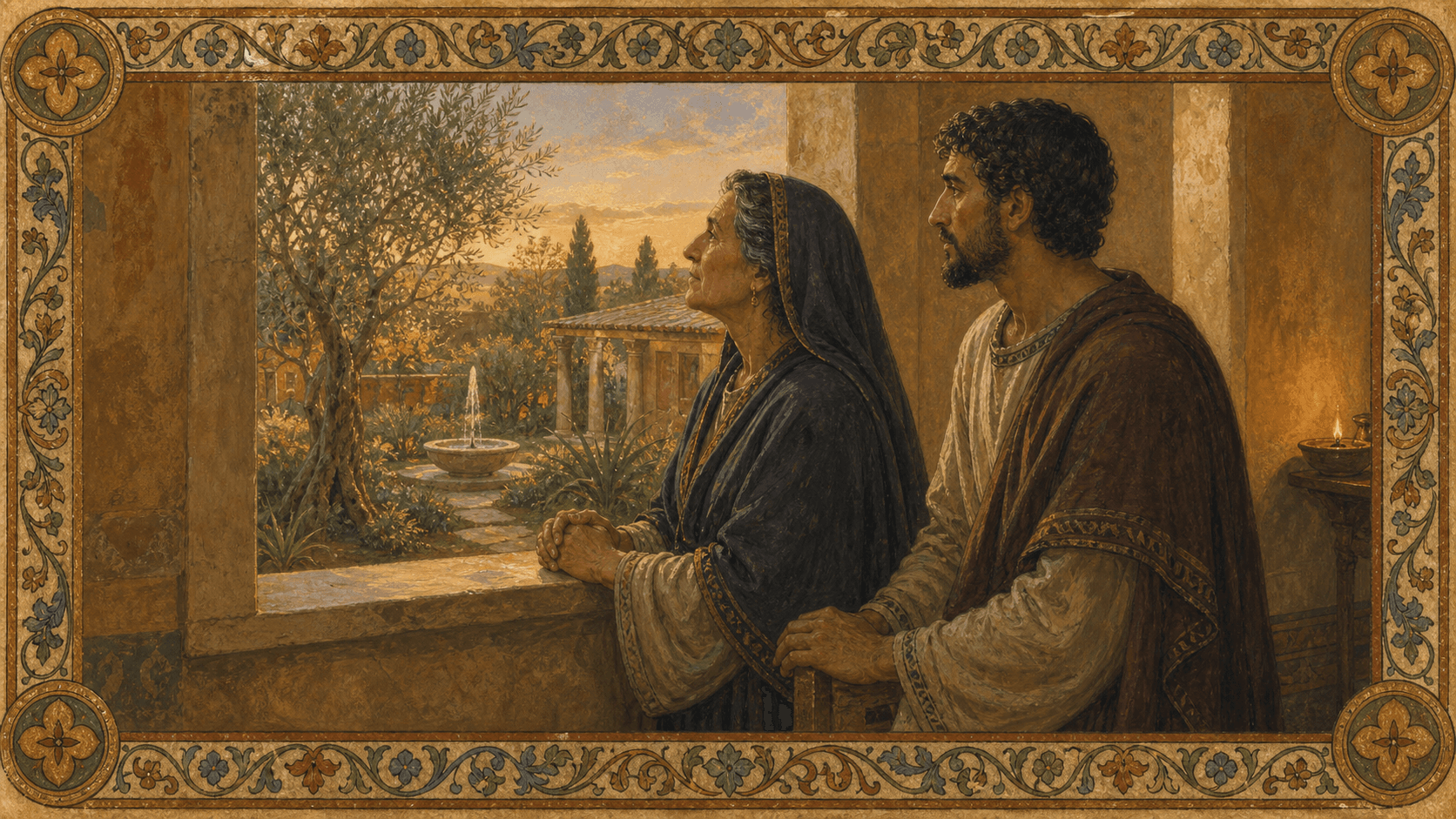
Monica and Augustine at a window overlooking a garden at Ostia, in the moment of shared contemplation described in the Confessions.
The window at Ostia

The villa where they stopped at Ostia had a window that overlooked an inner garden. One evening, late in the summer of 387, Monica and Augustine stood at that window and talked.

They were waiting for the ship that would take them back to North Africa. Augustine writes that the two of them began to talk about what the eternal life of the saints would be like, asking each other what the joy of being with God forever, beyond this world, could possibly mean. As they spoke, both of them found their minds rising. They were not analyzing anymore. They were not even speaking, by the end. They reached, together, for one instant — "with the whole effort of our heart," Augustine writes — and for the length of a single thought they touched it. Confessions 9.10.24

Then they came back to themselves. They could hear themselves speaking again. They sighed.

The Church has read this passage for sixteen hundred years as one of the high mystical moments in Christian literature. It is also one of the few places in the Confessions where Augustine is no longer alone with God: the conversation belongs to him and his mother together. He never tried to repeat the experience, in writing or otherwise. He did not need to.

Monica spoke first when they came back. She told him she was finished. She had no reason left to live in this world. She had wanted, she said, one thing only before she died — to see him a Catholic Christian — and God had given her more than that. What was she still doing here?

Her Death

At Ostia.

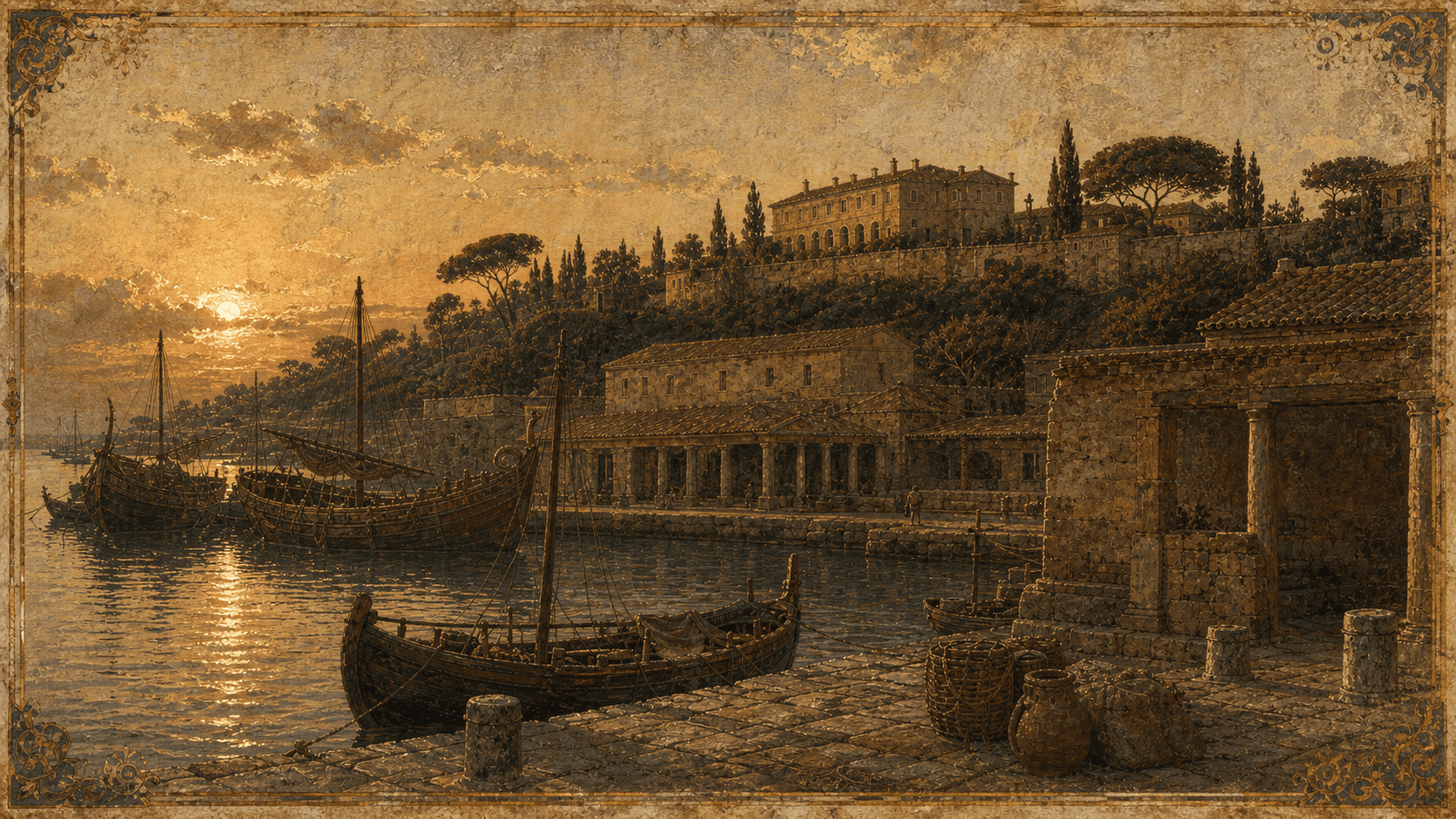
The harbor of Ostia at dusk, where St. Monica died in 387.
The harbor of Ostia at dusk

She fell ill within days. The fever was bad. She lay in the house at Ostia with her two sons beside her — Augustine and Navigius — and she told them not to worry about her burial. Confessions 9.11.27

Navigius, the more conventional of the brothers, was distressed that she would die so far from home. She had often spoken of being buried beside her husband at Thagaste. She did not seem to mind anymore.

Nine days later she was dead.

Augustine writes about his grief at her death more openly than about anything else in the Confessions. He cried in the bath. He was ashamed of his crying. He fasted from it. He went to the funeral with composure. Afterward, alone in the house, he wept for a long time, and finally let himself.

He buried her at Ostia, as she had asked. He came home to North Africa without her. Her relics were translated to Rome in the fifteenth century and remain today in the Basilica of Sant'Agostino, near the Piazza Navona.

Why Now

Why she matters now.

She is the patron saint of every Catholic parent who is praying for a child who has walked away from the faith.

She is the patron saint of every wife in a hard marriage who has decided that her husband's soul is more important than her satisfaction.

She is the patron saint of every person who has been praying for someone they love for so long that they cannot remember what it was like not to be praying.

She is the saint who shows the Church what it actually looks like to not give up — across years, against every visible sign, sometimes against the person you are praying for. She is the proof that the slow work of intercessory prayer is real work. That tears are not wasted. That a mother's prayers can outlast her son's resistance.

Augustine writes about her with a gratitude that is almost frightening. He believes — he says it plainly — that without her prayers he would not have been saved. The Catholic Church has not disagreed with him.

Reading Path

Where to read about her.

Monica wrote nothing. Her life is preserved in her son's Confessions, which is the best place to read her.

  1. Confessions Book III, chapters 11-12. Monica's dream of the wooden rule, and the bishop's sentence about the son of so many tears.
  2. Confessions Book V, chapter 8. Augustine leaves Carthage for Rome without telling her. She follows.
  3. Confessions Book VI, chapters 1-2 and 13. Monica in Milan, her friendship with Ambrose, her hope for her son's conversion.
  4. Confessions Book VIII, chapter 12. She is told of his conversion in the garden.
  5. Confessions Book IX, chapters 8-13. Her own life story, her marriage to Patricius, the window at Ostia, her death.

For a serious modern treatment, Peter Brown's Augustine of Hippo: A Biographydiscusses Monica throughout. Garry Wills's Saint Augustine(Penguin Lives) gives her real weight as her own person, not only as her son's mother.

Her Last Words

Lay this body anywhere.

She had no other final request. The body she had carried for fifty-six years could lie wherever was convenient. The one thing she wanted from her sons was the Eucharist offered for her, wherever they ended up. The Catholic understanding of how the living and the dead remain connected to one another — at the altar, in the Mass — was already, for her, the thing that mattered most.

Connected Saints

A family of holiness.

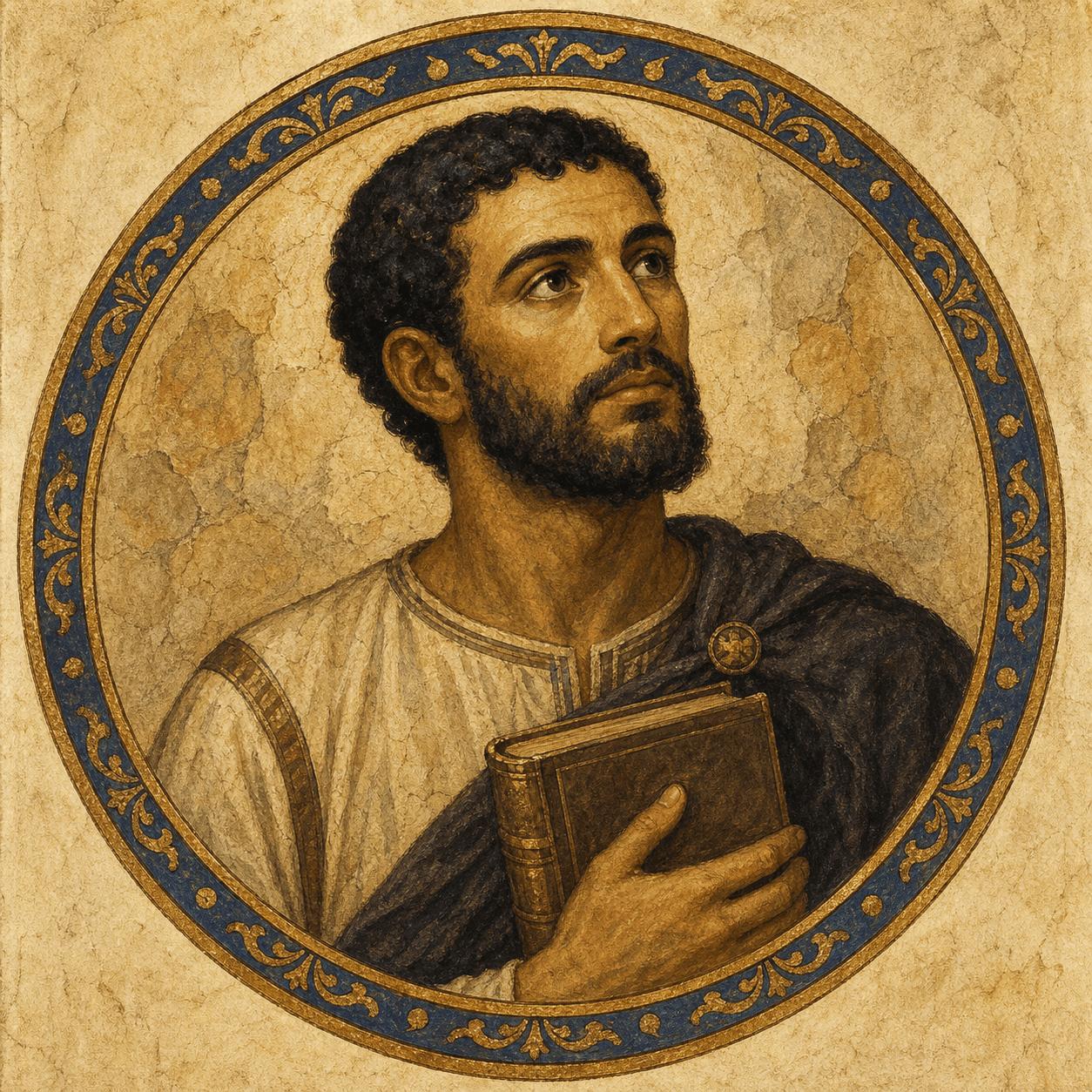
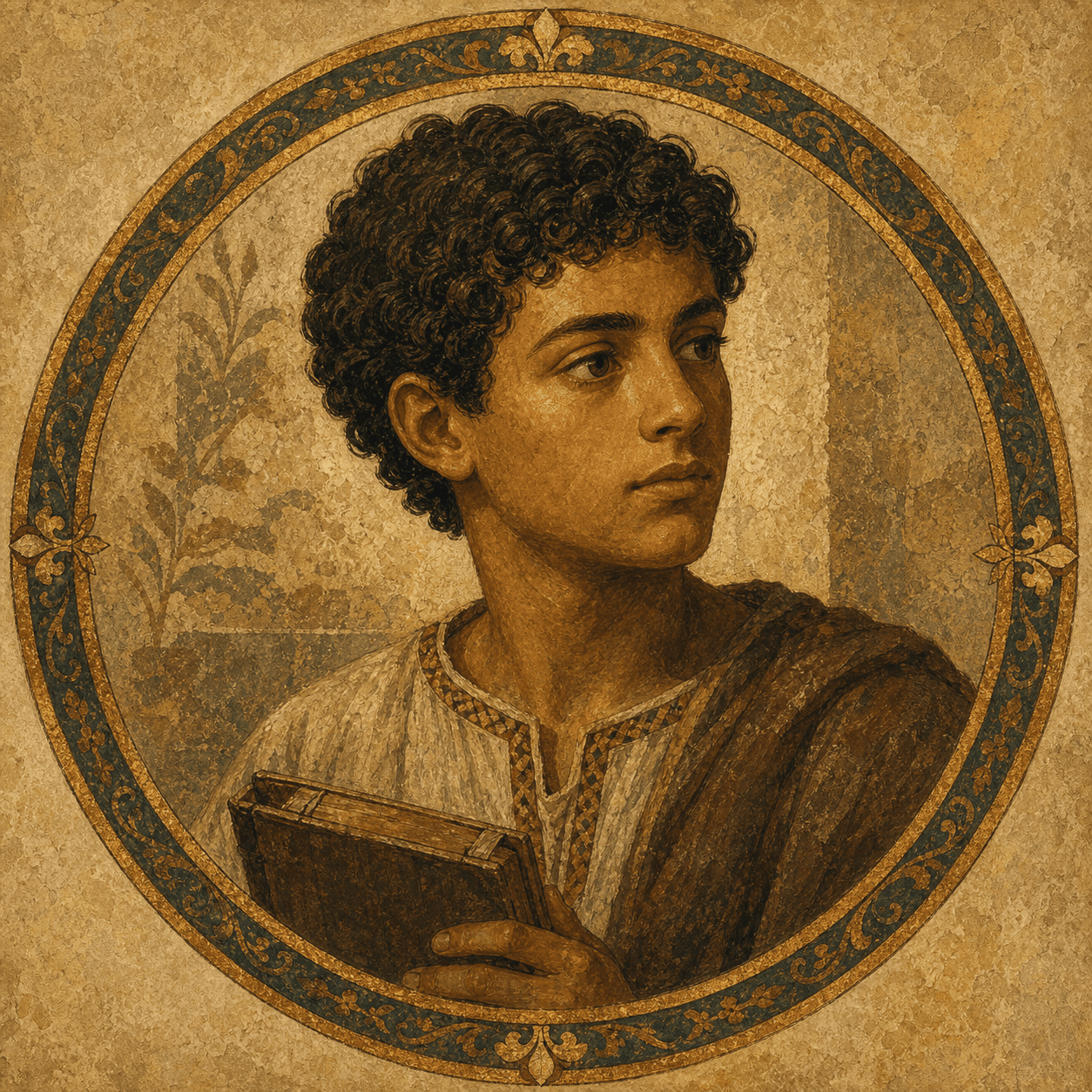
Portrait medallion of St. Augustine of Hippo, Monica's son.

St. Augustine

Her son. Feast August 28. Doctor of the Church. The conversion she prayed for through many years.

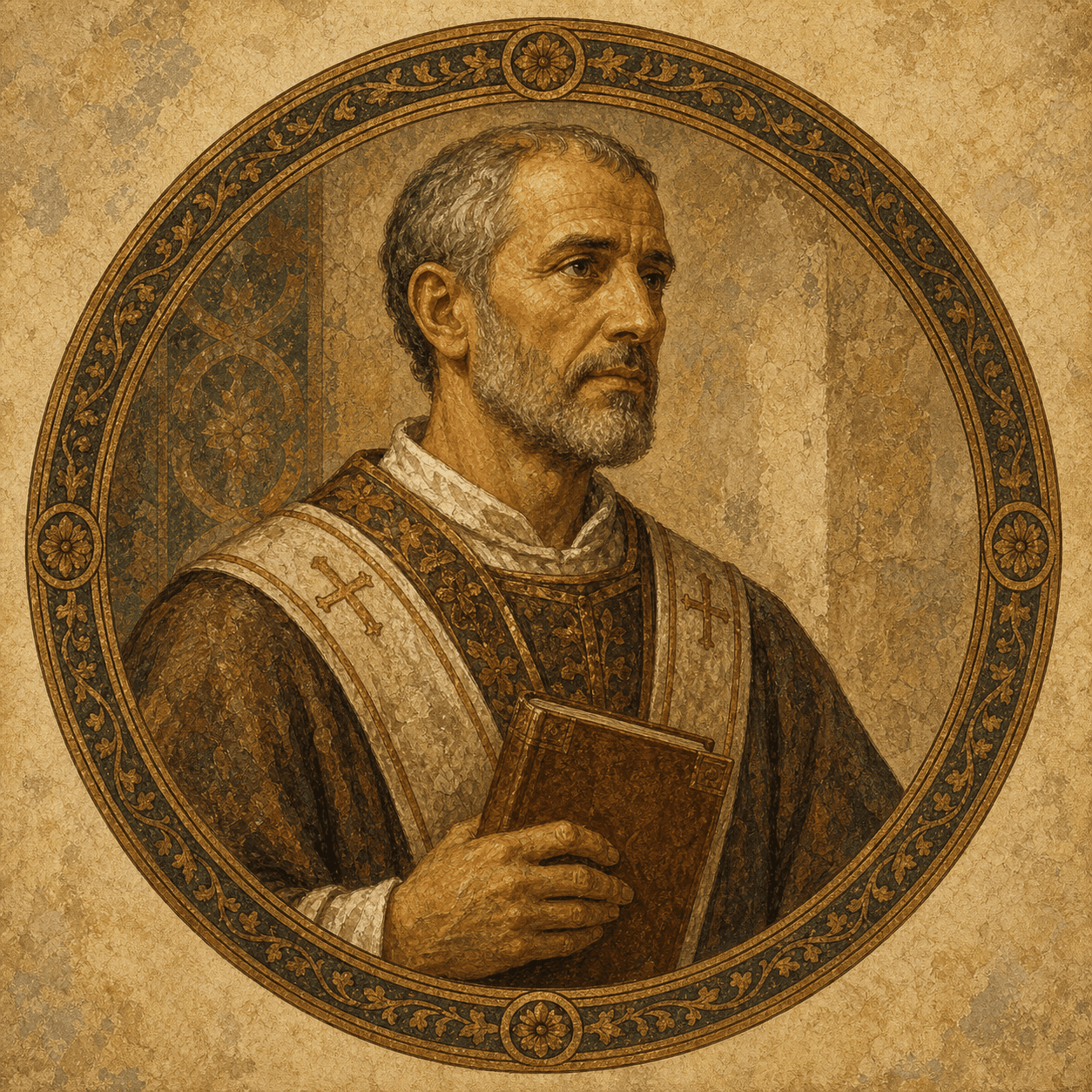
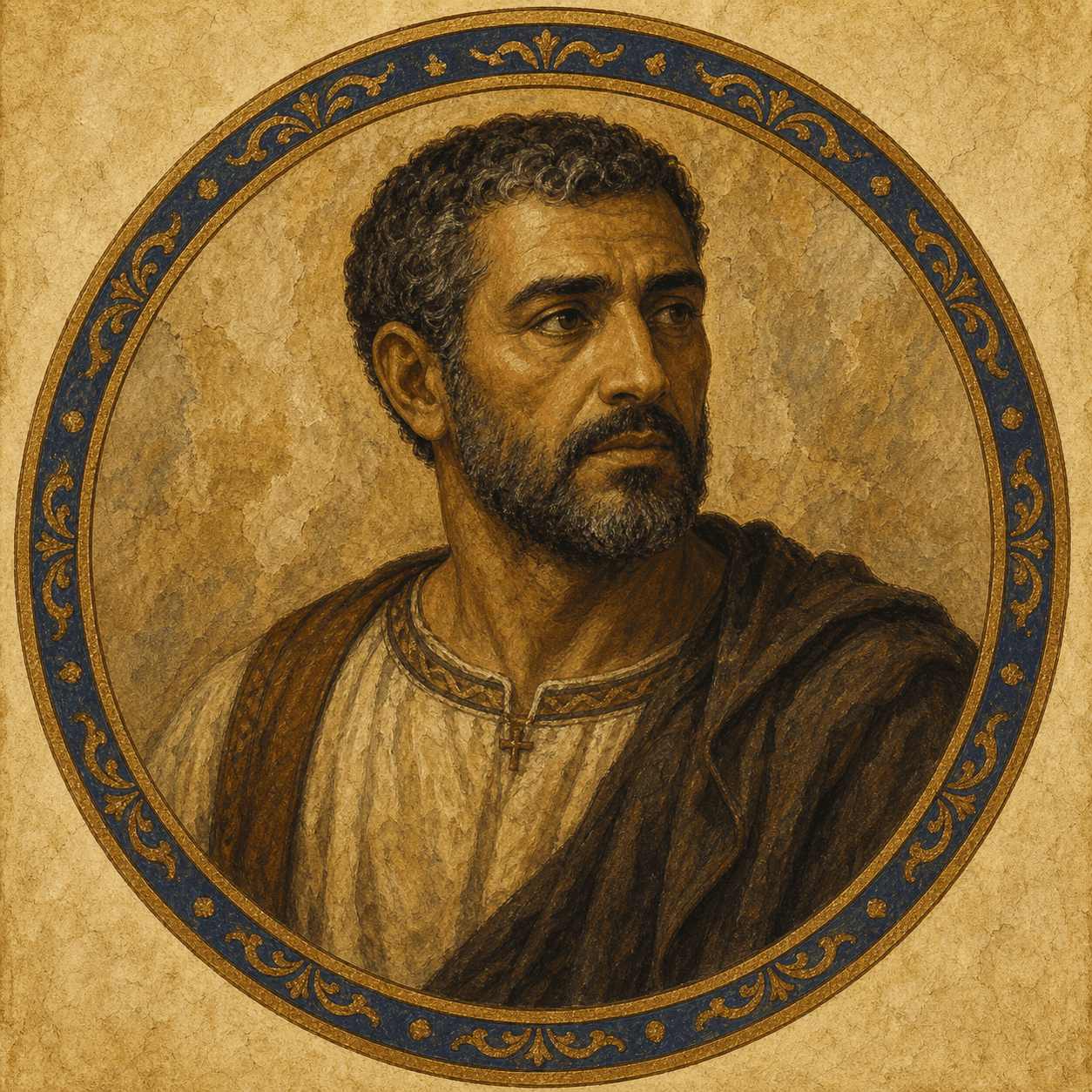
Portrait medallion of St. Ambrose of Milan.

St. Ambrose

Doctor of the Church. The bishop she befriended in Milan, whose intellect cracked her son's resistance.

Portrait medallion of Adeodatus, Monica's grandson.

Adeodatus

Her grandson, Augustine's son. Baptized with his father at Easter 387. Gifted, beloved, dead in youth.

Portrait medallion of Patricius, Monica's husband.

Patricius

Her husband. A pagan municipal official in Thagaste, hot-tempered, baptized only on his deathbed. Not canonized; remembered as the difficult marriage she carried for thirty years.

Frequently Asked

Common questions about Monica.

Who was St. Monica?+
She was a fourth-century North African Christian woman, the mother of St. Augustine of Hippo. She is honored as a saint primarily for her decades of prayer for her son's conversion, her patient endurance of a difficult marriage to a pagan husband, and her humility before the customs of foreign churches. Her feast day is August 27, the day before her son's.
Why is Monica the patron saint of mothers?+
Because of the depth, length, and seriousness of her prayer for her son. She prayed across years against every visible sign that her prayer was working. The Catholic Church reads her life as the most concrete example it has of sustained intercessory prayer for a wayward child, and so she has become, by long tradition, the saint Catholic mothers turn to when they are praying for children who have walked away from the faith.
What was Monica's dream about Augustine?+
Early in his life, Monica dreamed she was standing on a wooden rule, weeping for her son's spiritual ruin, when a radiant young man asked her why she wept. He then told her to look where she stood. When she looked, Augustine was standing there beside her. She took the dream as a promise from God that her son would one day stand where she stood, in the Catholic faith. She lived to see it. Confessions 3.11.20
What did Monica say at her death?+
Her last recorded words were: Lay this body anywhere, let not the care for it trouble you at all. This only I ask, that you will remember me at the Lord's altar, wherever you be. She is asking her sons to have the Mass offered for her, not for a particular burial, because she already understood the altar as the place where the living and the dead remain connected. Confessions 9.11.27
Where is Monica buried?+
She was originally buried at Ostia Antica, the port of Rome, where she died. Her relics were translated to Rome in the fifteenth century and are today in the Basilica of Sant'Agostino, near the Piazza Navona, in a chapel dedicated to her.
What was Monica's marriage like?+
She was married young, by family arrangement, to Patricius, a pagan municipal official in Thagaste with a hot temper. Augustine writes about the marriage at length in the Confessionsand does not pretend it was easy. But he also does not describe it as abusive: Patricius was bad-tempered and unfaithful, but Monica's household stayed quiet, the neighbors came to her for counsel, and Patricius was received into the Catholic Church on his deathbed. Confessions 9.9.19-22
Why is Monica's feast right before Augustine's?+
The Catholic liturgical calendar places her feast on August 27, immediately before her son's on August 28. The arrangement reflects the conviction the Church has held about her life from the beginning: that Augustine's sanctity flows in part from hers, and that to celebrate him without remembering her would miss what his own Confessions is trying to say.

Sources

Read beyond summaries.

Augustine deserves source trails: his own works, the Church's teaching, and serious historical scholarship.

Scholarship

  • Direct quotations use the public-domain Schaff/New Advent English text for rights clarity.
  • Henry Chadwick, Confessions (Oxford World's Classics) is the recommended modern reading translation.
  • Peter Brown, Augustine of Hippo: A Biography — discusses Monica throughout
  • Garry Wills, Saint Augustine (Penguin Lives) — Monica gets real weight as her own person

Last reviewed: May 26, 2026

On this page+