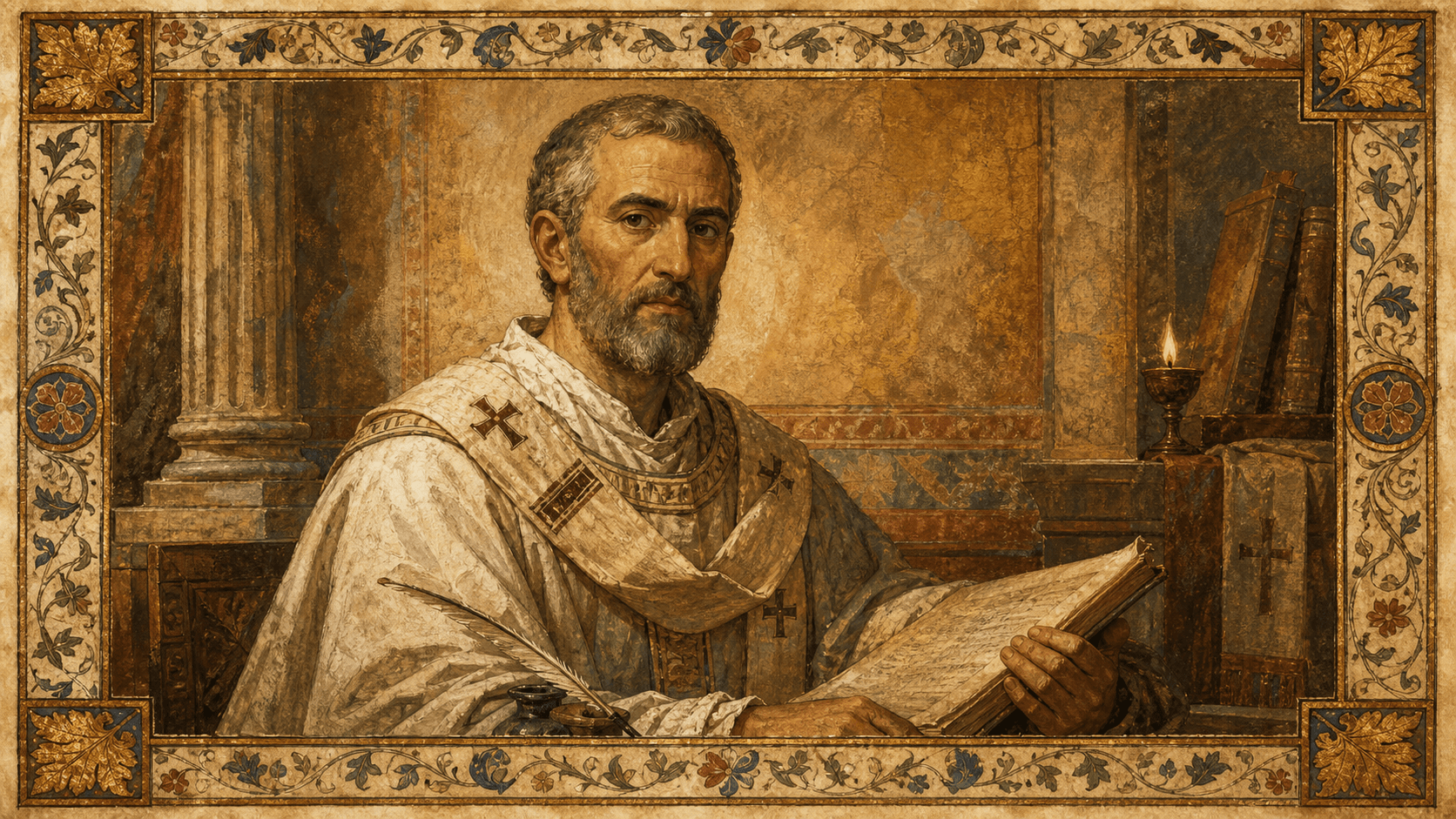
St. Ambrose of Milan in his episcopal dress, the Doctor of the Church who shaped Latin liturgical music and Western political conscience.

Saints Library

Ambrose of Milan

Feast December 7 · Doctor of the Church · c. 339-397

A Roman provincial governor acclaimed bishop by a crowd before he was baptized. The hymnodist who shaped Latin liturgical music. The bishop who made an emperor kneel for the massacre at Thessalonica and changed the relationship between the Church and the State for a thousand years.

The Story

The lawyer who was made bishop.

Ambrose did not want to be a bishop. He was the Roman governor of the northern Italian province when the previous bishop of Milan died and the people of the city, divided between Catholic and Arian factions, gathered in the cathedral to fight about the succession. Ambrose went, in his capacity as governor, to keep the peace. He gave a short, level-headed speech. Someone in the crowd — tradition says a child — shouted "Ambrose for bishop." The whole congregation took it up. Within eight days he was baptized, ordained through every clerical rank in sequence, and consecrated bishop. He was about thirty-five.

He spent the next twenty-three years remaking the Western Church.

He defended the Council of Nicaea against the Arian emperors. He stood in his own basilica for weeks under armed siege rather than hand it over for heretical worship. He told an emperor who had massacred seven thousand civilians in Thessalonica that he could not approach the Eucharist until he did public penance, and he made the emperor do it. He composed the hymns that taught the Western Church how to sing. He baptized Augustine.
Roman Gaul

The world he came from.

He was born around 339 in Trier, the capital of the Roman province of Gaul Belgica and one of the imperial residences of the late Empire. His father was Praetorian Prefect of Gaul — the highest civil office in the western half of the Empire after the emperor himself. The family was Christian. They were also very Roman.

When his father died, the family moved to Rome. There Ambrose was educated in the standard curriculum for an aristocratic Roman son: grammar, rhetoric, law, Greek and Latin literature. He read Cicero, Virgil, and the Greek philosophers. He also read the Greek Fathers — Origen and Basil — in the original, which would later set him apart from most of his Western contemporaries.

His brother Satyrus followed the same trajectory and became an administrator in his own right. His sister Marcellina had received the veil of a consecrated virgin from Pope Liberius. Three siblings — bishop, administrator, consecrated virgin — three legitimate Christian lives lived in the same Roman household. All three are saints.

Ambrose became a lawyer, then a provincial governor. He was probably never expected to become a bishop. He certainly never expected to become one.

December 374

From governor to bishop.

He was governor of Aemilia-Liguria, based in Milan, when the Arian bishop Auxentius died in 374. The Milanese church was split. The Arians wanted another Arian bishop; the Nicene Catholics wanted one of their own. The succession dispute threatened to become a riot.

Ambrose, in his official capacity, came to the cathedral to maintain public order. He spoke to the crowd, briefly, calling them to peace. He did not propose himself. He had not been baptized. He was a catechumen at most.

Someone shouted his name. The crowd took it up. By the end of the day both factions were calling for him.

He tried to escape it. He fled the city. He attempted to disqualify himself by ostentatiously associating with prostitutes and torturing prisoners, since neither was permitted in a bishop. Both ruses failed; the people knew him too well. Emperor Valentinian I confirmed the election. Ambrose was baptized, ordained through each clerical rank in turn, and consecrated bishop on December 7, 374.

He gave away his property to the Church and to the poor. He kept some land in trust for his sister Marcellina. He moved into the bishop's residence, learned the duties on the job, and asked his sister to send him books.

The Arian Crisis

Defender of Nicene Christianity.

The Arian crisis was the longest theological fight in early Christian history. The Council of Nicaea in 325 had defined the Son as homoousios— of the same substance — with the Father. Arius's followers had spent the next fifty years insisting this was wrong and pressing emperors to overturn it. By the time Ambrose was consecrated, the eastern Empire was largely Arian. The western Empire was tilting.

Ambrose did not tilt.

He wrote De fide and De Spiritu Sancto to defend the full divinity of Christ and the Holy Spirit. He preached against Arianism in his own city week after week. He pushed back when imperial officials, themselves Arian or sympathetic, tried to legalize heretical worship in Catholic basilicas.

385-386

The basilica standoff.

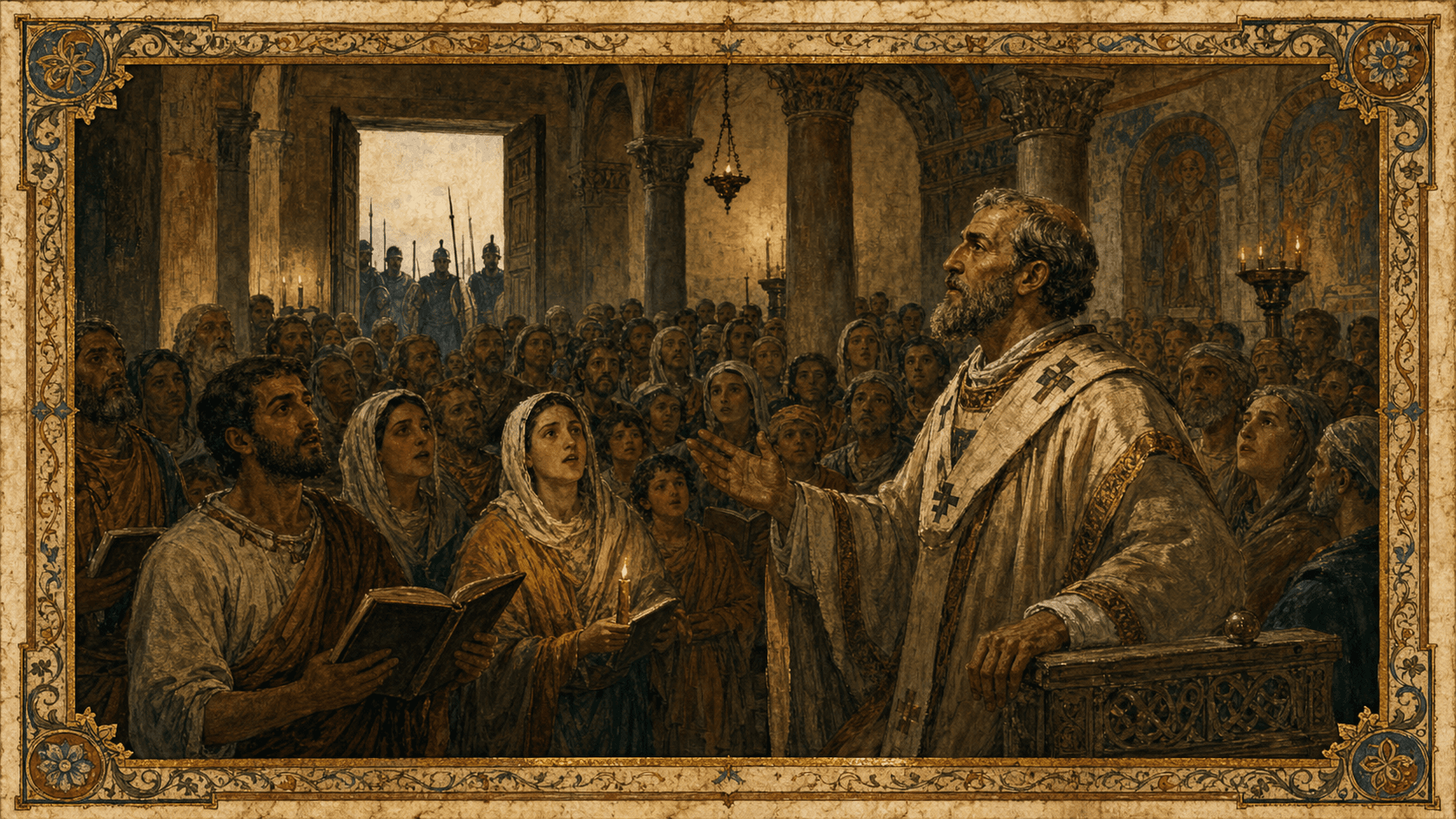
Ambrose and the Milanese congregation occupying their basilica under armed Arian siege in 385-386, singing antiphonal psalms as imperial soldiers wait outside.
The Milanese congregation occupies the basilica

In 385 and again in 386, the Empress Justina, regent for the boy emperor Valentinian II, demanded that one of Milan's Catholic basilicas be turned over to Arian worship. The court was Arian; the empress was Arian; the imperial guard was substantially Gothic and therefore Arian. The Catholic congregation was the city.

Ambrose refused. He told the imperial messengers that the basilica was God's house, not the emperor's. When the empress sent troops to take the building, Ambrose led his people into it and refused to leave.

The standoff lasted weeks. The congregation occupied the basilica day and night, with armed soldiers ringing the building. Augustine, then still a catechumen in Milan, was in the crowd. Monica was in the crowd. Ambrose, to keep the people calm and the long vigils singable, taught his congregation antiphonal psalmody — choirs answering one another, men's voices and women's voices alternating, the rhythm of the Eastern liturgies brought into Latin in a lasting way.

This became one of the foundations of Western liturgical chant. The Ambrosian hymns and antiphonal singing that helped shape the medieval West were composed under armed siege in a Milanese basilica refusing to surrender to Arian troops.

The siege ended. The empress yielded. The basilica stayed Catholic.

Augustine remembered the singing for the rest of his life. He cited it in the Confessions as one of the experiences that softened his heart toward the Catholic Church.

390

The penance of Theodosius.

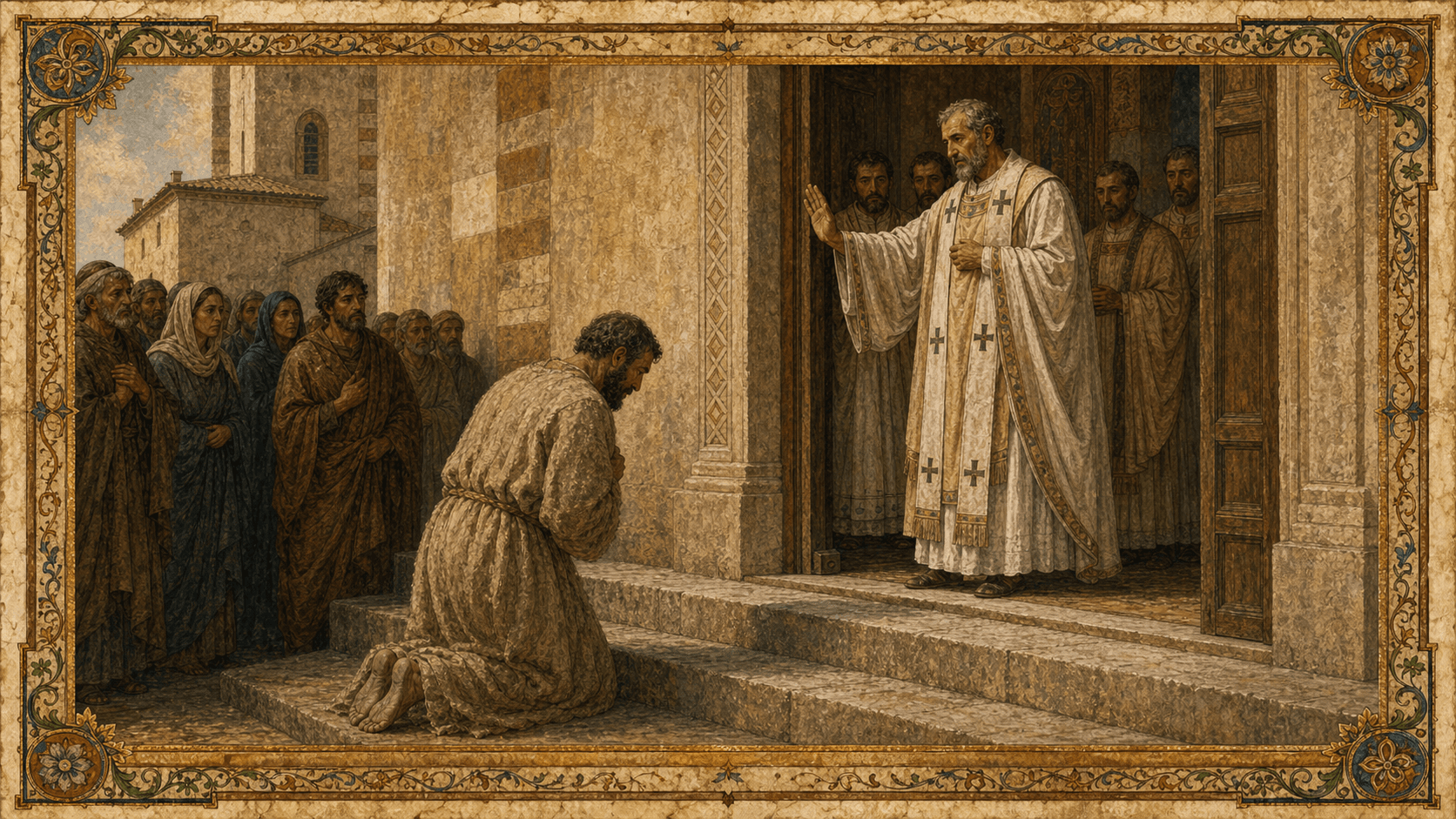
Emperor Theodosius doing public penance at the door of Milan's cathedral after the massacre at Thessalonica, with Bishop Ambrose composed in episcopal vestments at the threshold.
An emperor at the cathedral door

In 390, the eastern Emperor Theodosius the Great — Nicene Catholic, ally of Ambrose, generally a friend of the Church — ordered the slaughter of seven thousand civilians in Thessalonica in reprisal for a popular riot. Imperial troops surrounded the city's circus during a chariot race and killed the crowd indiscriminately, men, women, and children.

When the news reached Milan, Ambrose wrote to Theodosius. He told the emperor what he was: a man who had committed a great public sin and who could not approach the Eucharist until he had done public penance for it. Ambrose refused to celebrate Mass in the emperor's presence.

Theodosius was not a man who took correction well. He was the emperor of the whole Roman Empire. He had ended the Arian crisis. He had outlawed paganism. He was used to clergy thanking him for it.

He did the penance anyway.

For eight months, Theodosius appeared at the cathedral in Milan as a public penitent, in penitential garments, without the imperial insignia, on his knees. At Christmas of 390 — by tradition and most early accounts — Ambrose readmitted him to the Eucharist. Theodoret 5.18

It became one of the clearest early signs that even a Christian emperor remained answerable to the moral authority of the Church. It would not be the last. Much of later Western Christian political theology — from the medieval investiture controversy to modern Catholic teaching on the limits of state power — would look back, in part, to what Ambrose required of Theodosius and what Theodosius did about it.

Hymnody

Hymns and preaching.

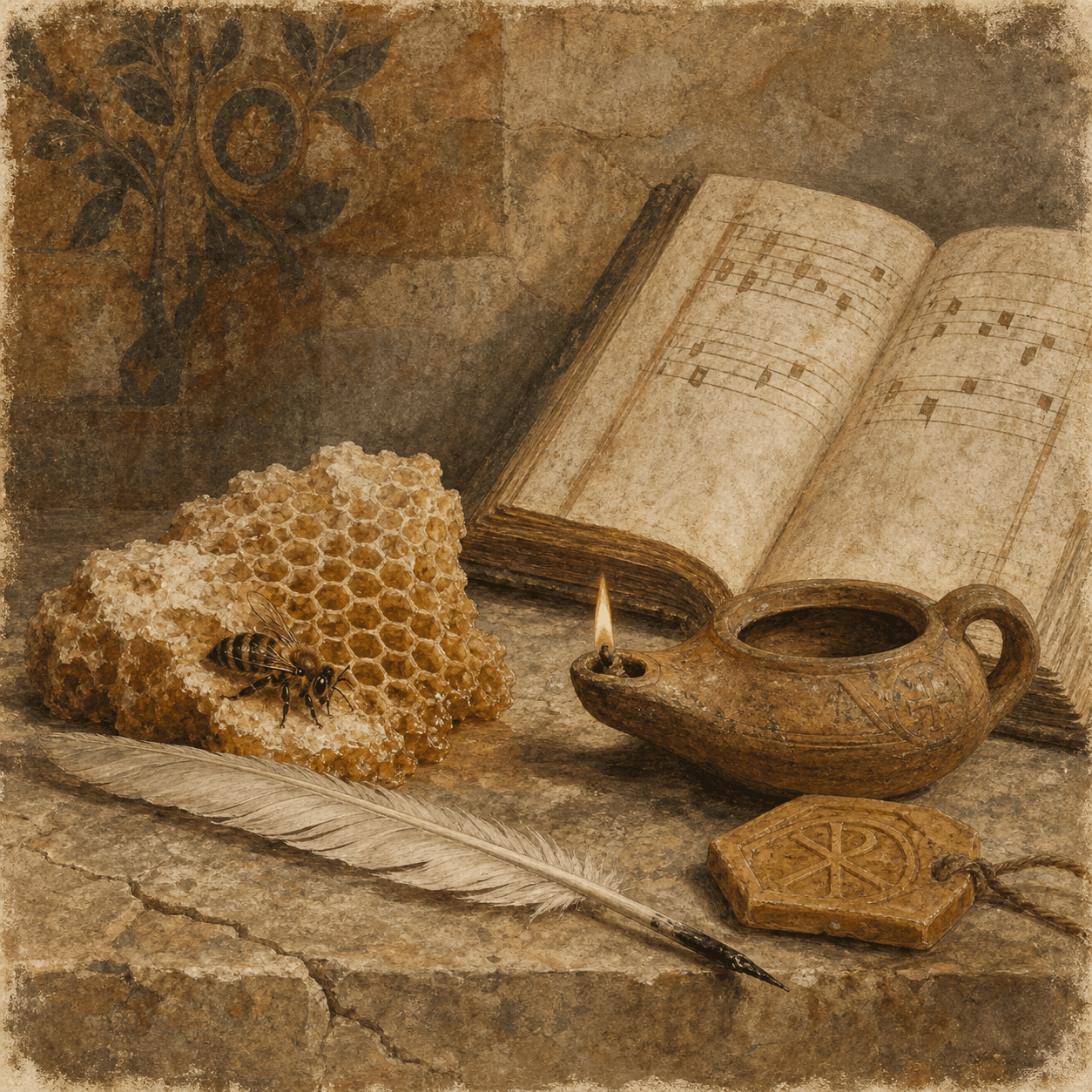
A still life of honeycomb, a quill, an open codex, and a bee — visual reference to Ambrose's hymns and to the bee tradition that marks his iconography.

He wrote hymns. They were short, doctrinally exact, set to a regular meter, easy to sing and easy to remember. He composed them in Latin at a moment when most Christian hymnody had still been in Greek. He gave the Western Church its own musical language.

Four of his hymns are still demonstrably his by modern scholarly standards: Aeterne rerum Conditor, Deus Creator omnium, Iam surgit hora tertia, and Veni Redemptor gentium. Many more were composed in his style by his successors. The whole tradition is still called Ambrosian — Ambrosian chant in Milan to this day, Ambrosian Rite for the local liturgy of the diocese, which is still distinct from the Roman Rite.

He also preached almost daily. His sermons on Scripture — particularly on Genesis, the Psalms, and the Gospel of Luke — were taken down by stenographers and edited into the books that survive. Augustine sat in those sermons. His commentary on Luke would become Augustine's first sustained encounter with figural reading of Scripture.

Tradition says a swarm of bees once settled on the lips of the infant Ambrose without stinging him, a sign of future eloquence. The bee remains his iconographic symbol. Bee-keepers are among his patrons.

Easter 387

Ambrose and Augustine.

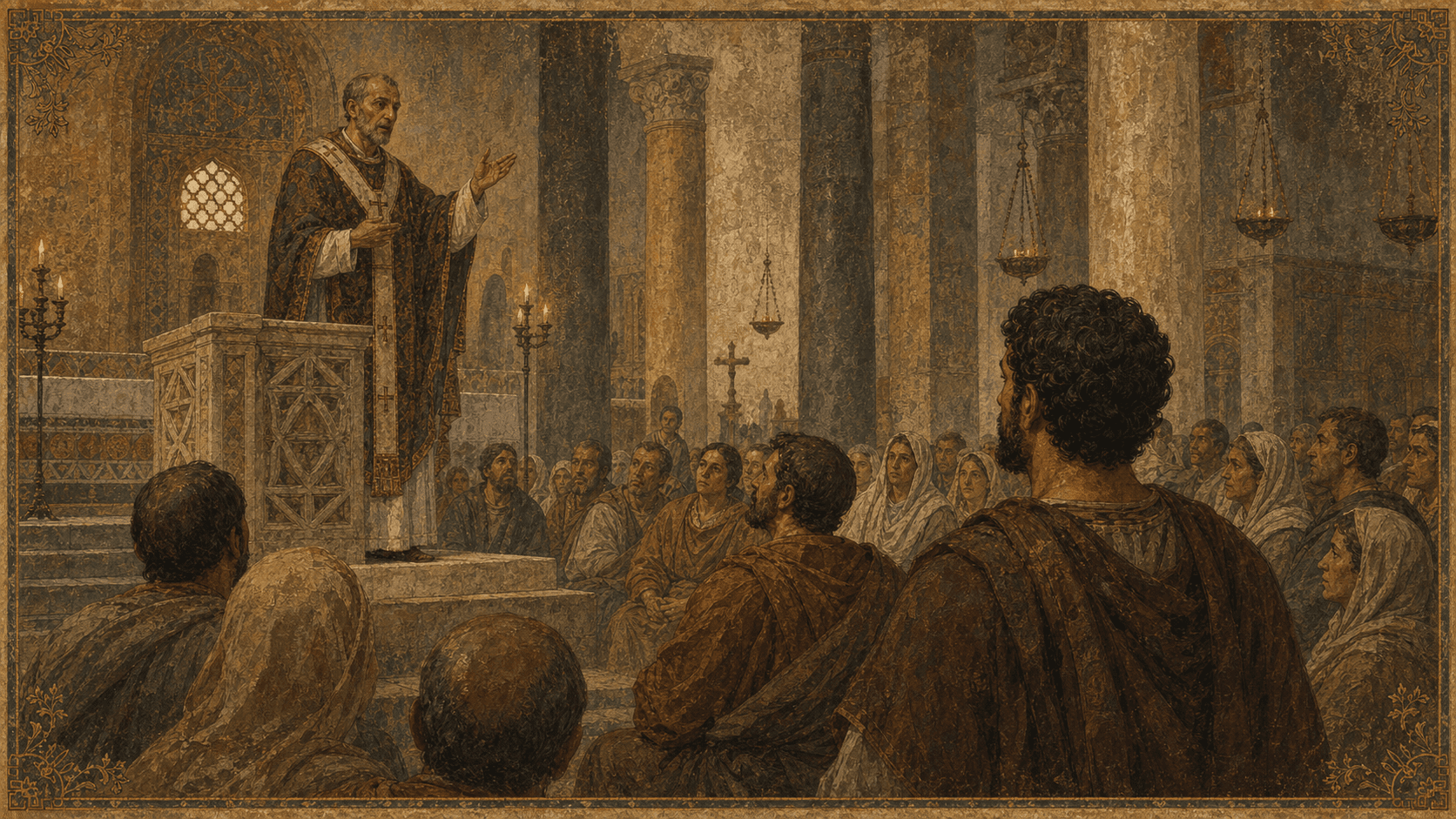
Ambrose preaching in his Milan cathedral, where Augustine first heard him.
Ambrose preaching, Augustine listening

When Augustine came to Milan in 384 as the city's new chair of rhetoric, he was a Manichean, intellectually arrogant, and looking forward to mocking the famous Catholic bishop. He went to Ambrose's sermons at first as a critic studying a rival orator.

He stayed because Ambrose was unmockable. Ambrose preached with a precision and a depth Augustine had not encountered in any Catholic teacher before. He read the Old Testament figurally, which solved problems Augustine had thought intractable. He gave Augustine a kind of Christianity that did not require him to disbelieve what he knew about the world.

Monica became Ambrose's friend before Augustine did. She attended his sermons constantly; he praised her openly to her son. When Augustine finally came to Ambrose for spiritual direction, the bishop was patient but busy, and not inclined to entertain him at length. The work, Augustine wrote, had to happen in Augustine.

At the Easter Vigil of 387, Ambrose baptized Augustine and his son Adeodatus in the cathedral at Milan. The man who would become the greatest Latin theologian of the West entered the Catholic Church through the hands of the bishop who had already, in many ways, given him to her.

Easter Eve 397

His death.

He stayed bishop of Milan for the rest of his life. He continued preaching, writing, defending Nicene orthodoxy against the next round of imperial pressures. He buried Theodosius in 395 and preached the funeral oration.

In the spring of 397 he fell ill. He continued the work as long as he could. He died on the night before Easter — Holy Saturday, April 4, 397 — in his cathedral, in his vestments, surrounded by his clergy.

He was about fifty-seven. He had been bishop for twenty-three years.

He was buried in the basilica he had built and named after the martyrs Gervasius and Protasius, whose relics he had discovered and translated there a decade before. The basilica is now called Sant'Ambrogio. His own bones rest there still, visible in a crypt beneath the high altar, alongside the two martyrs.

Doctor of the Church

One of the four original Latin Doctors.

He was named one of the four original Latin Doctors of the Church near the end of the thirteenth century by Pope Boniface VIII, alongside Augustine, Jerome, and Gregory the Great. The title recognized what was already obvious by the late medieval period: that the four of them had together built the intellectual frame of Western Catholic Christianity, and that none of the four was dispensable.

Of the four, Ambrose is often the least read in English-speaking Catholic life today. This is unjust. De officiis ministrorum is among the earliest systematic Christian treatments of moral philosophy. De mysteriis and De sacramentis are among the earliest substantive treatments of sacramental theology. His hymns are still sung. His insistence that the Church holds moral authority over the conduct of the state, even Christian states, is still — quietly, often uncomfortably — Catholic teaching.

Why Now

Why he matters now.

He matters now because he is the saint who answers the question every Catholic eventually asks: what does it mean for the Church to address the state? What does it mean for a Catholic to be a citizen?

Ambrose's answer is concrete and old. The Church does not govern. But the Church holds the conscience of every Christian, including every Christian who governs. There are public sins that bar a public official from public Communion. There are emperors who need to be told no, and who need to do public penance, and who must be readmitted to the sacraments only when the sin has been repented. The bishop is not the emperor's chaplain. The bishop is the emperor's pastor.

That has been Catholic teaching for sixteen hundred years. It will remain Catholic teaching long after every present political question has aged into dust. Ambrose gave the Church one of its clearest early public examples of what that teaching looks like in practice — not in theory, but with one of the most powerful men in the world kneeling at the cathedral door waiting to be let in.

He is also the patron saint of every Catholic who has ever tried to sing his faith into a difficult room.

Reading Path

Where to read him.

  1. The Hymns. Start with Aeterne rerum Conditor and Veni Redemptor gentium. They are short, dense, and easy to read alongside any modern English translation. The Liturgy of the Hours still uses several.
  2. De officiis ministrorum. Ambrose's adaptation of Cicero for Christian clergy. Often treated as one of the first major Christian treatises on moral philosophy.
  3. De mysteriis. Short, accessible, foundational for Catholic sacramental theology. Ambrose's introduction to baptism and the Eucharist for the newly baptized.
  4. Letters and sermons on the Theodosius affair. Letter 51 to Theodosius after the Thessalonica massacre is one of the great documents of Western political conscience.
  5. De fide. For serious students. The full Nicene argument against Arianism.

Most of Ambrose's writings are available in the public-domain Schaff/Wace Nicene and Post-Nicene Fathers series at New Advent.

A Word of Ambrose

To an emperor.

Theodoret places the rebuke at the church threshold, before one of the most powerful men in the world. Ambrose said it in the conviction that the Eucharist is not a prize for the powerful but a sacrament of repentance for sinners. He said it knowing that the emperor could have him exiled or killed. He said it anyway.

The emperor did the penance. The Church remembered.

Connected Saints

A family of holiness.

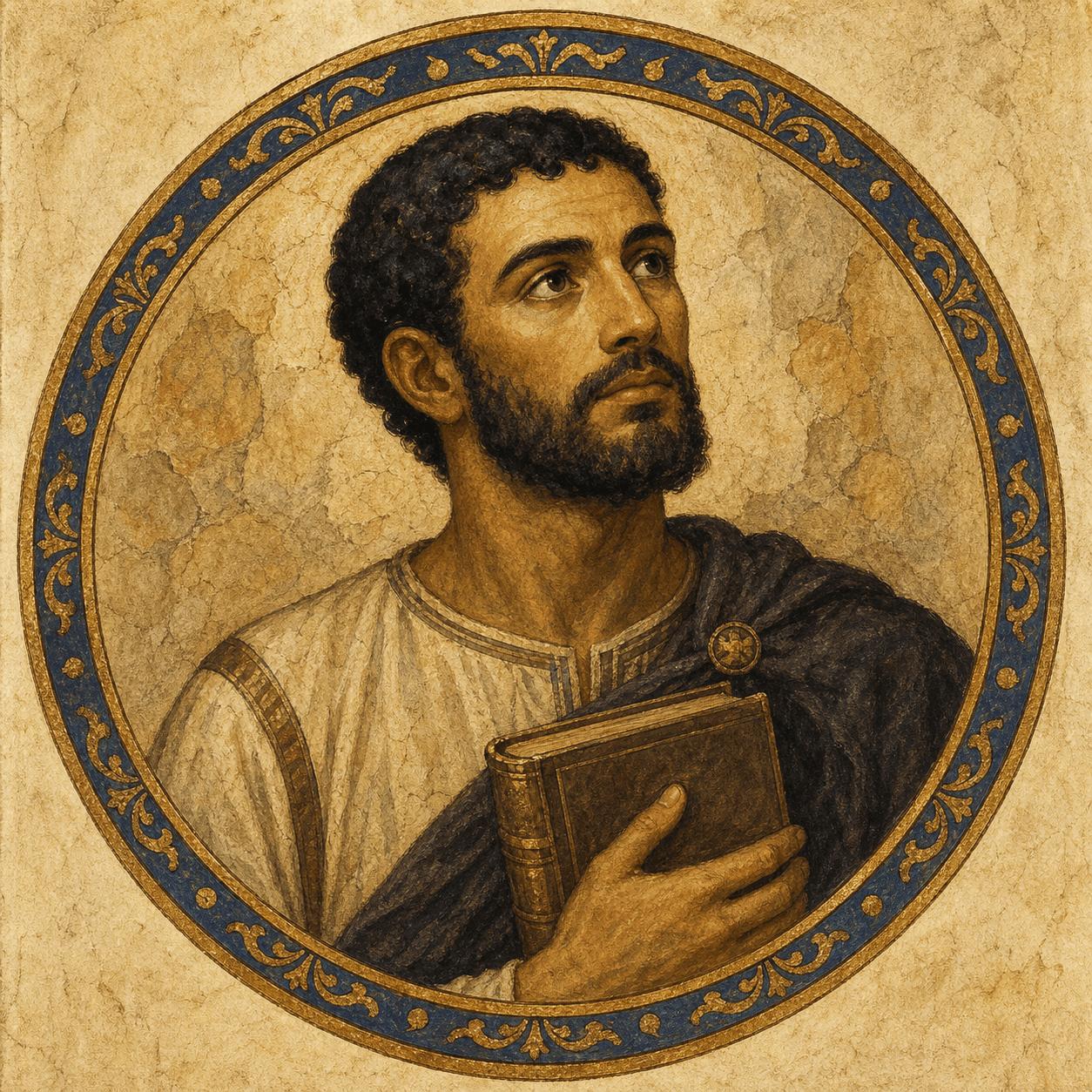
Portrait medallion of St. Augustine of Hippo.

St. Augustine

His disciple in faith. Doctor of the Church. The man he baptized at the Easter Vigil of 387.

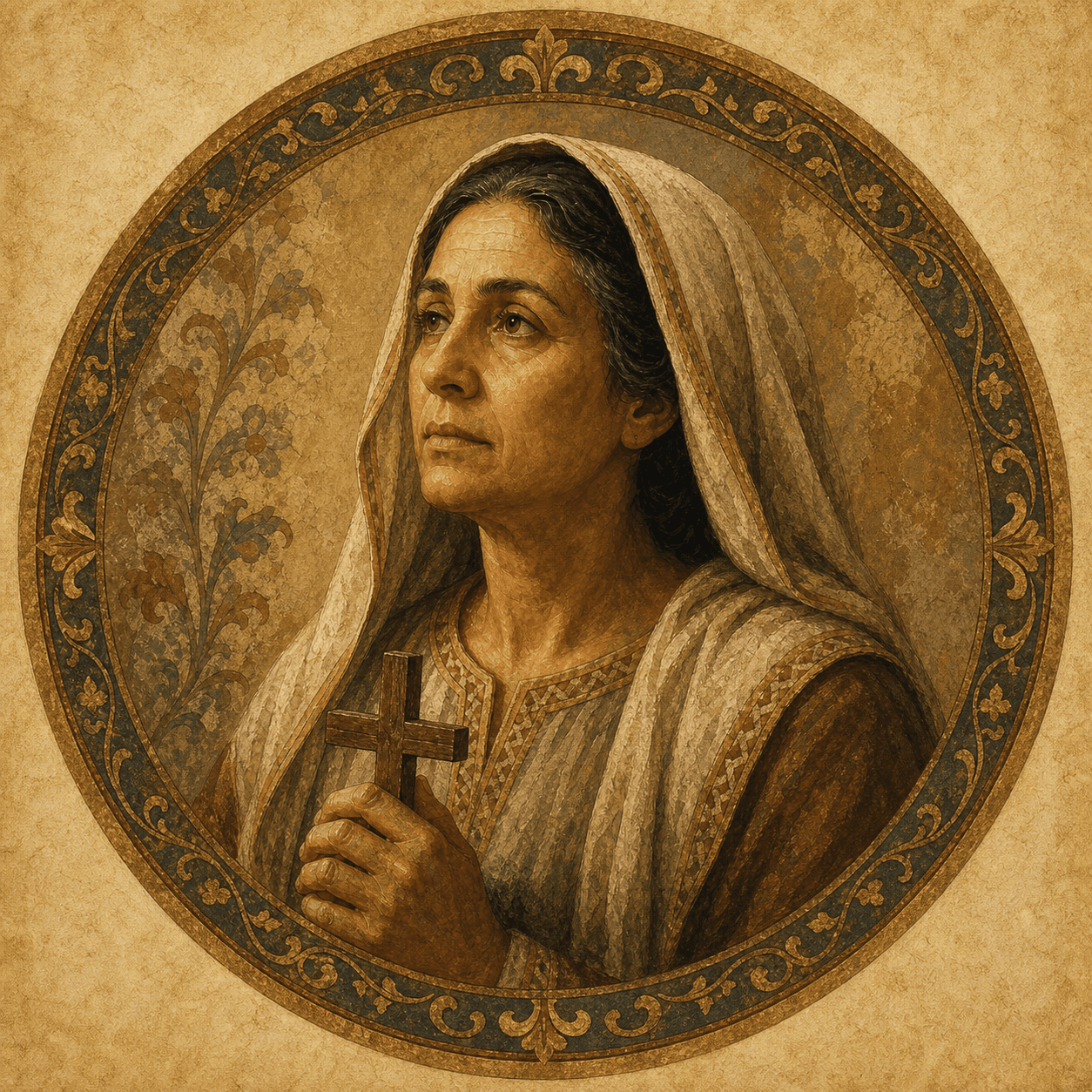
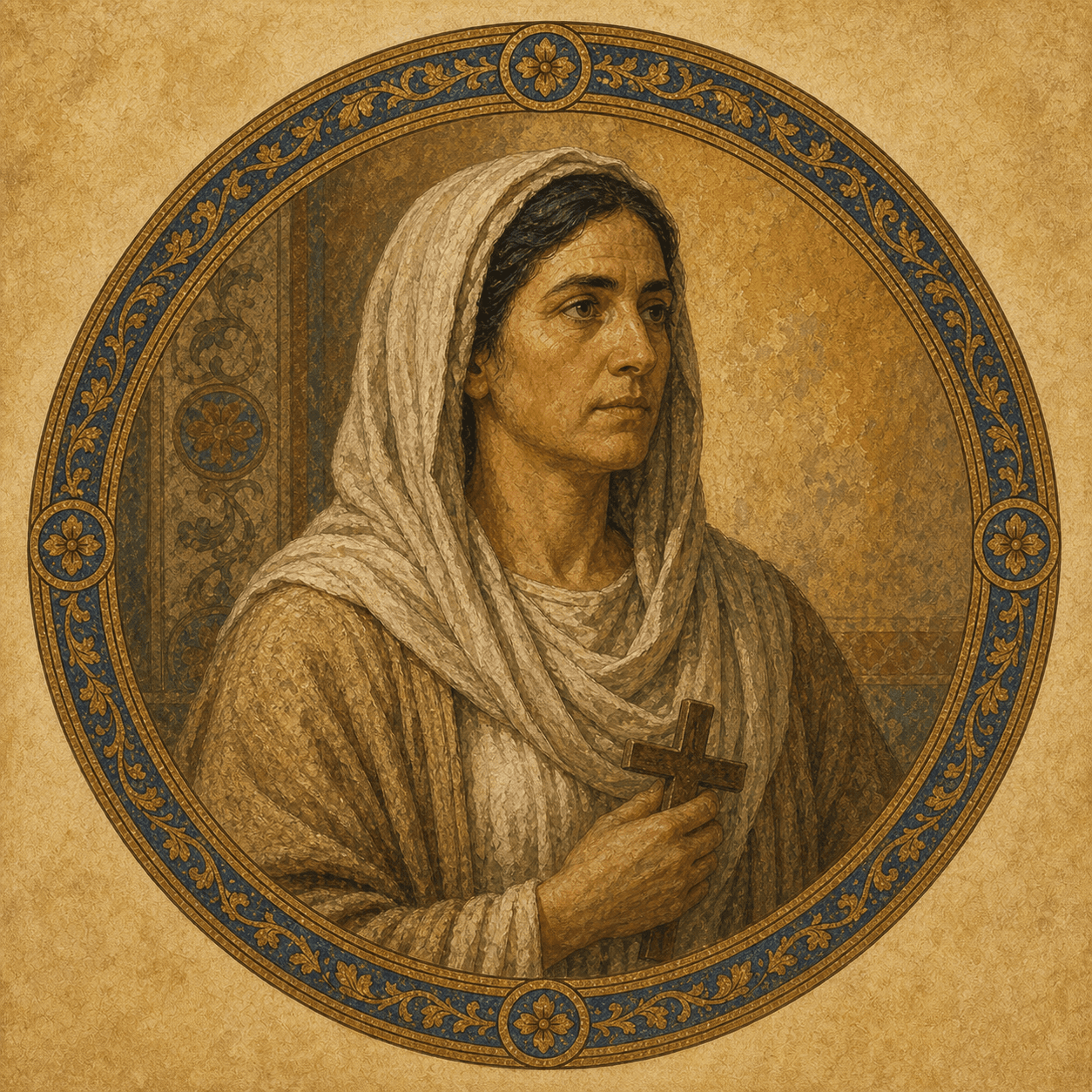
Portrait medallion of St. Monica.

St. Monica

Augustine's mother. The North African widow whose friendship he welcomed in Milan and whose son's conversion he completed at the font.

Portrait medallion of St. Marcellina, Ambrose's older sister, a fourth-century Roman consecrated virgin.

St. Marcellina

His older sister. A consecrated virgin who received the veil from Pope Liberius. Feast July 17.

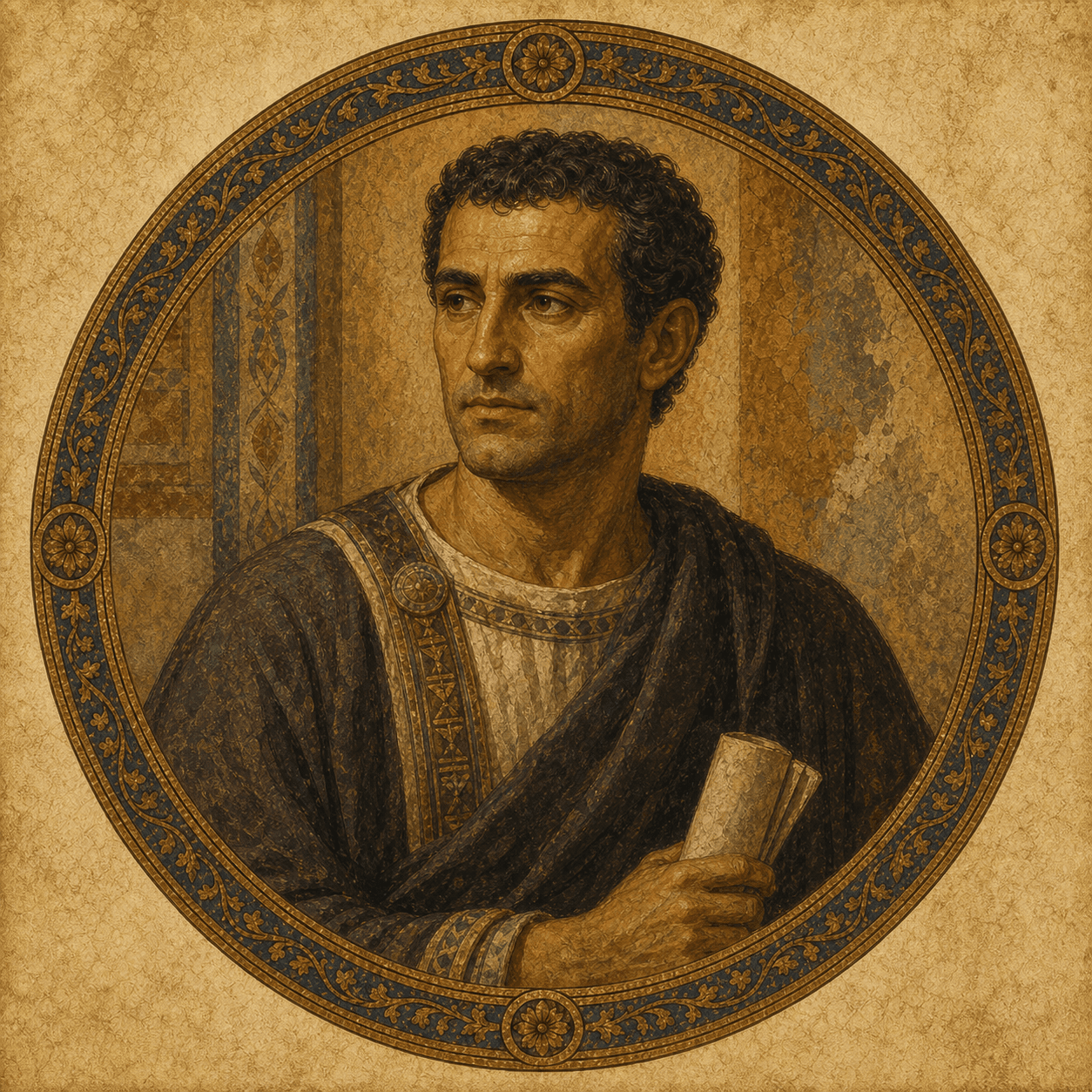
Portrait medallion of St. Satyrus, Ambrose's older brother, a late-Roman administrator and saint in his own right.

St. Satyrus

His older brother. A Roman administrator whose holiness Ambrose praised in two surviving funeral orations after his early death. Feast September 17.

Frequently Asked

Common questions about Ambrose.

Who was St. Ambrose of Milan?+
He was a fourth-century Roman provincial governor who was unexpectedly acclaimed Bishop of Milan in 374 while still a catechumen. He served twenty-three years as bishop, defended Nicene Christianity against the Arians, composed lasting early Latin hymns, baptized St. Augustine of Hippo, and required the Emperor Theodosius to do public penance after the massacre at Thessalonica. He is a Doctor of the Church and one of the four original Latin Doctors. His feast is December 7.
Why is Ambrose's feast on the day of his consecration rather than the day of his death?+
December 7 is the anniversary of his ordination as bishop in 374, not his death on April 4, 397. The Catholic Church usually celebrates a saint's feast on the date of death, but Ambrose's case is one of several where another date prevailed in local tradition. His death fell on the eve of Easter (Holy Saturday, April 4, 397), amid the most solemn and liturgically reserved days of the Church's year; the local Milanese Church kept the consecration date and the universal Church adopted it.
What did Ambrose do to Emperor Theodosius?+
After Theodosius ordered the slaughter of about seven thousand civilians at Thessalonica in 390, Ambrose refused him admission to the Eucharist until he did public penance. The emperor accepted the bishop's judgment. For about eight months he appeared at the Milan cathedral in penitential clothing, without imperial insignia, before being readmitted to Communion. It became one of the clearest early signs that even a Christian emperor remained answerable to the moral authority of the Church. It is one of the foundational episodes of Western political theology. Theodoret, Ecclesiastical History 5.18
Did Ambrose really invent congregational hymn-singing?+
He did not invent it. Antiphonal psalmody existed in the Eastern churches before him. But he made it central to Latin Western worship, and he composed early Latin hymns that survived long enough to set a tradition. The Western tradition of regular hymnody — the practice that helped shape everything from chant to the Catholic hymnals still in pews today — owes a real debt to what Ambrose did in Milan under the Arian siege.
Is St. Ambrose the patron saint of bee-keepers?+
Yes — by an old tradition. The story goes that when Ambrose was an infant, a swarm of bees once settled on his face and lips without stinging him, then flew off, leaving him unharmed. His father took it as a sign that the boy would grow up to be a great speaker. The bee became his iconographic symbol; bee-keepers and candle-makers are among his patrons. The tradition is not in any primary source from Ambrose's lifetime, but it is medieval and consistent across the Latin West.
Where is Ambrose buried?+
In the crypt of the Basilica of Sant'Ambrogio in Milan, the church he built and where he died. His relics are still visible in a glass case beneath the high altar, alongside the relics of the martyrs Gervasius and Protasius, whom he himself had translated to that church in 386. It is one of the few cases in Western Christianity where the saint's own bones remain visible to pilgrims in the original basilica he built.
What is the Ambrosian Rite?+
The Ambrosian Rite is the distinctive Catholic liturgy still celebrated in the Archdiocese of Milan and a few surrounding dioceses. It is one of the few non-Roman Latin liturgical rites that survived the medieval consolidation of the Western liturgy. Its texts, calendar, and liturgical practices preserve elements of fourth-century Milanese worship that Ambrose himself shaped, including features of the Eucharistic Prayer that differ from the Roman Canon. The Ambrosian Rite is fully Catholic and in full communion with Rome.

Sources

Read beyond summaries.

Ambrose deserves source trails: his own works, the Church's teaching, and serious historical scholarship.

Primary

  • St. Ambrose, De officiis ministrorum (On the Duties of Ministers)
  • St. Ambrose, De mysteriis (On the Mysteries)
  • St. Ambrose, De fide and De Spiritu Sancto — his major Trinitarian works against Arianism
  • St. Ambrose, Letters — especially Letter 51 to Theodosius on the Thessalonica massacre
  • The Ambrosian Hymns — Aeterne rerum Conditor, Deus Creator omnium, Iam surgit hora tertia, Veni Redemptor gentium
  • Paulinus of Milan, Vita Ambrosii (Life of Ambrose) — Ambrose's secretary, the contemporary biographer
  • Theodoret of Cyrus, Ecclesiastical History, Book V, ch. 18 — the Theodosius confrontation

Magisterial

  • Catechism of the Catholic Church — references to Ambrose throughout, especially on the sacraments and on prayer
  • Pope Benedict XVI, General Audience on Saint Ambrose (24 October 2007)
  • Pope Boniface VIII's 1298 decree on the four original Latin Doctors (Augustine, Ambrose, Jerome, Gregory the Great), described in the Catholic Encyclopedia

Scholarship

  • Direct quotations of Ambrose use the public-domain Schaff/Wace English translations from the Nicene and Post-Nicene Fathers series for rights clarity.
  • Neil B. McLynn, Ambrose of Milan: Church and Court in a Christian Capital — the standard modern critical biography.
  • Boniface Ramsey, Ambrose — Routledge "Early Church Fathers" series, accessible introduction.
  • Peter Brown, Power and Persuasion in Late Antiquity — political-historical context for Ambrose's confrontations with Justina and Theodosius.

Last reviewed: May 31, 2026

On this page+