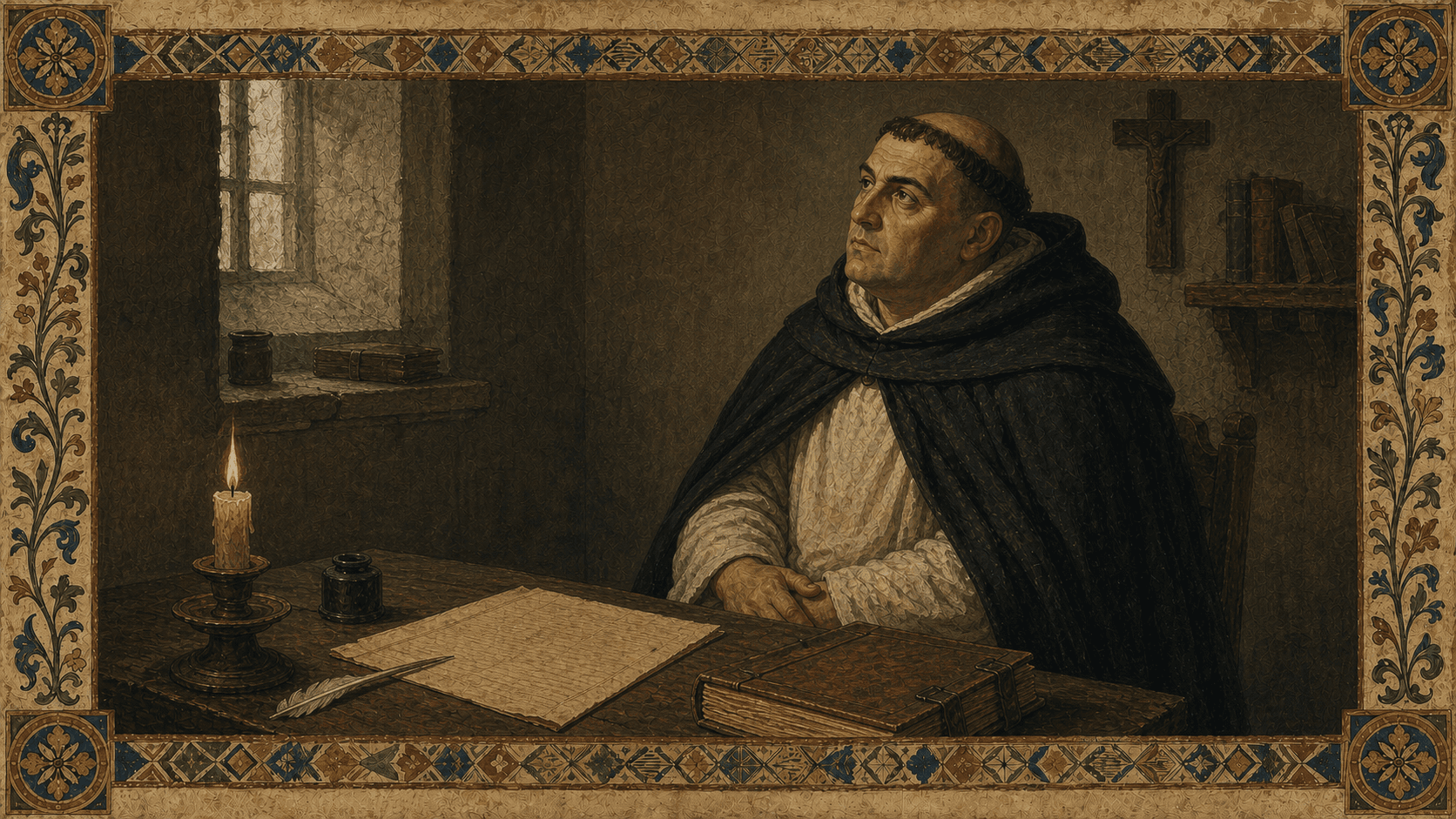
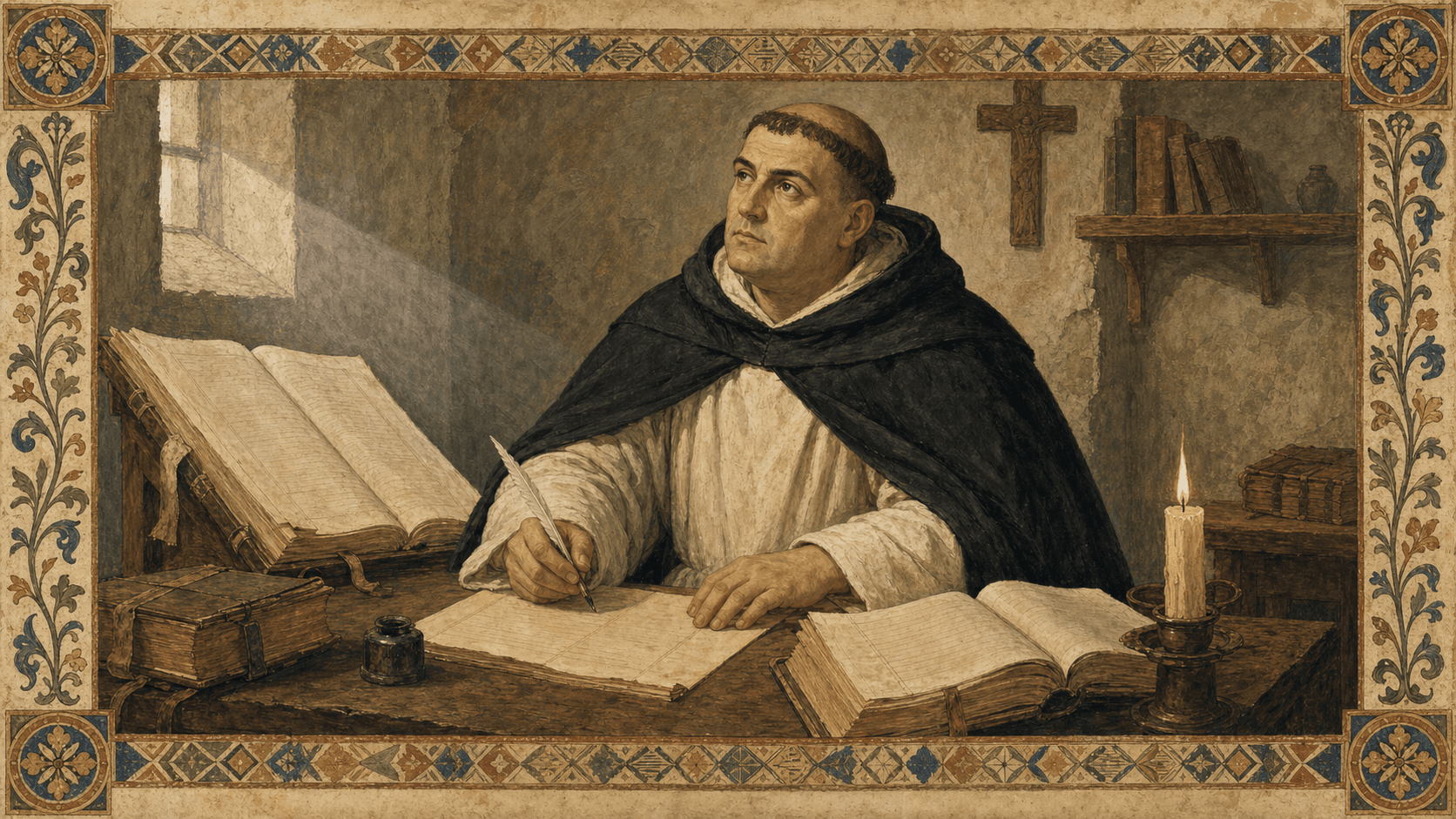
St. Thomas Aquinas at his writing desk with manuscripts and warm monastic light, rendered in the Saints Library fresco-editorial style.

Saints Library

Thomas Aquinas

Feast January 28 · Doctor of the Church · c. 1225-1274

The Dominican friar his classmates called a dumb ox, who became the most influential theologian in the history of the Western Church — and who, a year before he died, stopped writing, because next to what he had seen, everything he had written looked to him like straw.

The Story

The noble son who chose a begging order.

Thomas Aquinas was born into a noble family that had a different career in mind for him. They sent him to the great Benedictine abbey of Monte Cassino as a boy, expecting that he would rise there and one day govern it as abbot — a position of wealth and influence. Instead he met the Dominicans, a new order of begging friars who owned nothing and preached for a living, and he decided to become one of them.

His family was appalled. His brothers ambushed him on the road, brought him home, and locked him in the family castle for the better part of a year, by some accounts longer, to break his resolve. It did not break. He came out a Dominican and went north to study under the greatest teacher of the age.

He was a large, heavy, silent man, and his fellow students mistook his silence for stupidity. They called him the dumb ox. His teacher, Albert the Great, heard one of Thomas's arguments and corrected them: the bellowing of this ox would be heard throughout the world.

He was right. Over the next twenty years Thomas wrote more careful theology than most centuries produce. He took the whole inheritance of Catholic faith and the whole inheritance of Greek philosophy and showed that they did not contradict each other — that reason and revelation come from the same God and cannot finally disagree. The Summa Theologiae, his unfinished masterwork, is still the most important work of Catholic theology ever written by a single hand.

Then, near the end, he stopped. After a long experience at Mass in December 1273, he laid down his pen and would not pick it up again. When his friend begged him to keep writing, the early Life by William of Tocco says Thomas answered that everything he had written seemed to him like straw.

He died three months later, on the road to a Church council, at a monastery that was not his own. He was about forty-nine.
Roccasecca

The world he came from.

He was born around 1225 at Roccasecca, a hilltop castle in the Kingdom of Naples, into a family of the minor nobility connected by blood and politics to the highest powers of the age — the Holy Roman Emperor on one side, the great abbey of Monte Cassino on the other.

At about five years old he was sent to Monte Cassino as an oblate, a child given to a monastery to be raised toward religious life. The family's plan was straightforward and worldly: Thomas would become a Benedictine, and in time the abbot of one of the richest monasteries in Christendom. It was a path to power as much as to God.

War interrupted it. The emperor's armies and the pope's came into conflict around Monte Cassino, and Thomas was sent instead to the new university at Naples. There two things happened that his family had not planned. He encountered the freshly translated works of Aristotle, and he encountered the Dominicans.

The Dominicans were less than twenty years old. They were friars who lived by begging, preached in the streets and the new universities, and owned nothing. For the son of a noble house to join them was not a promotion. It was a renunciation of everything his family had arranged.

He joined anyway.

Vocation

The year in the castle.

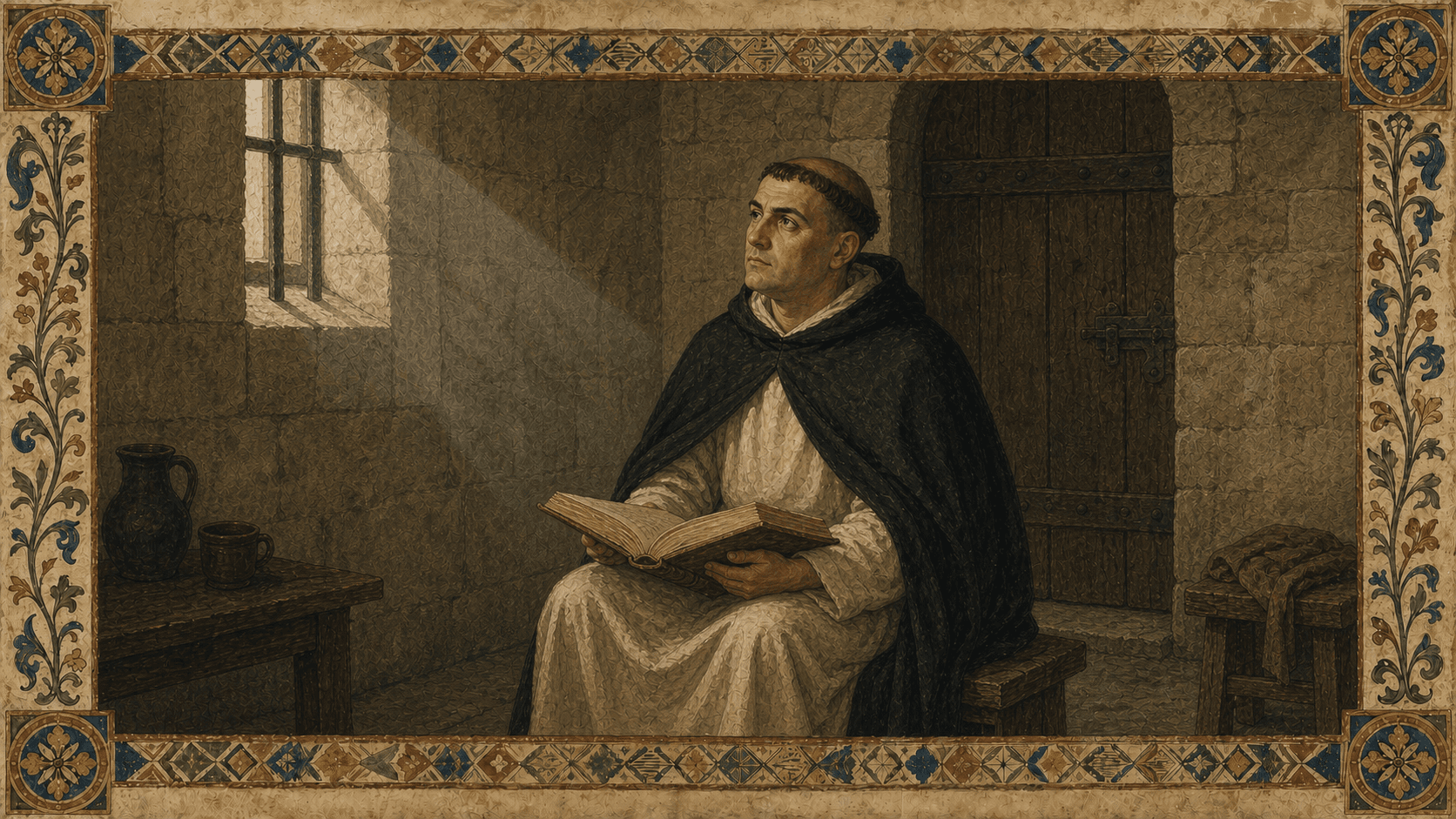
Thomas Aquinas held at Roccasecca by his family after joining the Dominicans, shown in a restrained castle interior.
Roccasecca, family pressure, and the Dominican habit.

His family tried to stop him. According to his early biographers, his brothers seized him on the road as he traveled north and brought him back to Roccasecca, where his mother and siblings held him under guard in the family castle for the better part of a year, by some accounts longer, working in turns to argue, shame, and tempt him out of his vocation.

The biographers report that at one point his brothers sent a woman into his room to seduce him out of his resolve. Thomas drove her from the room with a burning brand snatched from the fire, then traced a cross on the door with the charred end and went back to prayer. The story is tradition, preserved in the Lives written for his canonization; it is not in any document from the year it describes. What is certain is that the confinement happened, that it failed, and that his own family eventually let him go.

He returned to the Dominicans. They sent him to Paris and then to Cologne to study under Albert the Great, the one teacher in Europe who had already grasped what Aristotle was going to mean for Christian thought.

He had given up a castle for a begging order, and a family for a habit. He never seems to have looked back.

Cologne

The dumb ox.

Thomas was large, slow-moving, and quiet. In the lecture halls of Cologne his classmates took his silence for dullness and nicknamed him the dumb ox of Sicily. One of them, out of pity, offered to help him with his lessons. Thomas accepted the help without correcting him.

Albert the Great knew better. When he finally drew Thomas out in a disputation and heard the depth of what the silent student had been thinking, the early tradition says Albert judged that the bellowing of this ox would be heard throughout the world.

The judgment was exact. Within a few years Thomas was teaching in his own right — in Paris, in Rome, in Naples, at the papal court — and the questions he was answering were the largest the age could pose.

The Mind

Faith and reason.

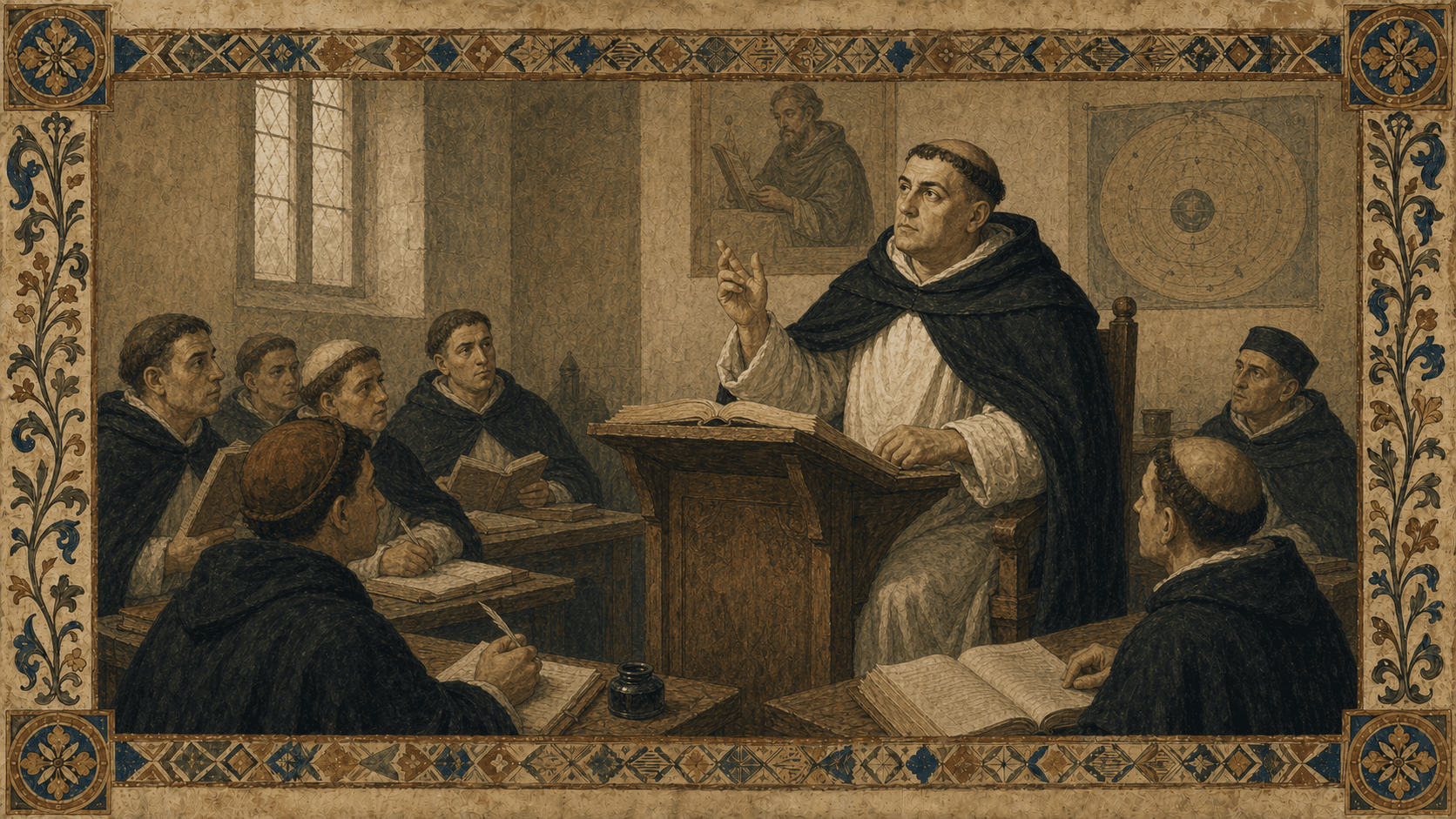
Thomas Aquinas teaching in a medieval disputation with Aristotle's works and students gathered around him.
The medieval disputation: objections first, then an answer.

The problem Thomas inherited was new and dangerous. The complete works of Aristotle had just reached the Latin West, mostly through Arab and Jewish scholars, and they were intoxicating. Here was a pagan philosopher, dead for fifteen hundred years, who had explained the natural world with a rigor no Christian thinker had matched. Some scholars wanted to embrace Aristotle and quietly let the faith bend around him. Others wanted Aristotle banned outright as a threat to belief.

Thomas did neither. He argued, across thousands of pages, that the truth of reason and the truth of faith cannot contradict each other, because both come from God — the God who is the author of the natural mind and the author of revelation alike. Where they seem to conflict, either the reasoning is bad or the faith has been misunderstood. Reason cannot reach all the way to God on its own; it cannot discover the Trinity or the Incarnation. But it can go a long way, and everything it truly finds is God's truth.

This sounds abstract. It is in fact one of the most consequential ideas in the history of the Church. It is the reason Catholicism has never had to choose between belief and the life of the mind. It is why a Catholic can study the sciences, read the philosophers, follow an argument wherever it honestly leads, and remain a Catholic. Thomas built the bridge that the Western Church has walked on ever since.

He worked it out in the open, in the medieval disputation — a public, adversarial exercise in which a master had to take the hardest objections to his position, state them better than his opponents could, and then answer them. The Summa Theologiae is built in that form. Every article begins with the strongest arguments against what Thomas is about to teach. He never hides from the best case for the other side. He states it, and then he answers it.

Masterwork

The Summa.

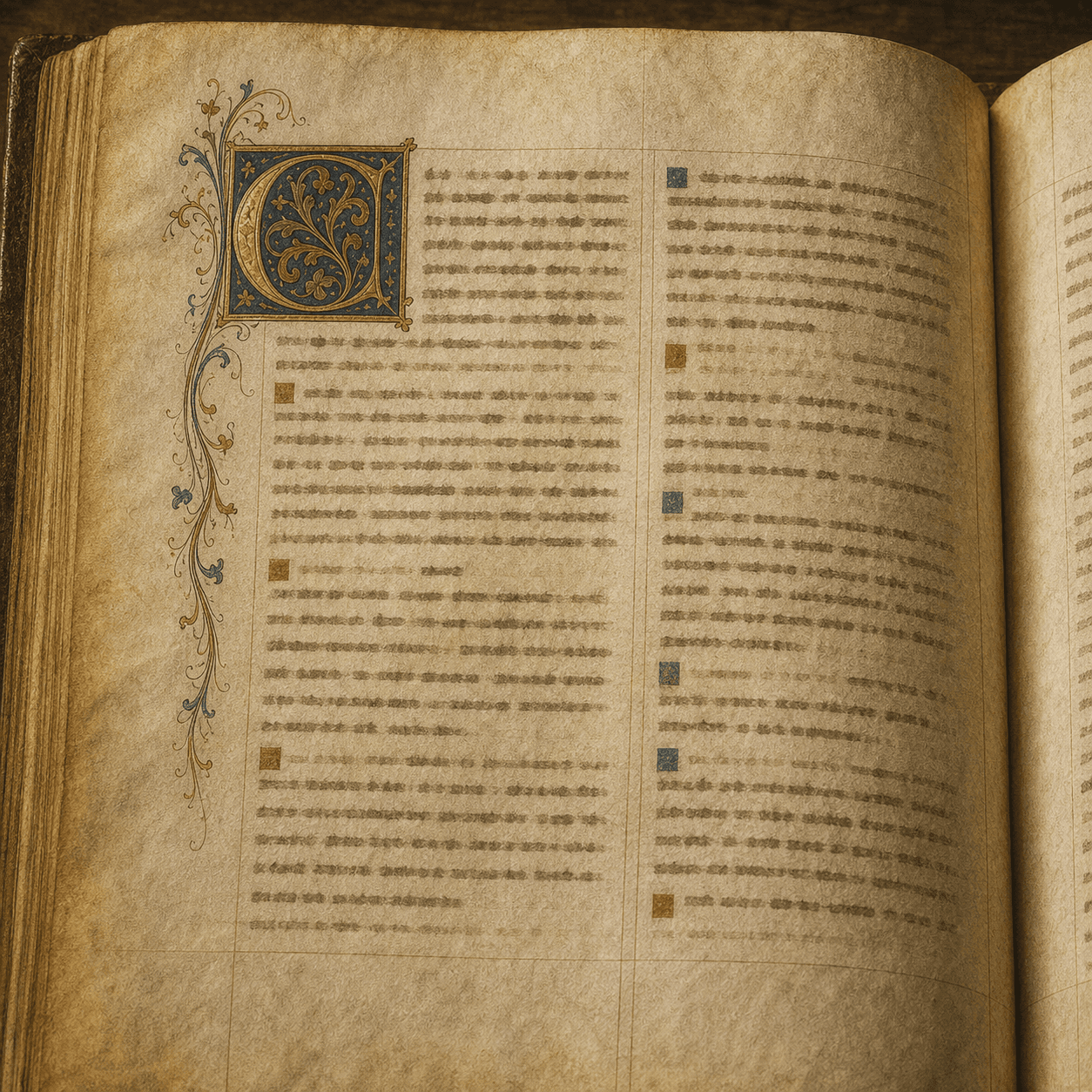
A manuscript-style page for the Summa Theologiae with ruled lines and illuminated scholastic ornament.
The Summa as manuscript: questions, objections, answers.

The Summa Theologiae— the "summary of theology" — was meant as a textbook for beginners. It is enormous. It runs to thousands of articles across three vast parts, moving from God, to creation, to the moral life, to the virtues, to Christ and the sacraments. He never finished it.

What makes it more than a reference work is the shape of every page. Thomas asks a question — Does God exist? Is it lawful to kill? Can a person be happy in this life? Did Christ have to suffer? — and then he refuses to answer it until he has stated the case against his own position as forcefully as anyone could. Only then does he give his judgment, and then he answers each objection in turn. The method is patient, fair, and relentless. It assumes that the truth has nothing to fear from the hardest question.

The Summa gave the Church a common language. For centuries it was the framework in which Catholic theology was taught, argued, and developed. Leo XIII later repeated the tradition that the Council of Trent kept it on the altar beside the Scriptures. Popes have urged its study for seven hundred years. When the Church wanted, in the modern age, to recover a serious intellectual tradition, it returned to Thomas first.

It is also, page by page, a school of how to think honestly — how to disagree without distortion, how to hold a hard question open long enough to answer it well. That alone would make it worth reading. That it is also right about most of what matters is the reason the Church has never let it go.

The Eucharist

Corpus Christi.

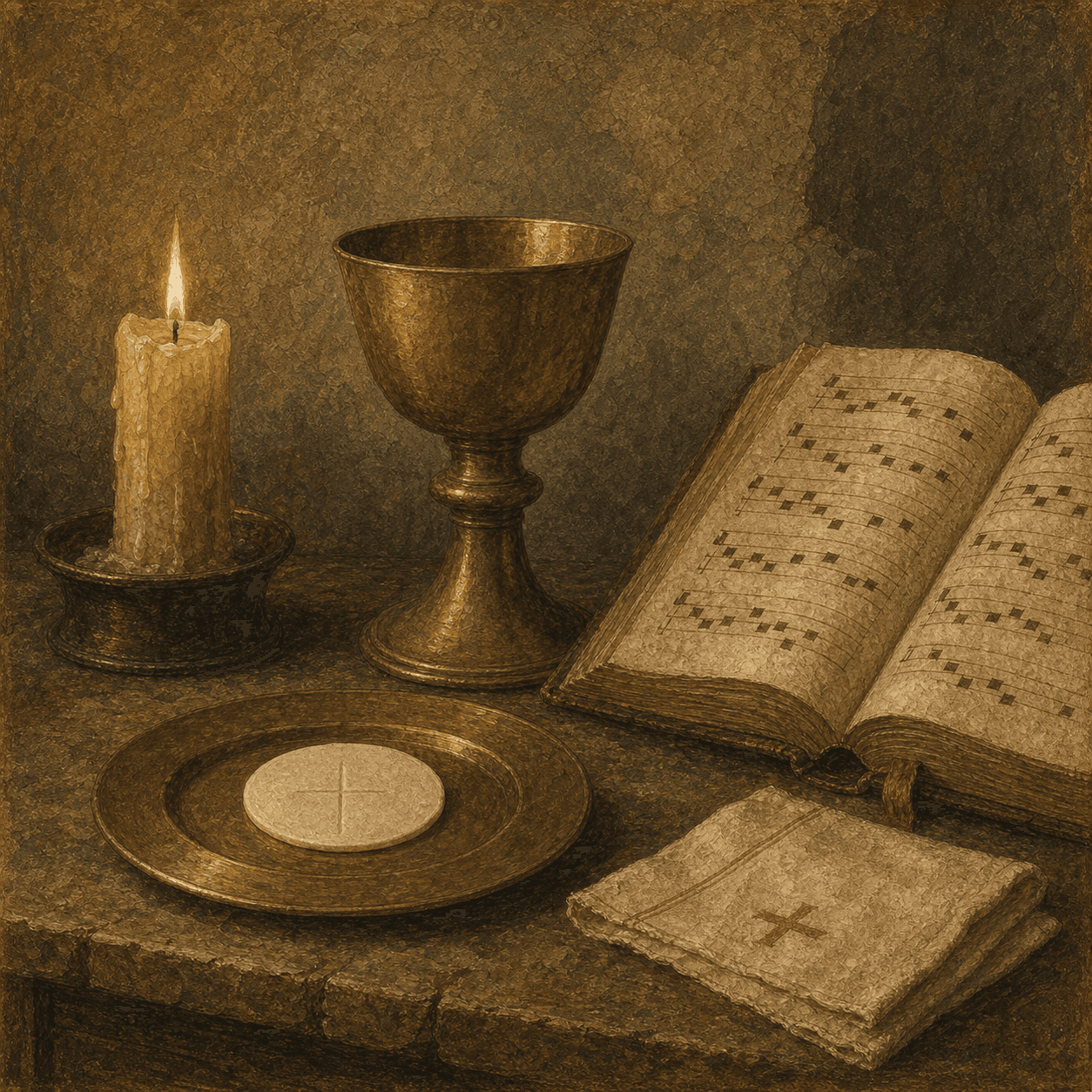
A Eucharistic still life for Aquinas with chalice, host, candle, manuscript, and Dominican restraint.
Chalice, host, manuscript, and candle.

Thomas was a poet as well as an arguer, and the place the two met was the Eucharist.

Around 1264, Pope Urban IV established the feast of Corpus Christi — the Body of Christ — for the whole Church, and asked Thomas to compose its Mass and Office. What Thomas wrote for that feast is still sung. The hymns Pange Lingua, whose final two verses are the Tantum Ergo sung at Benediction; Sacris Solemniis, whose verse Panis Angelicus is one of the best-known pieces of sacred music in the world; Verbum Supernum, which gives us the O Salutaris Hostia; and the sequence Lauda Sion are all his.

This is worth pausing on. The man who wrote the most rigorous theology in the history of the Church also wrote some of its most tender devotion, and he saw no tension between the two. The same mind that could dismantle a philosophical objection in four sentences knelt in front of the Blessed Sacrament and wrote poetry to it. For Thomas the Eucharist was the point where the whole structure of theology came to rest — where what the mind cannot fully grasp, faith adores.

The hymn Adoro te devote, traditionally attributed to him, captures the same conviction: what the senses fail to perceive, firm faith holds. It is the Summa, set to music.

Naples

The straw.

Thomas Aquinas laying down his pen near the end of his life after the experience that made his writings seem like straw.
Thomas lays down the pen, and the Summa remains unfinished.

On December 6, 1273, while saying or hearing Mass at Naples, something happened to Thomas. He never described it in detail. Afterward he stopped writing and would not continue the Summa, which he left unfinished.

His secretary and friend Reginald of Piperno, alarmed, begged him to go back to work. The early Life by William of Tocco records his answer: he could not, because everything he had written seemed to him like straw.

It is the most famous sentence in the story of his life, and the Church has read it carefully for seven hundred years. It is not a renunciation of his work. Thomas did not say his theology was false; he said that next to whatever he had been given to see, it was straw — light, dry, fit to be blown away. The greatest theologian in the history of the Church spent his last months in silence, having concluded that the reality his thousands of pages pointed at was greater than the pages by an order he had not previously imagined.

A few weeks later he set out for the Second Council of Lyons, summoned there by the pope. He never arrived.

Fossanova

His death.

He fell ill on the journey north. He stopped at the Cistercian abbey of Fossanova, between Naples and Rome, and could go no farther. The monks cared for him there. He asked for the Blessed Sacrament; the traditional accounts record his last words as a profession of faith in the Eucharist he had spent his life defending and adoring.

He died at Fossanova on March 7, 1274. He was about forty-nine years old.

He had been a friar for roughly thirty years. In that time he had written more, and more carefully, than seems humanly possible — and had ended by calling it straw. The Church canonized him forty-nine years later, in 1323. Two and a half centuries after that, in 1567, Pope St. Pius V named him a Doctor of the Church and gave him the title by which he is still known: the Doctor Angelicus, the Angelic Doctor.

His relics were moved in 1369 to Toulouse, the city where the Dominican Order had been born, and they remain there today in the Church of the Jacobins.

Doctor of the Church

The Church keeps returning to him.

There are now thirty-eight Doctors of the Church. Thomas holds a place among them that is genuinely unique: no other theologian has been so consistently and so emphatically commended to the whole Church by the popes.

For seven centuries the Church has returned to him. In 1879, Pope Leo XIII wrote an entire encyclical, Aeterni Patris, urging the recovery of Thomas's thought as the surest guide for Catholic philosophy and theology. The Code of Canon Law directs that seminarians be formed in his method and principles. The Catechism of the Catholic Church quotes him repeatedly. When a modern Catholic wants to know what the Church actually teaches and why, the road very often runs through Thomas.

He is not infallible, and the Church has never treated him as if he were. He worked some questions harder than others; later theology has refined him in places. But the structure he built — faith and reason as allies, not rivals; the careful, fair, adversarial pursuit of the truth; the conviction that the natural world is real and good and knowable because God made it — is load-bearing in Catholic thought to this day.

For Today

Why he matters now.

He matters now because he is the saint for anyone who has been told that they have to choose between faith and thinking.

That choice is offered constantly, from both directions. One side says that to be a serious believer you must close your mind — stop asking, stop reading, stop following the argument. The other side says that to be a serious thinker you must give up your faith. Thomas spent his life proving that both are wrong. He was the most rigorous thinker of his century and one of its great saints, and the two facts are not in tension. They are the same fact.

He matters, too, because of how he argued. In an age that mistakes volume for victory and treats the other side's position as something to be caricatured and shouted down, Thomas modeled the opposite. He would not answer a question until he had stated the case against himself so well that his opponents could not have done it better. He assumed the truth could survive the hardest objection — and so he went looking for the hardest objection first. There is no more countercultural intellectual habit available today.

And he matters because of the straw. The man who out-thought everyone ended his life convinced that what he had seen of God made his entire life's work look small. That is not a failure of the mind. It is the mind arriving, finally, at the edge of what it was made for. Thomas is the patron of students and scholars not because learning is the highest thing, but because he showed where learning, honestly pursued, eventually leads.

Reading Trail

Where to read him.

A reading sequence, in order:

  1. The Eucharistic hymns — start here. Pange Lingua, Adoro te devote, Lauda Sion. They are short, they are sung, and they show you the heart before you meet the system.
  2. The Summa Theologiae, selected articles — do not start at page one and read straight through. Read the five ways (I, q. 2, a. 3), the treatment of happiness (I-II, qq. 1-5), and the articles on the Eucharist (III, qq. 73-83). Notice the structure: objections first, then his answer.
  3. The Catena Aurea — Thomas's golden chain, a verse-by-verse commentary on the Gospels woven entirely from the Church Fathers. A good way to read Scripture with the early Church.
  4. Summa contra Gentiles — for serious students. His case for the Christian faith made to those who do not share it, argued largely from reason.

Most of Thomas's works are available in older public-domain English translations; the Summain the Dominican Fathers' translation is freely available online. For modern reading, the translations from the Aquinas Institute and the older Benziger edition are both widely used.

A Word of Aquinas

Nothing but you.

The sentence comes from the tradition preserved by William of Tocco, Thomas's earliest biographer. A voice from the crucifix asked what reward he wanted for what he had written: You have written well of me, Thomas; what reward will you have?

Thomas's answer, in the traditional Latin, was Non nisi te, Domine. Nothing but you, Lord.

It is the sentence that holds his whole life. He had been offered, in the vision, anything — and the most learned man in the Church asked for nothing he could study, write, or possess. He asked for God. William of Tocco tradition

The man who knew more than anyone about God wanted, in the end, only God. Everything else — including his own incomparable work — was straw.

Connected Saints

A family of holiness.

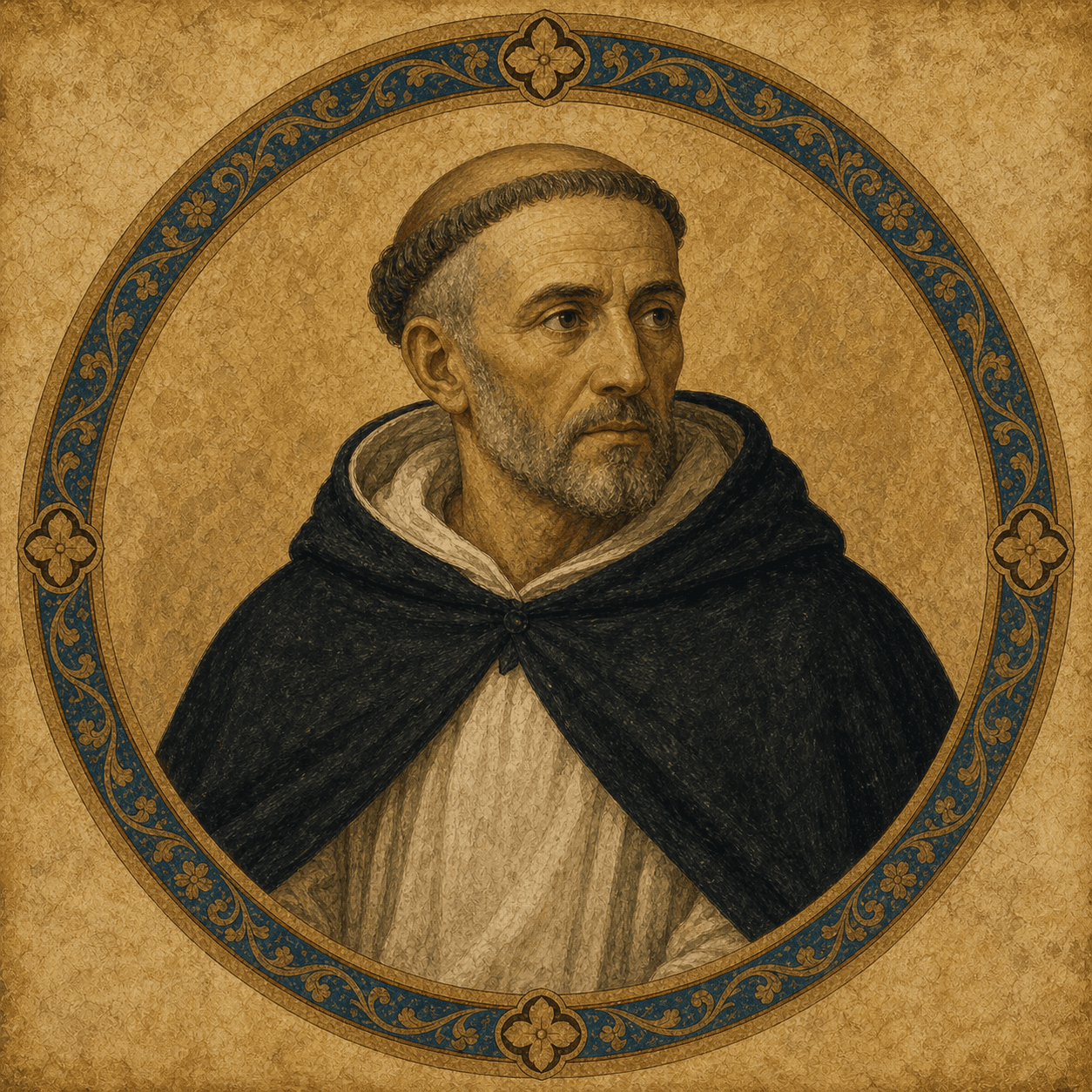
Portrait medallion of St. Albert the Great, Dominican teacher of Thomas Aquinas.

St. Albert the Great

His teacher. The Dominican master at Cologne who recognized the silent dumb ox and knew his voice would be heard.

Portrait medallion of St. Dominic, founder of the Order of Preachers.

St. Dominic

Founder of the Order of Preachers, the begging friars Thomas joined against his family's plans.

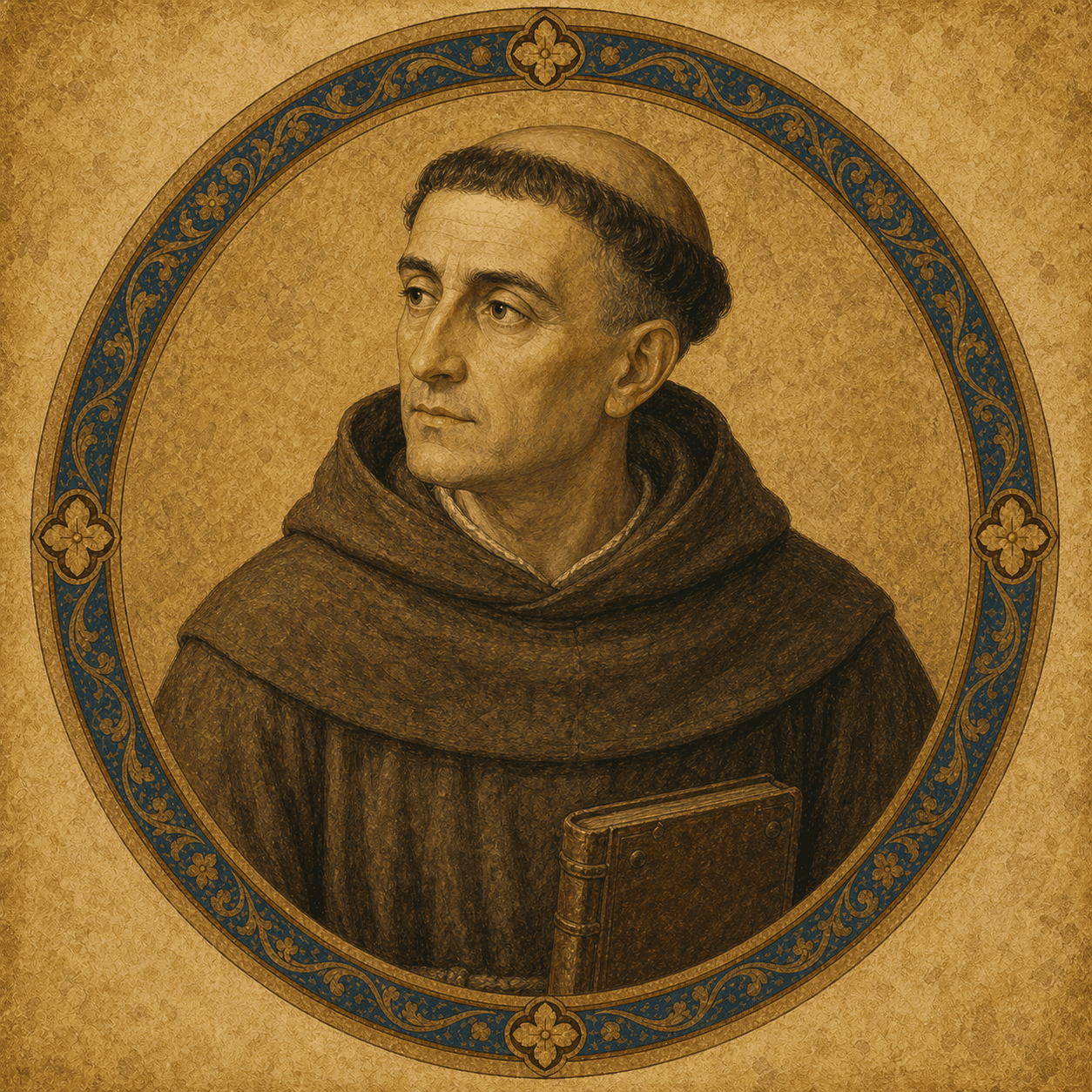
Portrait medallion of St. Bonaventure, Franciscan theologian and Doctor of the Church.

St. Bonaventure

The great Franciscan theologian, Thomas's friend and contemporary at Paris, and a Doctor of the Church.

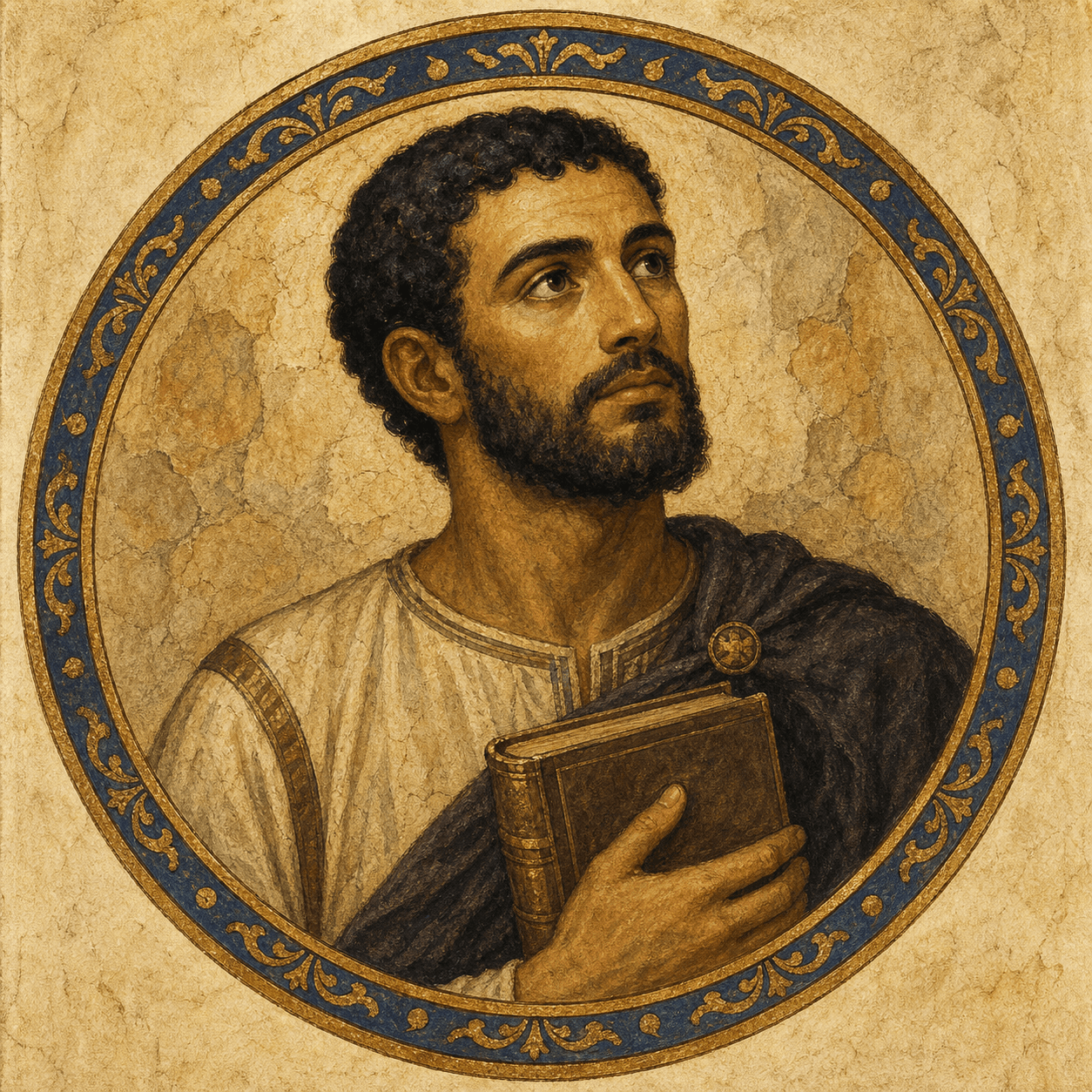
Portrait medallion of St. Augustine of Hippo, Latin Doctor of the Church.

St. Augustine of Hippo

The Latin master whose theology Thomas inherited, honored, and built upon with a Dominican mind.

Frequently Asked

Aquinas, plainly.

Who was St. Thomas Aquinas?+
He was a thirteenth-century Italian Dominican friar, priest, and theologian — the most influential theologian in the history of the Western Church. He showed that Christian faith and human reason come from the same God and cannot finally contradict each other, wrote the Summa Theologiae, composed the liturgy and hymns of Corpus Christi, and is honored as a Doctor of the Church with the title Doctor Angelicus, the Angelic Doctor. His feast is January 28.
Why is his feast on January 28 and not the day he died?+
He died on March 7, 1274, and that was his feast for centuries. In the 1969 reform of the calendar his feast was moved to January 28, the anniversary of the transfer of his relics to Toulouse in 1369, because March 7 almost always falls in Lent. The move lets his memorial be celebrated freely.
Why was Aquinas called the dumb ox?+
He was large, heavy, and quiet, and his fellow students at Cologne mistook his silence for slowness. The nickname was theirs. His teacher, Albert the Great, corrected them after hearing Thomas argue, saying that the bellowing of this ox would be heard throughout the world. The judgment proved exact.
What did Aquinas mean when he said his work was like straw?+
After an experience at Mass in December 1273 he stopped writing and left the Summa unfinished. When his friend Reginald begged him to continue, the early Life by William of Tocco says Thomas answered that everything he had written seemed to him like straw. He was not saying his theology was false. He was saying that next to whatever he had been given to see of God, even his greatest work was light and dry by comparison.
Did Aquinas write the hymn Tantum Ergo?+
Yes. Tantum Ergo is the final two verses of his hymn Pange Lingua, written for the feast of Corpus Christi around 1264 at the request of Pope Urban IV. He also wrote Sacris Solemniis, source of Panis Angelicus; Verbum Supernum, source of O Salutaris Hostia; and the sequence Lauda Sion. The hymn Adoro te devote is traditionally attributed to him as well.
Is the Summa Theologiae finished?+
No. Thomas stopped writing in December 1273 and died about three months later, leaving the third part incomplete. His followers later assembled a Supplement from his earlier writings to fill the gap, but the Summa as Thomas left it ends unfinished — stopped by the experience that made his own work look like straw to him.
What is Aquinas the patron saint of?+
By long tradition he is the patron of students, universities and Catholic schools, theologians and philosophers, and booksellers. Because he united deep learning with deep holiness, he is the saint Catholics turn to for help in study and in the honest use of the mind.

Sources

Read beyond summaries.

Thomas's page distinguishes his own works from the canonization-era Lives. The famous sayings are treated as hagiographic tradition, not contemporary documentary record.

Primary

  • St. Thomas Aquinas, Summa Theologiae, especially I, q. 2, a. 3; I-II, qq. 1-5; and III, qq. 73-83.
  • St. Thomas Aquinas, Summa contra Gentiles; Catena Aurea; disputed questions; commentaries on Aristotle and St. Paul.
  • The Corpus Christi liturgy and hymns: Pange Lingua, Sacris Solemniis, Verbum Supernum, Lauda Sion, and, by tradition, Adoro te devote.

Early Lives

  • William of Tocco, Vita S. Thomae Aquinatis, the early Life prepared for the canonization process and the source tradition for the dumb ox, castle confinement, crucifix vision, and straw saying.
  • Bernard Gui and other canonization-era Lives, read as hagiographic tradition rather than contemporary documentary record.
  • The Catholic Encyclopedia entry on St. Thomas Aquinas for core chronology, canonization, Doctor of the Church status, and biographical tradition.

Magisterial

  • Pope Leo XIII, Aeterni Patris (1879), on the restoration of Thomistic philosophy.
  • Pope John XXII, canonization of Thomas Aquinas (18 July 1323), and Pope St. Pius V, declaration of Thomas as Doctor of the Church (1567).
  • The Catechism of the Catholic Church, which quotes Aquinas repeatedly across doctrine, moral theology, and sacramental theology.
  • Recommended modern scholarship: Jean-Pierre Torrell, Saint Thomas Aquinas: The Person and His Work; G. K. Chesterton, St. Thomas Aquinas: The Dumb Ox; Josef Pieper, Guide to Thomas Aquinas.

Last reviewed: June 3, 2026

On this page+