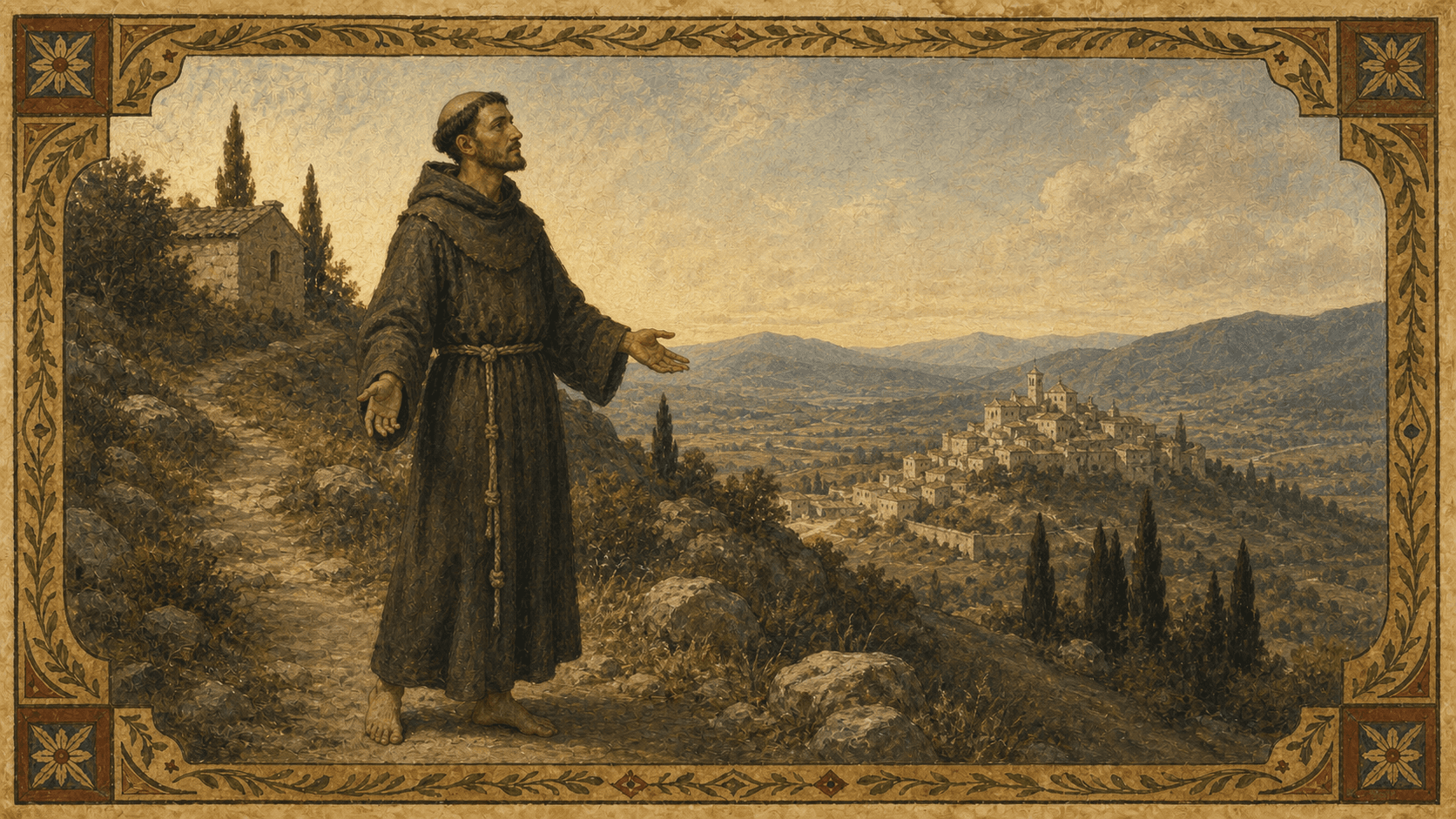
St. Francis of Assisi in a rough grey-brown habit in the Umbrian hills.

Saints Library

Francis of Assisi

Feast October 4 · Founder of the Franciscans · 1181/82-1226

The rich merchant's son who gave away everything he owned, including the clothes off his back, to marry Lady Poverty and live the Gospel without a single exception.

The Story

The saint beneath the garden statue.

Francis was born rich. His father was a cloth merchant prosperous enough that his son spent his youth as the leader of the young revelers of Assisi — fashionable, free-spending, popular, dreaming of becoming a knight and winning glory. He went to war, was captured, spent a long imprisonment in Perugia, came home sick, and somewhere in the convalescence the glory drained out of his ambitions.

He found Christ in two places that revolted him. Riding one day, he met a leper and, instead of fleeing, got down from his horse, embraced the man, and kissed him. Praying in a ruined chapel called San Damiano, he heard the painted crucifix tell him to repair Christ's house, which was falling into ruin. He took it literally at first and began carrying stones.

Then his father hauled him before the bishop, and Francis returned everything: money, inheritance, even the clothes on his back. He walked out of his old life owning nothing. Men began to follow him, then thousands of them, and the Order of Friars Minor was born almost by accident from one man's attempt to live the Gospel exactly as it was written.

Near the end, fasting on La Verna, he received in his own body the five wounds of the Christ he had spent his life imitating. He died two years later at the Portiuncula, laid on the bare ground at his own request, singing.
Assisi

The world he came from.

He was born in 1181 or 1182 in Assisi, a hill town in Umbria, the son of Pietro di Bernardone, a wealthy cloth merchant. Francis grew up with money, fine clothes, songs, friends, and the taste for a beautiful life. He wanted to be a knight. It was the great romantic ambition of his age, and he had the means to chase it.

War with Perugia broke the spell. Francis was captured and spent the better part of a year in prison. He returned home ill, and a later attempt at military glory ended almost before it began, turned back by a dream he did not yet understand. The world he had wanted — wealth, status, knighthood, admiration — began to look like nothing.

He drifted toward the poor, toward ruined country chapels, toward prayer. His father watched the heir to the family business become a man who gave the family's money away. The conflict was not a misunderstanding. Francis's conversion touched his father's purse, and that meant it touched the household order itself.

The Leper

Conquered revulsion.

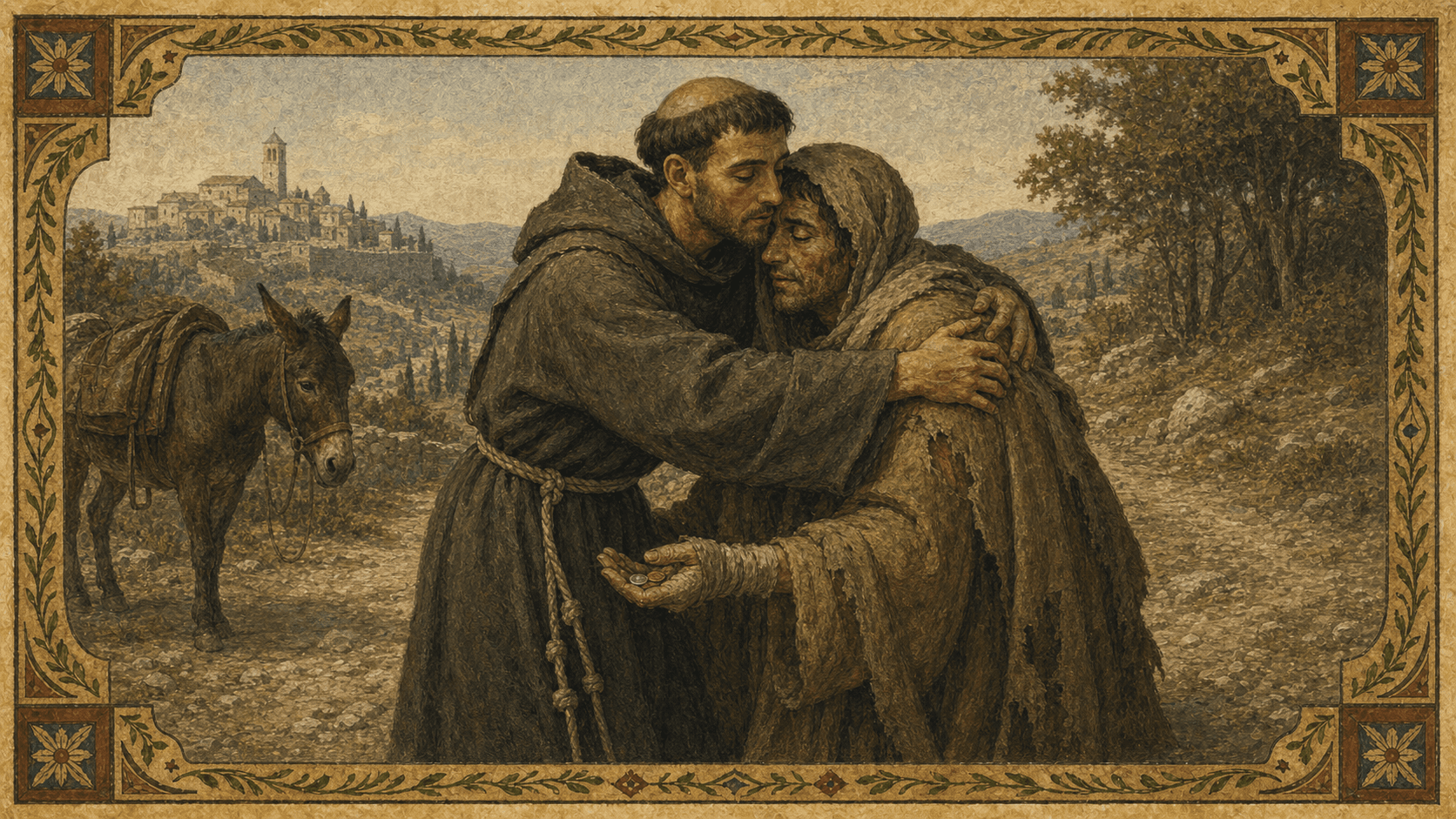
Francis embracing a leper on the road with dignity and restraint.
The embrace is the conversion hinge.

Lepers were the horror of the medieval world — disfigured, contagious, legally cut off, forced to warn others of their approach. Francis, by his own later account, could not bear them. The revulsion was physical and total.

One day, riding outside Assisi, he met one. Instead of turning away, he dismounted, put money in the man's hands, embraced him, and kissed him. In his Testament, Francis remembered the turn: what had seemed bitter was changed into sweetness Testament of St. Francis.

This is the Francis the sentimental picture leaves out. Before the birds and the gentleness, there was a hard act of will, a deliberate embrace of the thing he feared and loathed most. His tenderness was not softness. It was conquered revulsion.

San Damiano

Repair my house.

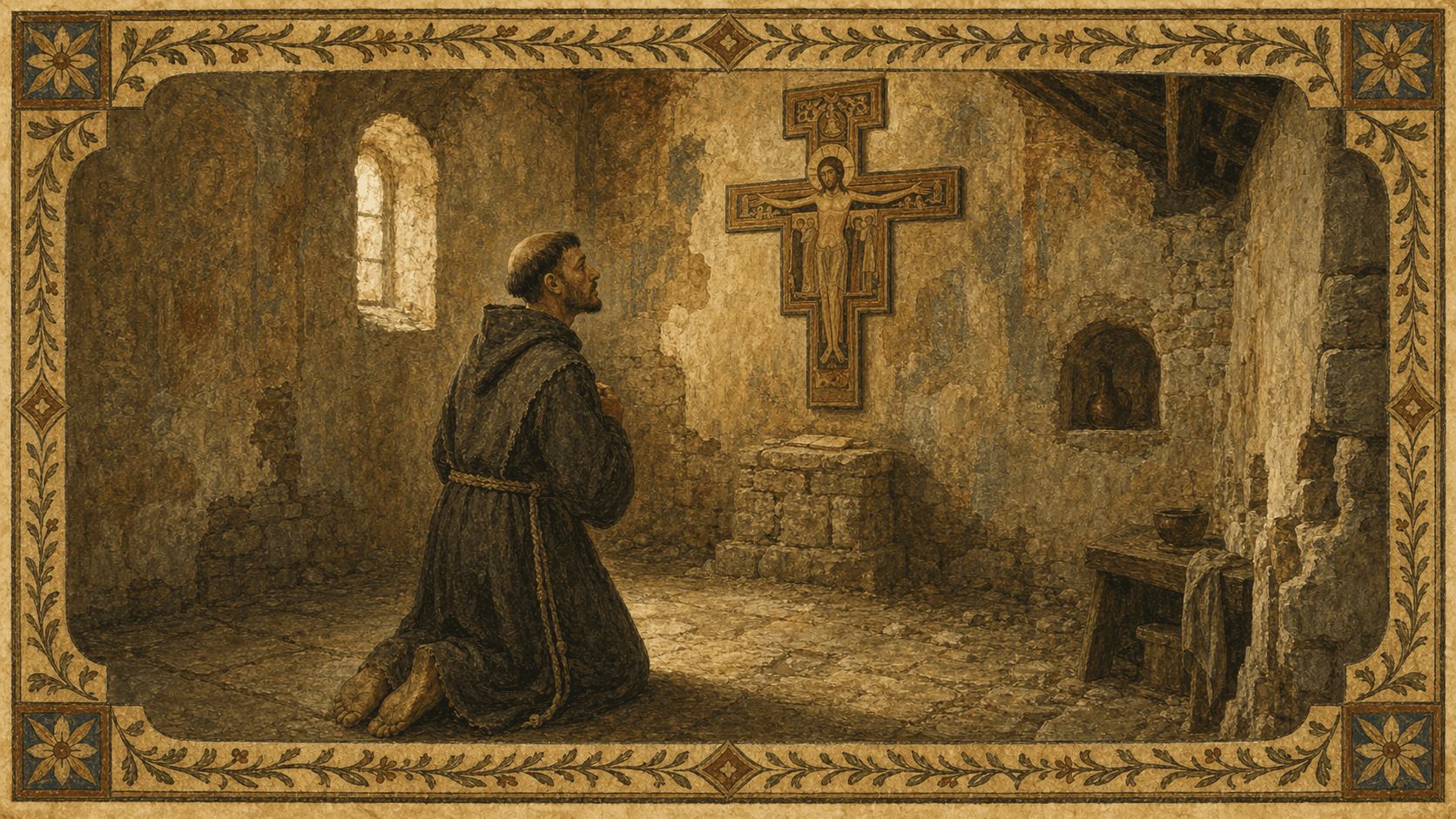
Francis praying before the painted San Damiano crucifix in a ruined chapel.
The call came before the painted crucifix of San Damiano.

Around the same time, praying in the half-ruined church of San Damiano outside Assisi, Francis heard the painted figure on the crucifix speak to him: repair my house, which, as you see, is falling into ruin.

He took the words literally. He began rebuilding San Damiano with his own hands, then other small ruined churches nearby. To pay for the work, he sold cloth from his father's business and tried to give the money to the priest.

Only later did the larger meaning become clear. The house Christ wanted repaired was the Church, and Francis would rebuild it not by office or policy but by a life so radically obedient to the Gospel that the whole Church felt the shock of it.

Renunciation

He gave back even his clothes.

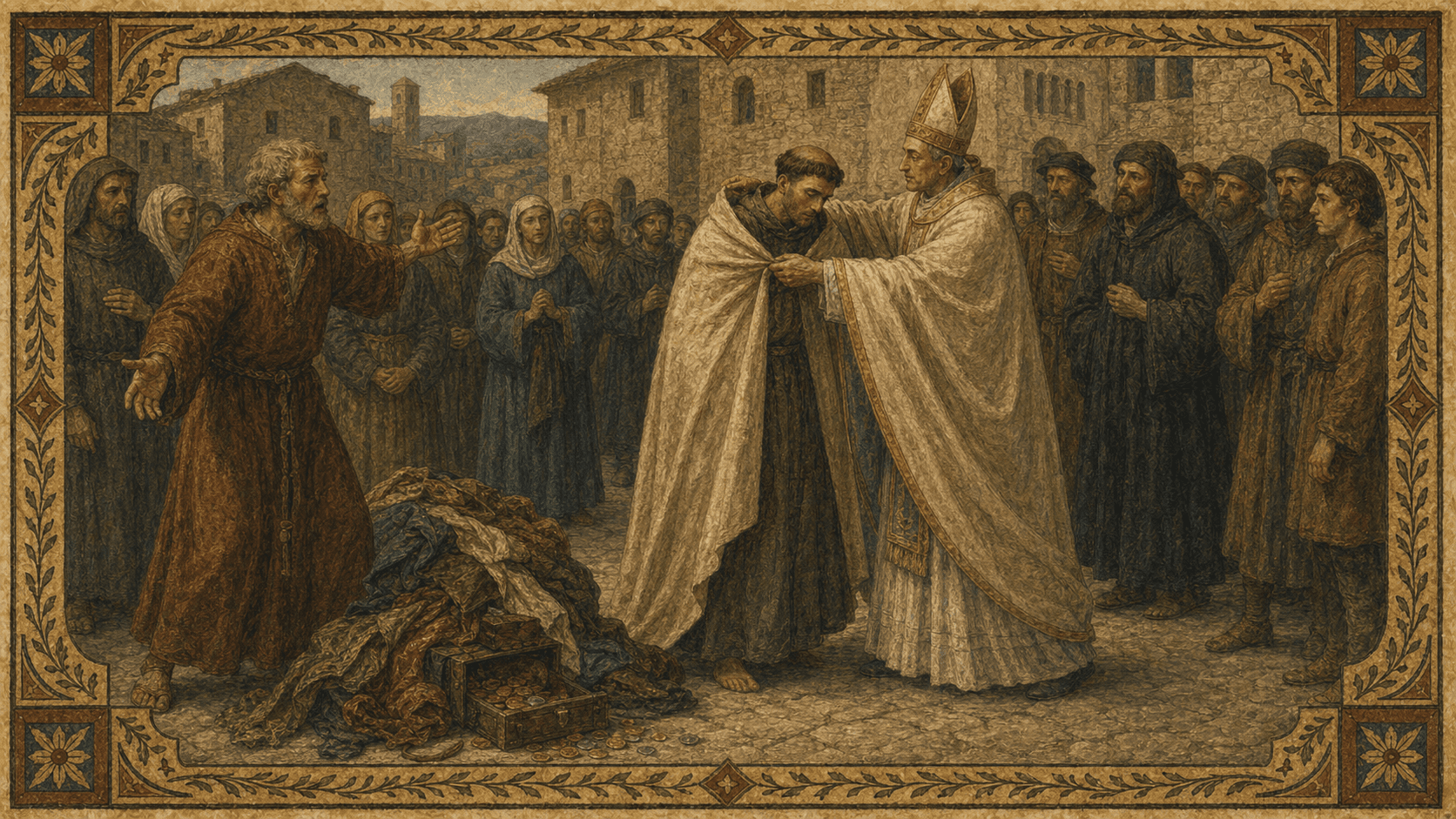
Francis renouncing his father's wealth before the bishop of Assisi.
The bishop's cloak preserves the dignity of the scene.

Pietro di Bernardone wanted his money back, and he wanted his son brought to heel. He brought Francis before the bishop of Assisi to settle the matter publicly.

Francis returned more than the money. In front of the bishop and the town, he took off the rich clothes his father had bought him, placed the money with them, and handed the bundle back. He could now say with complete freedom, he declared, that he had one Father: the Father in heaven.

The bishop covered him with his cloak. Francis walked out of his father's house, his father's wealth, and his father's name. It is the founding gesture of his whole life: the man who owned nothing and therefore had nothing left to defend.

Friars Minor

Lady Poverty and the lesser brothers.

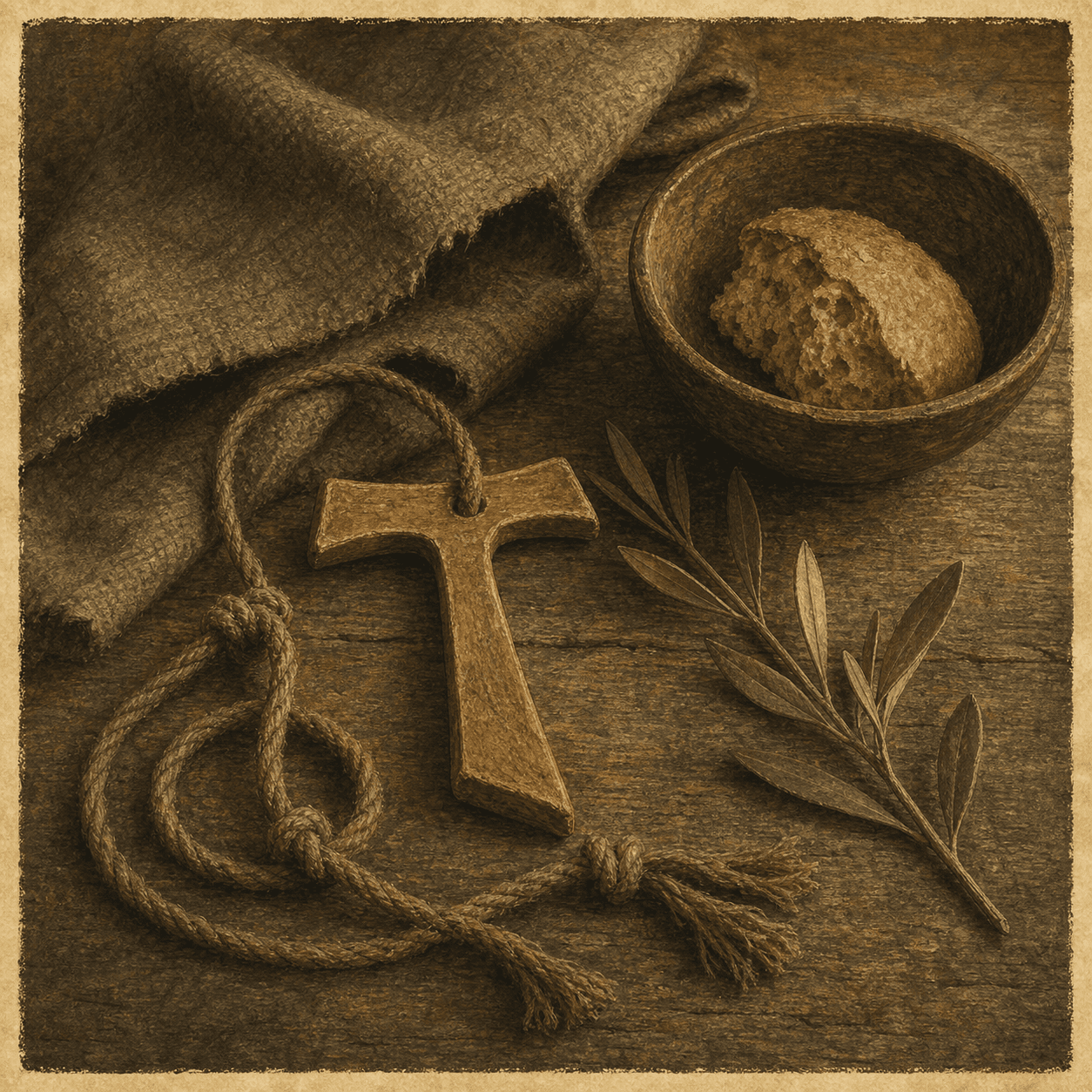
A Franciscan still life with Tau cross, knotted cord, bread, and a small sprig.
Tau cross, cord, bread, and poverty.

Francis did not set out to found an order. He set out to live the Gospel exactly as it was written, and other men asked to do the same. The decisive moment came in 1208, when he heard at Mass Christ's command to go out with no money, no bag, no spare clothes, and to proclaim the kingdom. Francis heard it and recognized his rule of life.

He called his chosen way Lady Poverty. His brothers were to own nothing, not individually and not as a community. They were to work for their bread and beg when work failed, living among the poor as the poorest of all. A man who owns nothing has nothing to lose and nothing to protect.

Men came. First a handful, then many. Francis went to Rome for approval, and Pope Innocent III gave it. The Order of Friars Minor, the lesser brothers, had begun.

Clare

His truest companion.

In 1212, an eighteen-year-old noblewoman of Assisi named Clare heard Francis preach and was set on fire by the same Gospel. On the night after Palm Sunday she left her father's house, met Francis and his brothers, and let him cut her hair and clothe her in a rough habit. Her family tried to take her back. She would not go.

Francis placed Clare and the women who joined her at San Damiano, the first church he had rebuilt. There she founded what became the Poor Clares, the women's branch of the Franciscan movement. Clare embraced poverty as fiercely as Francis did and defended the privilege of poverty for her sisters after his death.

She was his companion in spirit. When Francis was blind and in pain, it was near Clare at San Damiano that he composed the Canticle.

Damietta

Across the battle line.

In 1219, during the Fifth Crusade, Francis crossed the lines between the Christian and Muslim armies at Damietta and asked to see the Sultan, al-Kamil. He went poor, unarmed, and willing to die.

He preached Christ openly. The Sultan did not convert, by the accounts, but neither did he kill Francis. He listened, treated him with courtesy, and sent him safely back. In an age of holy war, Francis crossed a battlefield to meet his enemy face to face and offer him the Gospel.

Greccio

The first Christmas crib.

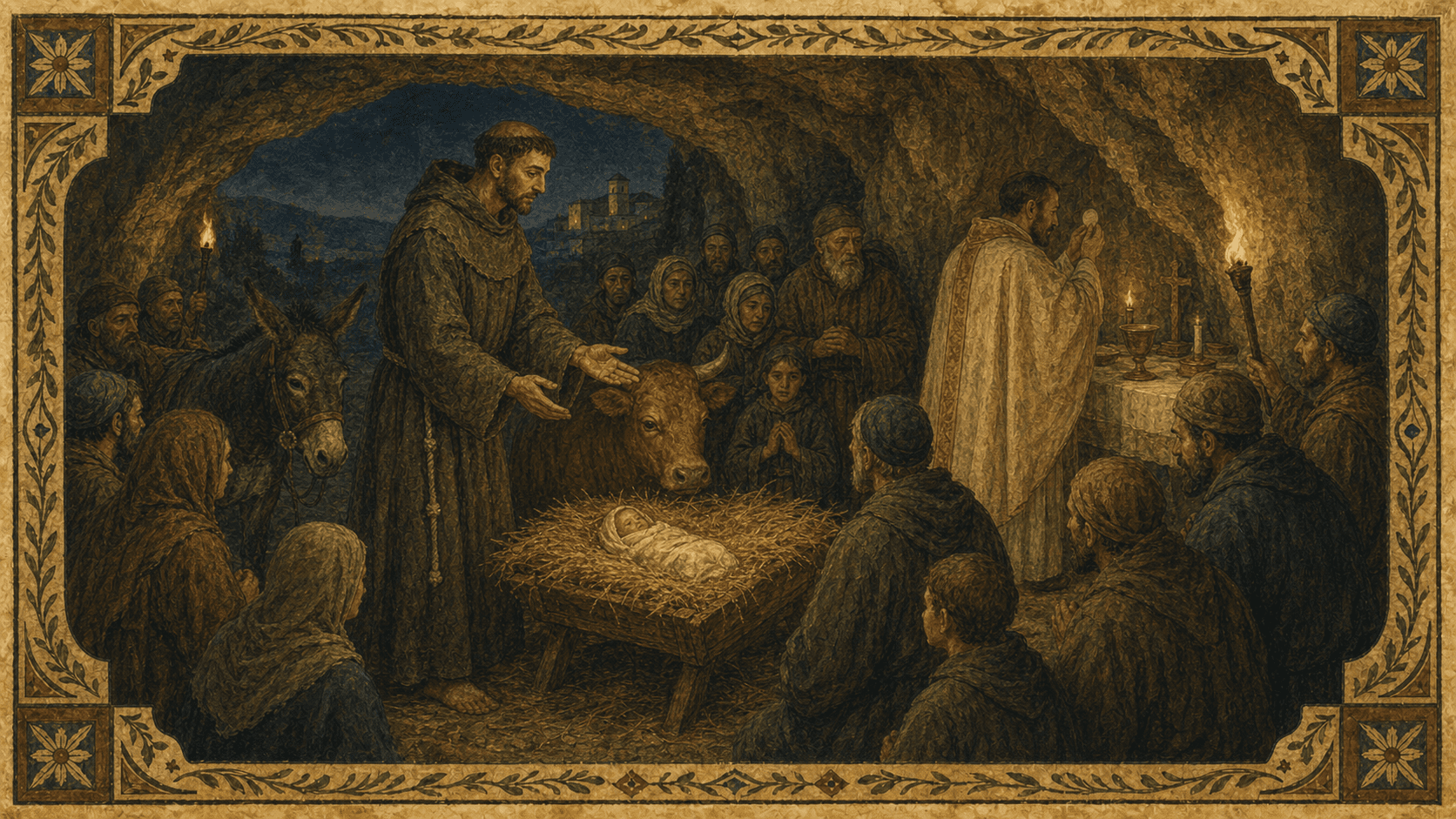
The Christmas crib at Greccio with Francis, villagers, torchlight, and a reverent manger.
The poverty of Bethlehem made visible.

At Christmas of 1223, in the little town of Greccio, Francis arranged a living representation of the Nativity: a manger, hay, an ox and a donkey, the people gathered by torchlight while Mass was offered. He wanted them to see the poverty of Christ's birth — the straw, the cold, the tenderness of God made a child.

Every Christmas crib in church or home descends from that instinct. Francis made the Gospel concrete. He wanted people to touch and see the fact that God had made himself poor and small for love of them.

La Verna

The wounds of the Crucified.

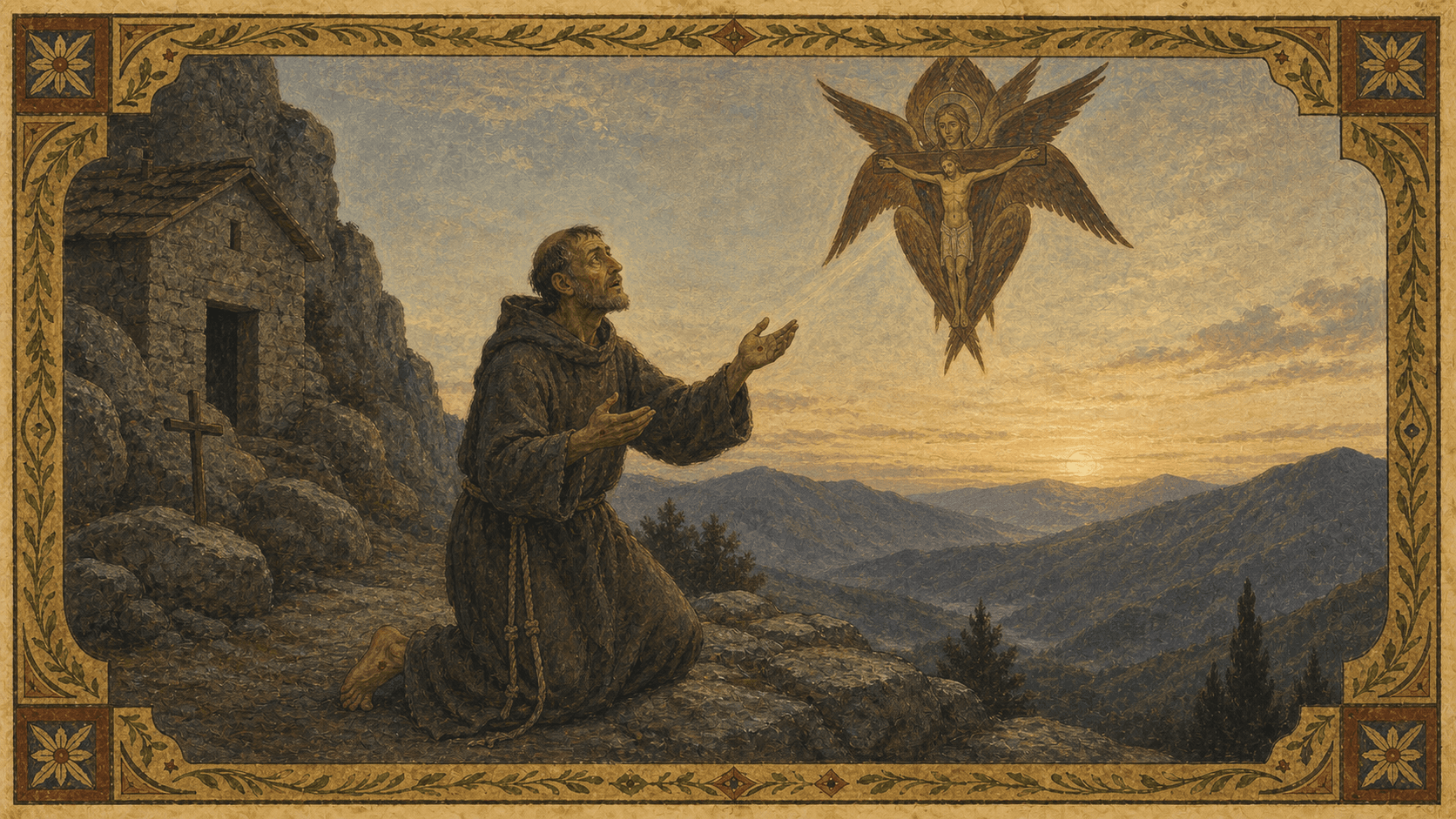
Francis receiving the stigmata at La Verna, shown as restrained marks of light.
The page treats the stigmata as witness, not spectacle.

In the late summer of 1224, two years before his death, Francis withdrew to La Verna for a forty-day fast. He was worn down, nearly blind, and longing to be conformed completely to the crucified Christ.

Around the feast of the Exaltation of the Cross, while he was praying at dawn, he saw a vision of a seraph bearing the figure of the Crucified. When the vision faded, the marks of Christ's wounds appeared on Francis's hands, feet, and side. He bore them for the last two years of his life and tried to keep them hidden.

His is the first recorded case of the stigmata in Christian history, and the early attestation is unusually strong. Brother Leo, who cared for Francis, left written testimony. The Church has not needed to make the event theatrical. A man who spent his life trying to imitate the crucified Christ was, at the end, marked by him.

The Canticle

Creation as praise of the Creator.

In the last year of his life, nearly blind and in constant pain, Francis composed the work that is most purely his: the Canticle of the Creatures, also called the Canticle of Brother Sun.

It is a hymn of praise to God sung through creation. Francis praises God for and through Brother Sun, Sister Moon, Brother Wind, Sister Water, Brother Fire, and Sister Mother Earth. Near the end, sick and dying, he added praise even through Sister Bodily Death, from whom no living person can escape.

It is one of the earliest poems in the Italian language, and it has never stopped being loved. But it is not nature-worship. It is praise of God, the Most High and good Lord, offered through a created world that Francis received as gift.

Portiuncula

He died with nothing.

By autumn of 1226 he was dying. He asked to be taken back to the Portiuncula, the little chapel near Assisi where his movement had begun. At the end, he asked the brothers to lay him on the bare ground, stripped of even his habit, so that he might die as he had lived: poor, holding nothing, in the hands of God.

He blessed his brothers, asked for bread to be broken in memory of the Last Supper, had the Passion according to St. John read aloud, and died singing the psalms. It was the evening of October 3, 1226. He was forty-four or forty-five years old.

Fewer than two years later, on July 16, 1228, Pope Gregory IX canonized him at Assisi. The man who wanted to own nothing is buried under one of the most beloved churches in the world.

Creation

Patron of ecology, not nature-worship.

In 1979, Pope St. John Paul II named Francis patron of ecology. It is a fitting honor and an easily misunderstood one.

Francis loved creation because he loved the Creator. He did not worship nature; he worshiped the God whose handiwork nature is. He saw every created thing as a reason to praise God. The creatures were his brothers and sisters because they shared one Father.

Understood rightly, his patronage is a gift to a confused age. It shows that a Catholic can love the created world precisely because it is created: not God, but charged with the glory of God.

Why Now

The real Francis is better than the sentimental one.

He matters now because he took the Gospel literally, and it worked. Everyone admires the Sermon on the Mount in theory. Francis is the man who actually did it: gave away everything, loved enemies, blessed the poor, took no thought for tomorrow, and found freedom.

His poverty was not contempt for good things. It was freedom from grasping. In a culture arranged around acquiring and keeping, Francis is still disruptive: a rich man who discovered that the way to be free was to let go of everything.

And the sentimental version is a lie. The true Francis is not a garden statue. He is a man who embraced a leper to conquer his own disgust, stripped in a public square to be free of his father's money, crossed a battlefield unarmed, and bore the wounds of Christ. He was gentle because he was first brave.

Reading

Where to read him.

Francis wrote little, and most of what shaped his popular image came later. Go first to the genuine sources: the Canticle, the Testament, the Admonitions, and the early Lives.

Read the Canticle of the Creatures slowly, noticing that every created thing leads back to God. Then read the Testament and the Admonitions, plain words from Francis to his brothers. After that, read Thomas of Celano and Bonaventure. Save the Little Flowers for what it is: beloved legend that catches his spirit without functioning as eyewitness history.

A Word of Francis

The order of the Canticle.

This is how the Canticle begins, and it is the key to everything. Before a single creature is named — before Brother Sun and Sister Water and Sister Mother Earth — there is God, the Most High, the all-powerful, the good, to whom all praise belongs.

Francis does not begin with nature. He begins with the Lord of nature, and only then turns to the creatures, who are praiseworthy because they are his. Get that order right, and you have Francis. Get it wrong, and you have a garden statue.

Connected Saints

A family of holiness.

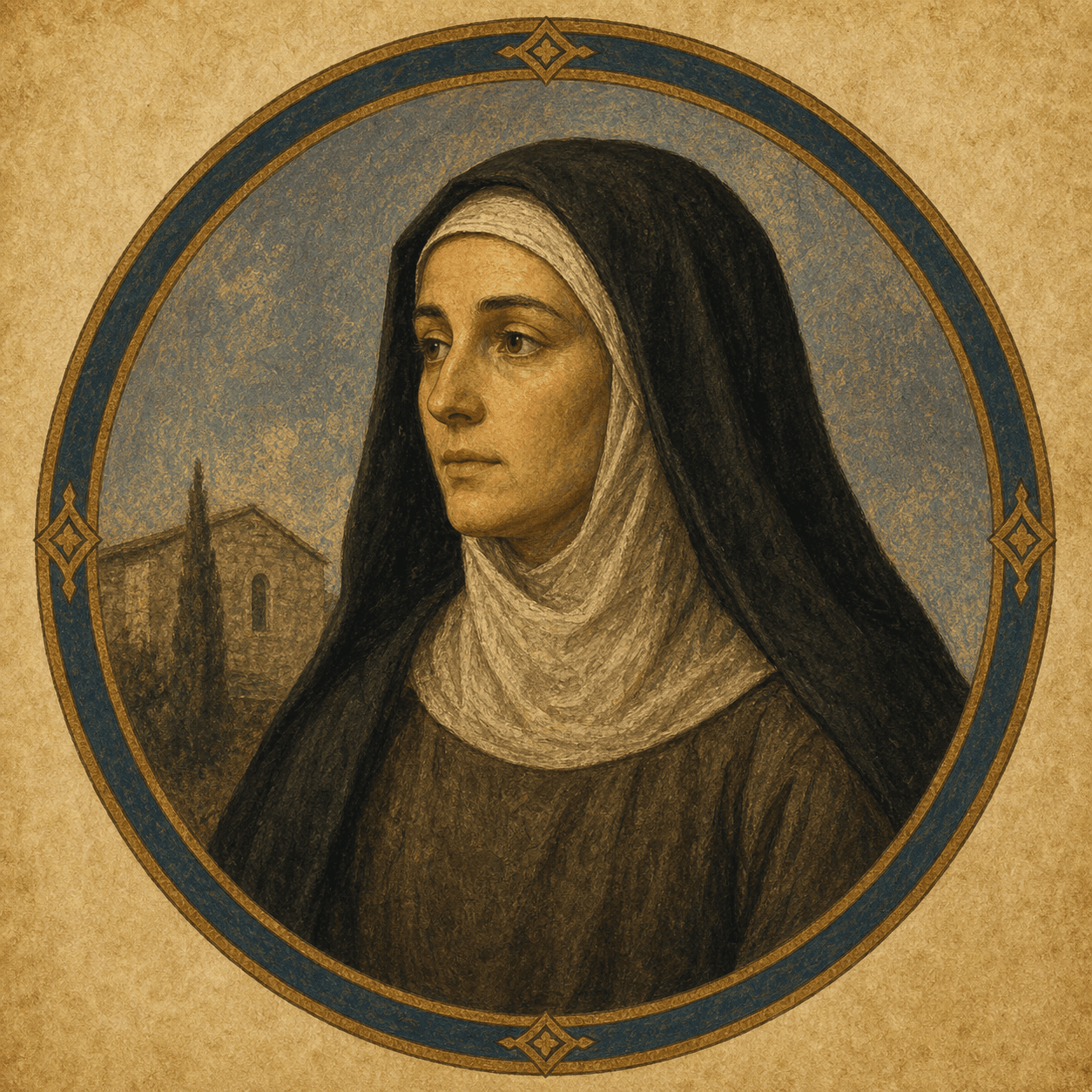
Portrait medallion of St. Clare of Assisi in a Poor Clare habit.

St. Clare of Assisi

His spiritual sister and truest companion, foundress of the Poor Clares at San Damiano.

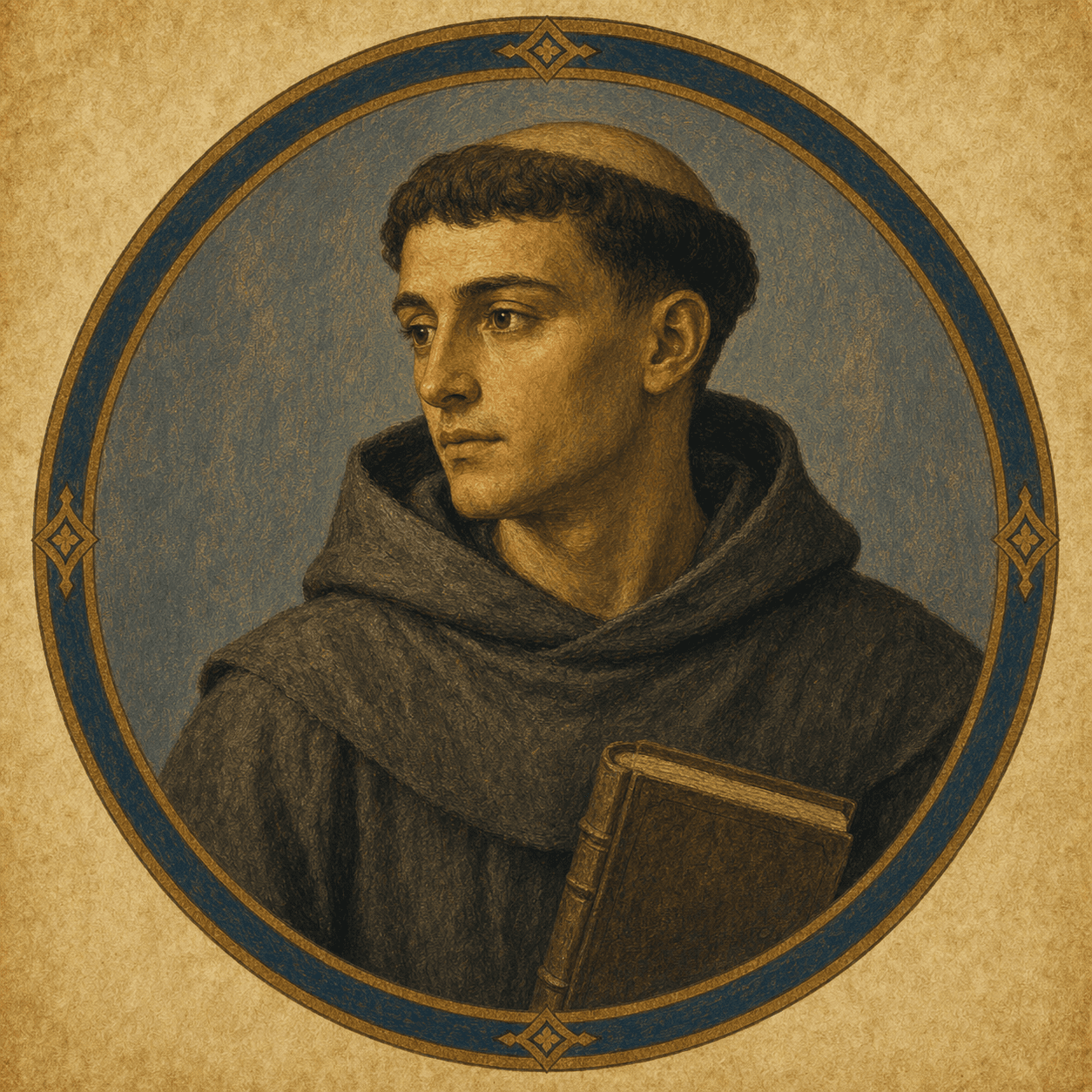
Portrait medallion of St. Anthony of Padua as a young Franciscan Doctor with a book.

St. Anthony of Padua

His famous Franciscan follower, preacher, and Doctor of the Church.

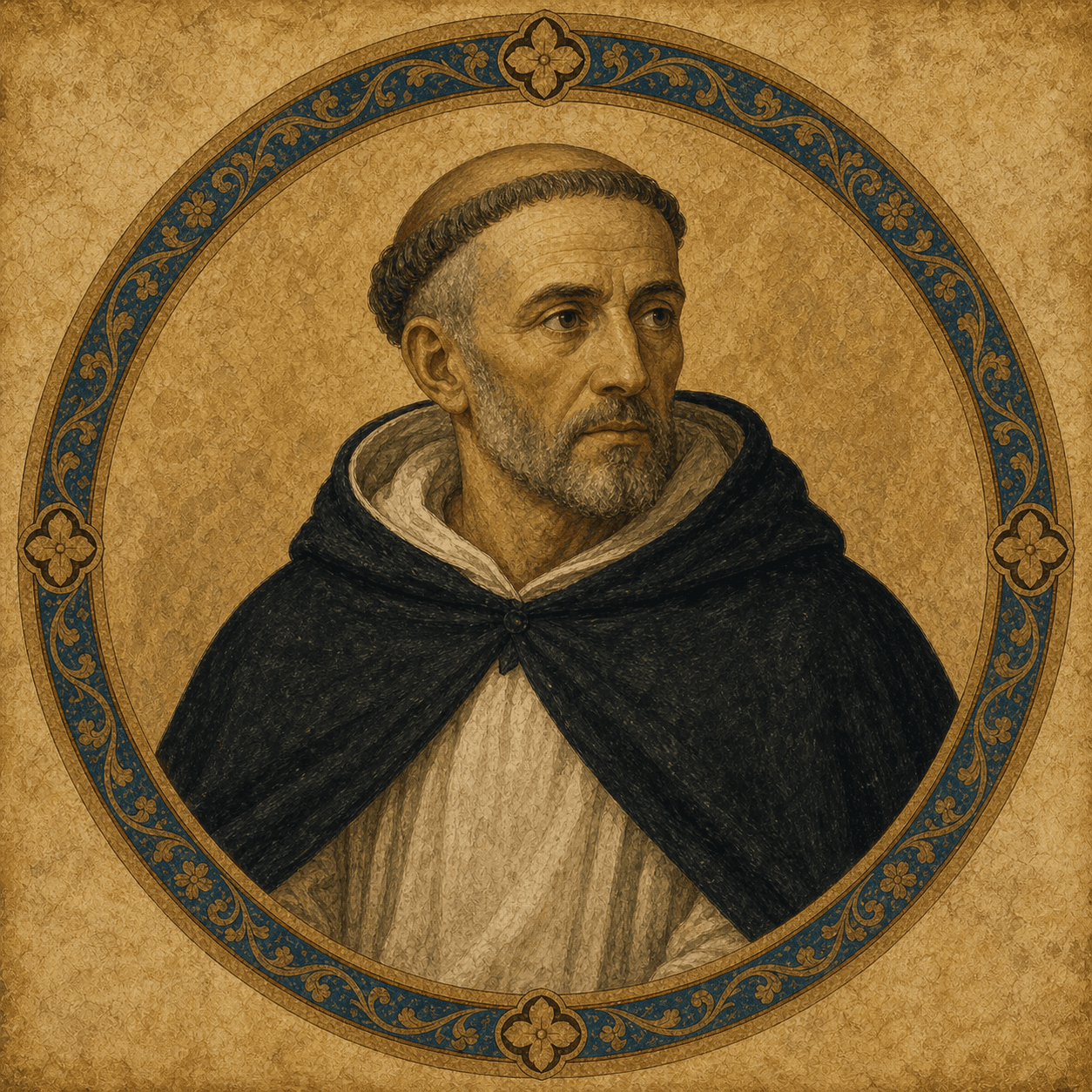
Portrait medallion of St. Dominic, founder of the Order of Preachers.

St. Dominic

His great contemporary, founder of the Preachers, and partner in the mendicant renewal.

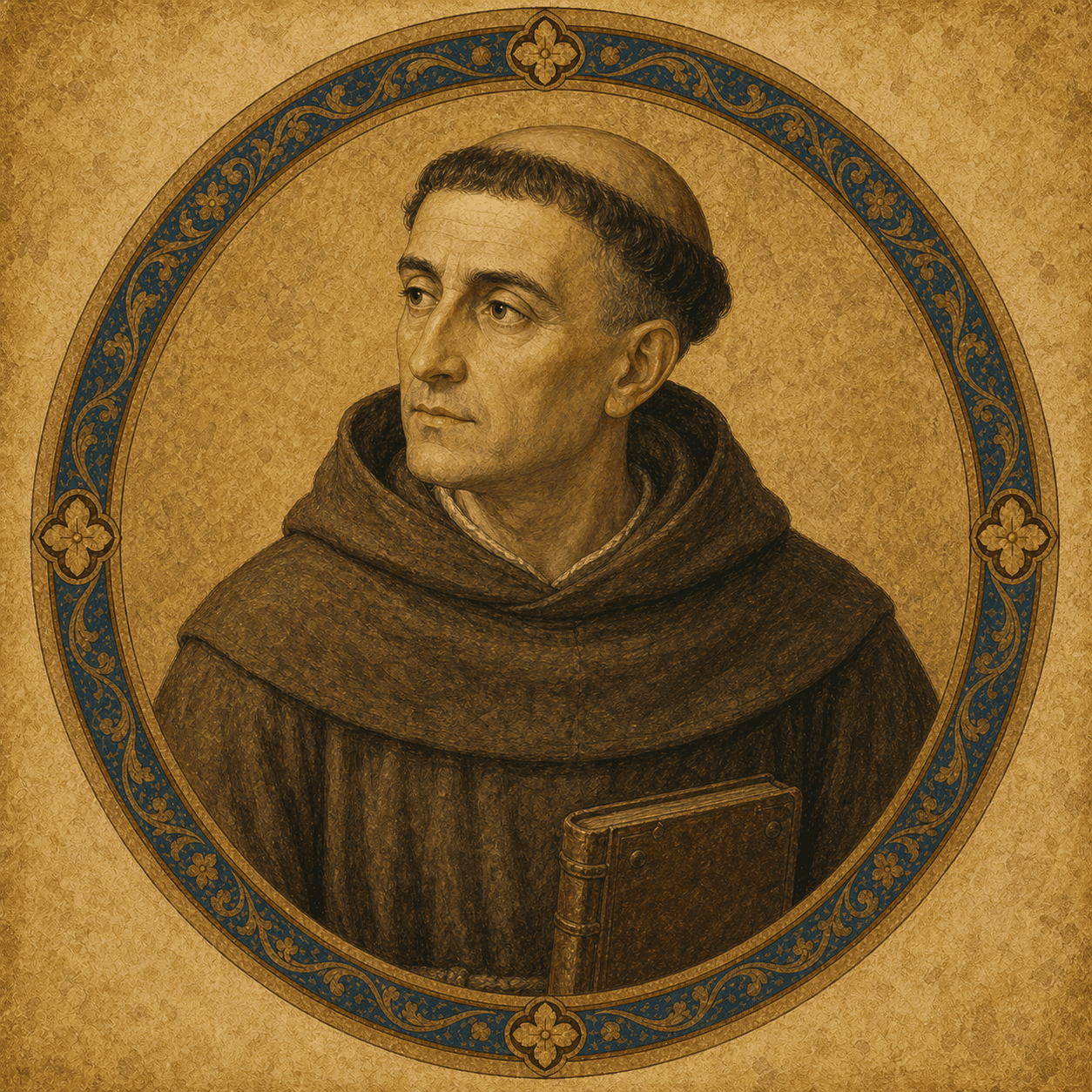
Portrait medallion of St. Bonaventure, Franciscan Doctor of the Church.

St. Bonaventure

The Franciscan Doctor who wrote the official Life of Francis, the Legenda Maior.

Frequently Asked

Questions that keep the real Francis clear.

Who was St. Francis of Assisi?+
He was a thirteenth-century Italian saint, the son of a wealthy cloth merchant, who gave up his possessions to live the Gospel in radical poverty. He founded the Order of Friars Minor, helped St. Clare found the Poor Clares, created the first Christmas crib at Greccio, received the stigmata on Mount La Verna, and wrote the Canticle of the Creatures. He is one of the most beloved saints in history. His feast is October 4.
Did St. Francis write the "Peace Prayer" ("Lord, make me an instrument of your peace")?+
No. Despite being widely called the "Prayer of St. Francis," it is not his and was unknown for the seven centuries after his death. The prayer first appeared anonymously in a small French magazine in 1912 and became associated with Francis later. It beautifully expresses something of his spirit, which is why the connection lasted, but it is a twentieth-century prayer, not a work of Francis. His genuine prayer-poem is the Canticle of the Creatures.
Did St. Francis really talk to animals?+
The famous stories, including preaching to the birds and taming the wolf of Gubbio, come chiefly from the Little Flowers of St. Francis, a cherished collection compiled more than a century after his death. They are legend, not eyewitness history. What is historically firm is that Francis loved creation intensely and saw every creature as a brother or sister under one Father. The Canticle, which is genuinely his, shows the source of that vision.
What are the stigmata, and did Francis really have them?+
The stigmata are the wounds of the crucified Christ appearing on a living person's body. Francis received them on Mount La Verna in September 1224, after a vision of a seraph, and bore them for the last two years of his life. His is the first recorded case in Christian history and unusually strong in early attestation: Brother Leo, who cared for him, left written testimony. The Church reads it as the bodily seal on a life spent imitating the crucified Christ.
Why is St. Francis the patron saint of the environment?+
Pope St. John Paul II named Francis patron of ecology in 1979 because of his profound reverence for creation. But Francis loved nature because he loved the God who made it, not as a substitute for God. He praised the Creator through creatures, calling them brothers and sisters because they share one Father. His is not nature-worship; it is care for creation as God's gift.
Why did St. Francis give away everything he owned?+
Not because he hated good things, but because he discovered that owning nothing made him free — free of grasping, anxiety, and the need to defend what he possessed. He called poverty his Lady and embraced it with joy. The scene of his renunciation, returning even his clothes to his father before the bishop of Assisi, is the founding gesture of that freedom.
Was St. Francis a priest?+
No. Francis was a deacon, not a priest. He remained among the lesser brothers, leading by example, preaching repentance, and living poverty with a humility that avoided the honors of clerical rank.

Sources

Read beyond summaries.

This page distinguishes Francis's own writings and early Lives from later legends, later devotional prayers, and modern sentimental readings.

Primary

  • St. Francis of Assisi, the Canticle of the Creatures, the Testament, the Admonitions, and his surviving Rules and letters.
  • Thomas of Celano, First Life and Second Life of St. Francis, the canonization-era biographies.
  • St. Bonaventure, Legenda Maior, the official Life of St. Francis for the Franciscan Order.
  • Brother Leo's testimony and the early Lives are used for the stigmata; later animal stories are identified as the Fiorettitradition.

Historical

  • The Catholic Encyclopedia entry on St. Francis of Assisi for the life chronology, Greccio, La Verna, canonization, and major early-source traditions.
  • The Canticle pull quote on this page is a project rendering from Francis's Umbrian Italian, not an uncredited modern copyrighted translation.
  • The Peace Prayer is not attributed to Francis; it first appeared anonymously in France in 1912 and is treated here as a later devotional text.

Magisterial

  • Pope St. John Paul II's 1979 declaration naming St. Francis patron of ecology, framed as praise of the Creator through creation.
  • Pope Francis, Laudato Si', on care for our common home, named from Francis's Canticle.
  • The Catechism of the Catholic Church on creation, poverty, the evangelical counsels, and the call to follow Christ.

Last reviewed: June 3, 2026

On this page+